

Split Set Bolts, Resin Bolts, and Cable Bolts: Choosing the Right Ground Support System

Dayang Yang
AuthorWith over 15 years of experience in the production and sales of ground anchoring and mining support products, we operate our own rock bolt and accessory manufacturing facility with stable large-scale production capacity. We are specialists in rock bolts, resin cartridges, anchor cables, bearing plates, and customized ground anchoring products for mining support and geotechnical anchoring solutions.
Three bolts can be quoted for the same roadway and still do different jobs. A split set bolt grips the borehole along its length and begins to carry load as it is driven. A resin bolt bonds a steel bar to the rock and can be tensioned against a plate. A cable bolt anchors a flexible, high-capacity tendon deep behind the excavation. They are not three grades of the same product. They are three ways of building a support system.
That distinction matters at the procurement stage. A quotation that compares price per bolt, or price per meter, can hide differences in hole size, installation time, grout, tensioning, testing and the depth of rock each element actually reinforces. The right choice starts with the ground and the failure mode, not with the product name.
This guide compares the three systems for underground mining and tunneling. It is a selection and procurement framework, not a support design. The approved design, ground-control plan and testing programme govern.
Quick answer
- Split set bolt: a common first choice for primary support in competent to moderately jointed rock where fast installation and immediate friction anchorage are needed. Less suitable where the hole will not stand or the rock is too soft to develop useful radial pressure.
- Resin bolt: a bonded, tensionable bolt for laminated, broken or soft rock where the hole stands long enough to install a cartridge. The result depends on hole quality, annulus, mixing and cure.
- Cable bolt: a deep, high-capacity tendon for large spans, high stress, thick loosening zones or long-term reinforcement. It is usually part of a combined system, not a replacement for surface support.
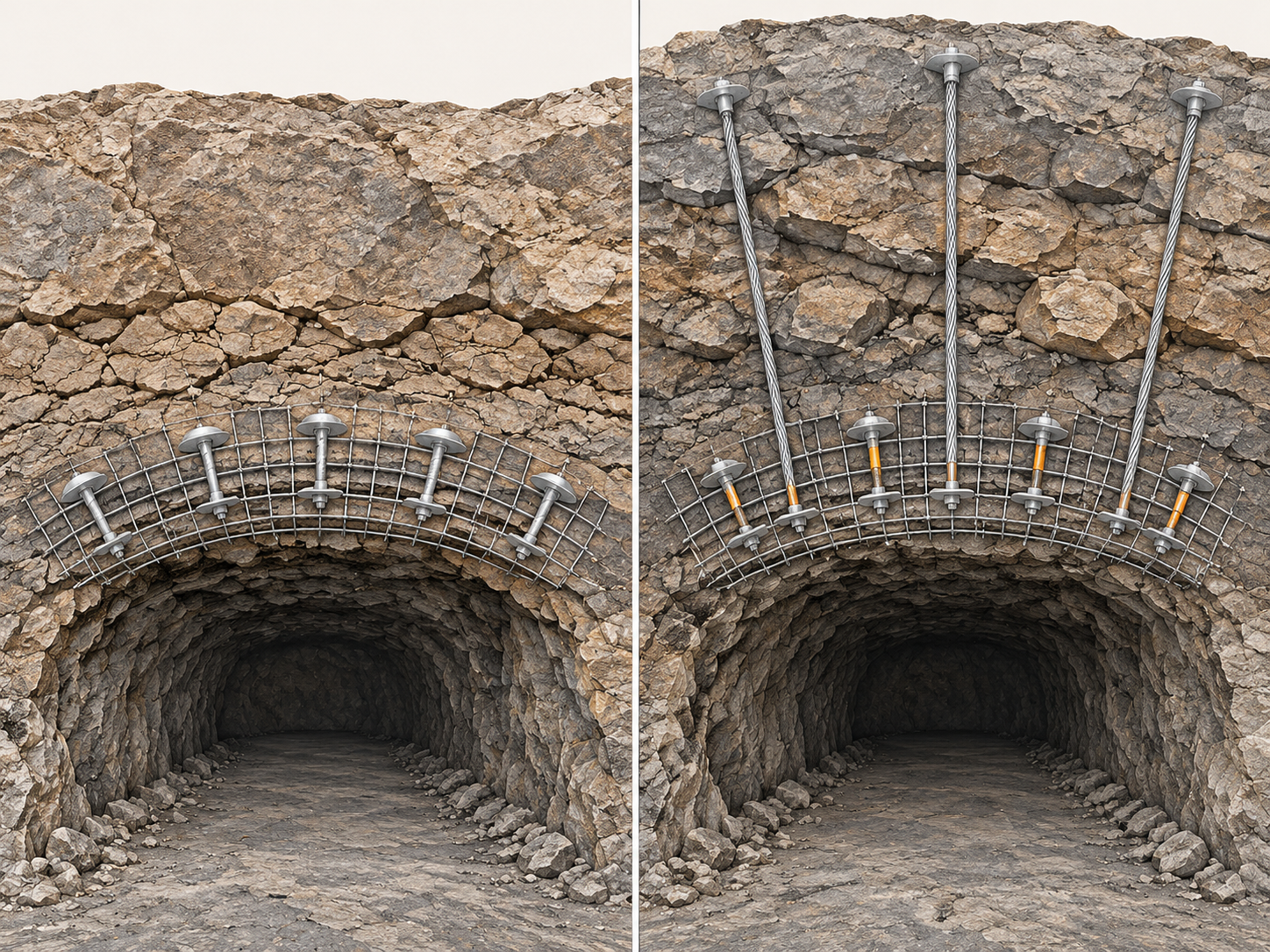
- Many projects need more than one. Short bolts clamp the surface; cables anchor the deep zone; mesh, straps, shotcrete or arches connect the surface.
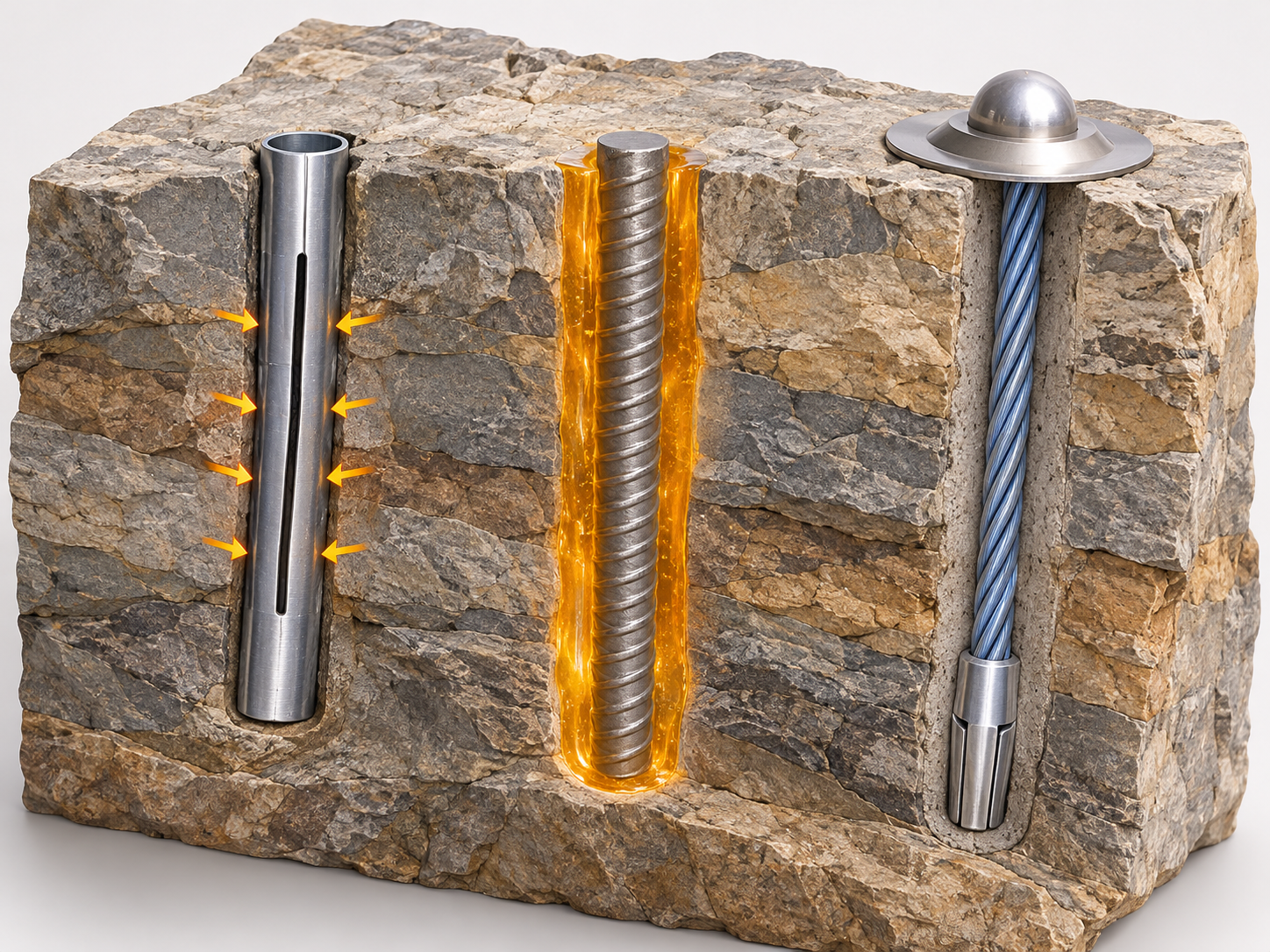
The three systems carry load in different ways
A rock bolt is often described by its diameter and length. Those are dimensions, not a support mechanism. The mechanism determines where the load goes, how quickly it develops and what has to be controlled during installation.
| System | Primary load path | Activation | Typical role | Main limitation |
|---|---|---|---|---|
| Split set | Radial friction along a compressed slotted tube | Immediate on driving | Primary support, surface clamping, fast cycle | Needs a hole that stands; sensitive to hole size and rock softness |
| Resin bolt | Shear bond through cured resin at the bar and hole wall | After mixing and cure | Bonded support, tensioning, layer clamping | Installation quality and hole condition govern |
| Cable bolt | Tension in a strand anchored beyond the loose zone | After anchorage and tensioning | Deep reinforcement, high capacity, large span | Long-hole drilling, grouting and tensioning; not a surface-only solution |
The table is a starting point, not a selection rule. A split set and a resin bolt can both be used in the same roadway. A cable can be added above either. The question is which element carries which part of the load.
Start with the failure mode and the depth of the problem
Before comparing products, define what the support has to prevent. The same rock type can fail in different ways, and the failure mode points to a different element.
Ask:
- Is the roof or wall coming apart as blocks, or is the whole mass converging?
- Is the loosening zone shallow and defined, or thick and uncertain?
- Is the ground squeezing, bursting, swelling or simply falling?
- Does the support need to be tensioned immediately, or can it develop load over minutes?
- Is the opening large enough for a long cable hole, and is there access for grouting and tensioning?
- What surface support will connect the bolts: mesh, straps, shotcrete, steel arches?
- What is the design life, and what corrosion exposure comes with it?
- What installation equipment and cycle time are available?
- What test and acceptance evidence does the project require?
The answers produce a short selection basis: failure mode, depth of the unstable zone, required capacity, allowable displacement, surface support, installation method and service life. Without that basis, a quotation is only a price for a shape.
Depth is the first divider
If the stable ground is within the reach of a normal bolting cycle, a split set or resin bolt can anchor the surface layer. If the unstable zone extends beyond that, a longer tendon is needed. This is why cable bolts are common in large-span openings, deep mines and areas with thick bedding or fault zones.
Depth is not the same as length. A long bolt that stops inside the loose zone adds little. A shorter bolt that reaches competent ground can do more. The design should state the anchorage zone, not only the bolt length.
Tension is the second divider
A split set is not tensioned with a nut. It develops load through radial friction from the moment it is driven; subsequent rock movement can change that load. A resin bolt can be tensioned after the resin has developed sufficient strength. A cable bolt is tensioned against a bearing plate and locked with a wedge anchor. If the design requires active pre-tension, the split set is the wrong tool for that part of the system.
Surface support is the third divider
A bolt is a point restraint. Mesh, straps, shotcrete and arches distribute the load between points and catch small blocks. A cable bolt without surface support can leave the face between cables unprotected. The surface system and the reinforcement system have to be selected together.
Ground support is also only one control measure. Excavation geometry, sequencing, stress management and monitoring can change the demand on the bolts. In high-stress or deep mining, the support system has to be designed around the expected failure mode, not around a standard pattern copied from another site.
Split set bolts: friction along the hole
How it works
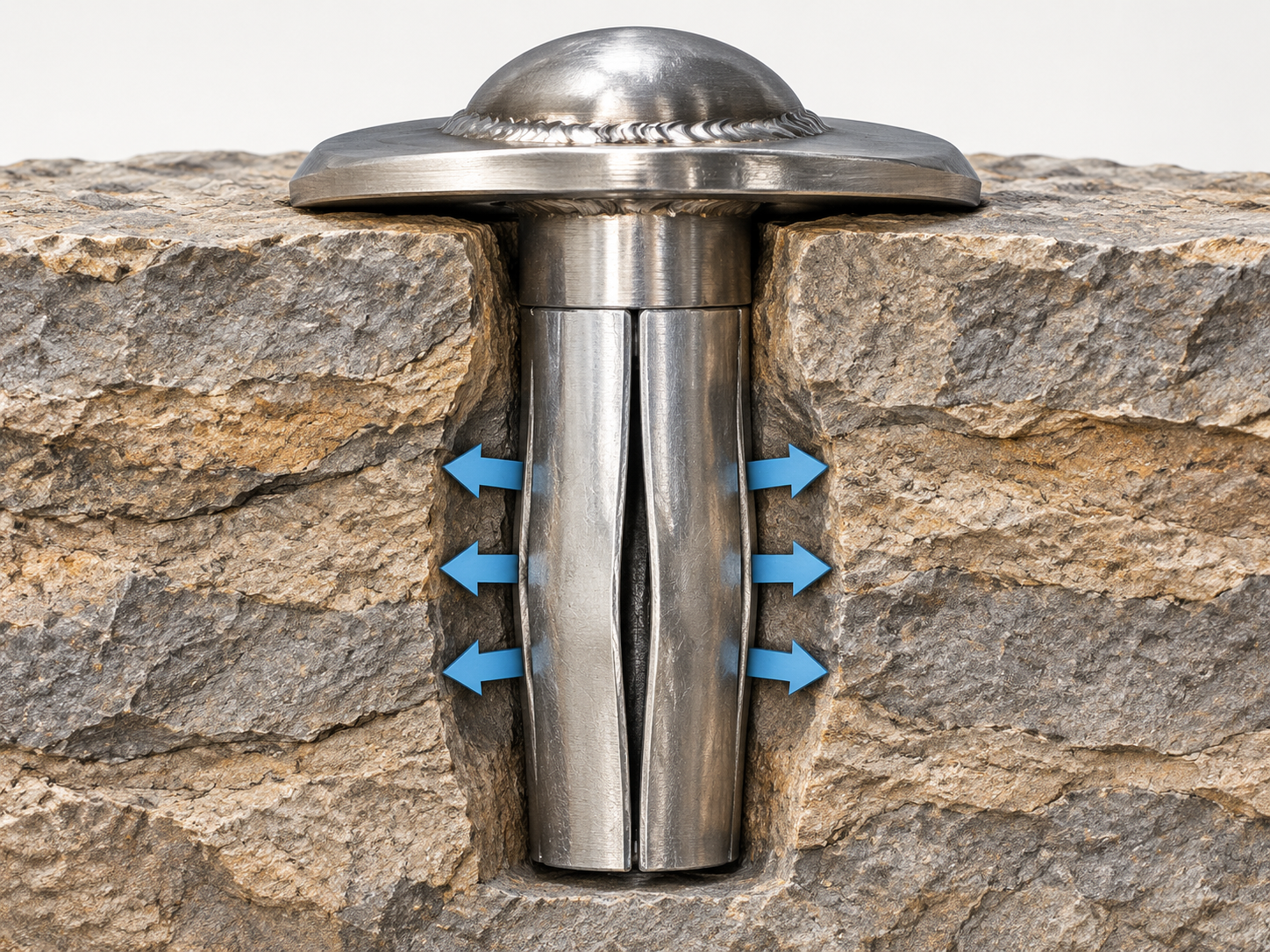
A split set bolt is a steel tube with a full-length slot. It is manufactured slightly larger than the drilled hole. When driven in, the tube compresses, the slot closes partly, and the tube presses outward against the hole wall. Load is transferred by friction along the embedded length. There is no grout and no chemical cure.
Installation is fast relative to grouted systems, which is why split sets are common in development headings and areas where the bolting cycle is on the critical path. The bolt also has some ability to accommodate rock movement as the tube slips. That movement is not the same as engineered yielding. A standard split set should not be treated as a dynamic or energy-absorbing bolt unless it has been designed and tested for that role.
Where it fits
Split sets are a good fit for:
- competent to moderately jointed rock that will stand open after drilling;
- primary support where immediate load transfer is needed;
- temporary or semi-permanent openings where installation speed matters;
- hard-rock mining and tunneling where a simple, grout-free system is preferred;
- conditions where the bolt needs to follow some deformation without losing all contact.
They are a poor fit for:
- very soft rock that cannot develop useful radial pressure;
- ravelling ground where the hole will not stand;
- zones where the design requires active tensioning;
- long spans with deep-seated instability;
- aggressive corrosion environments unless the coating and design life are addressed.
What to confirm before ordering
A split set is a matched system of tube, hole, collar and plate. The catalogue diameter is not the drill-hole diameter.
- Hole range: confirm the recommended hole range for the exact tube, not for a generic diameter class.
- Actual hole: check bit size, bit wear, drilling method and measured hole diameter. A worn bit can drill undersize; broken ground can drill oversize.
- Length: confirm the anchorage zone, the surface allowance and how length is measured. Nominal length is not embedded length.
- Tube: confirm wall thickness, slot geometry, steel grade and collar weld.
- Plate: confirm center hole, bearing area, seat and coating. A plate selected only by bolt diameter can be the wrong plate.
- Coating: confirm the corrosion protection for the service life.
- Installation: confirm the rig, adapter, thrust and hole cleanliness.
CQ Rockbolt's public pages show more than one split-set range: one catalogue page lists 33 mm, 39 mm and 46 mm diameters with lengths from 0.9 m to 3.0 m, while another page describes 38–51 mm and 1.5–3.0 m. Those are catalogue ranges, not a single model datasheet. For an order, ask for the drawing and datasheet for the exact model and confirm diameter, hole range, length and strength together. The friction bolt selection guide explains the diameter, length, strength and washer checks in more detail.
Installation checks that matter
- Measure a sample of holes with a gauge, not by eye.
- Confirm the hole is clean and deep enough for full insertion.
- Check that the tube is straight, the slot is continuous and the cut end is burr-free.
- Confirm the plate seats on the rock, not on a hollow.
- Record installation time, driving behavior and any refusal.
- Pull-test a sample in representative ground.
Resin bolts: bond, stiffness and tension
How it works
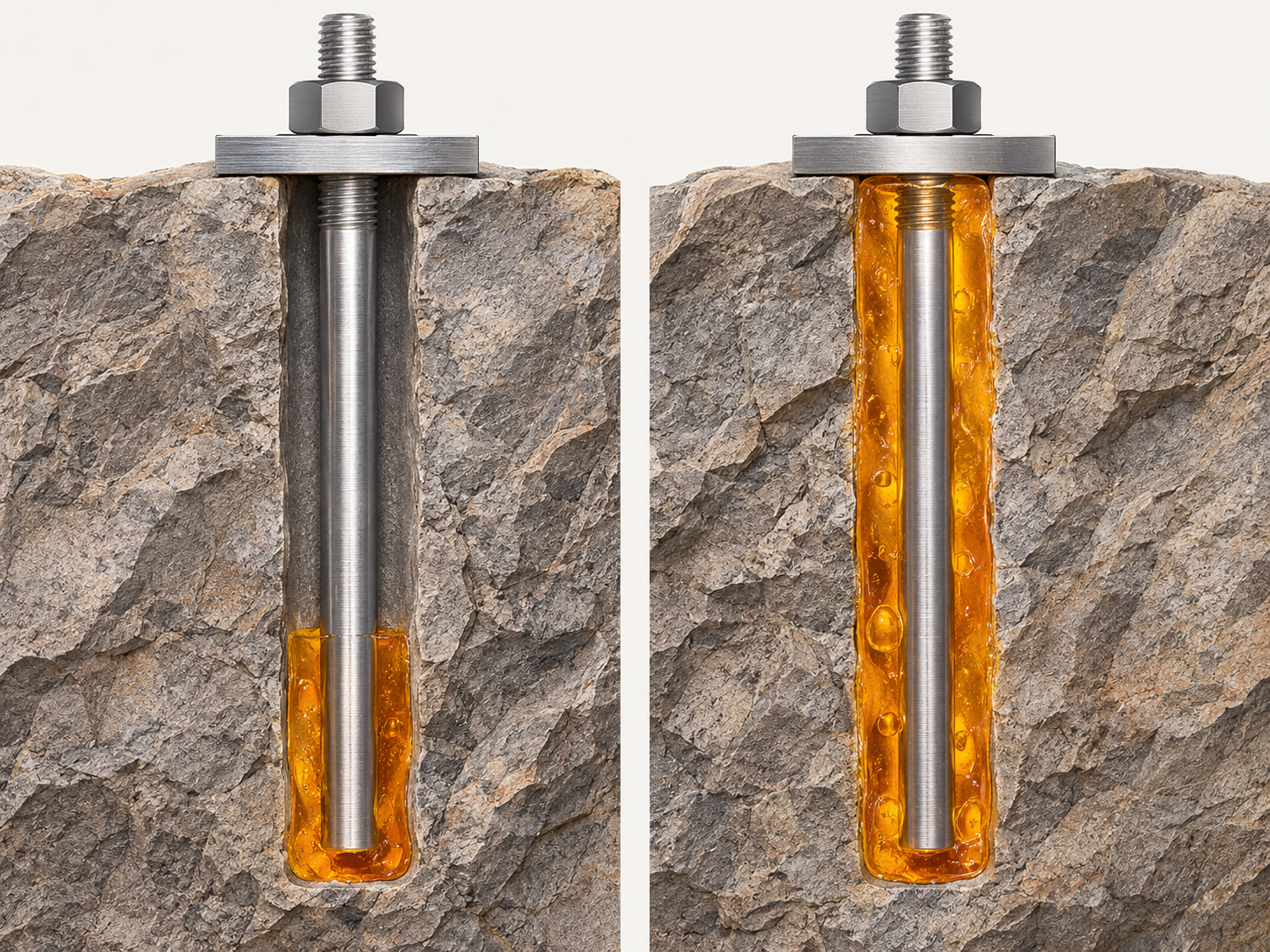
A resin bolt is a steel bar installed in a drilled hole with a two-component resin cartridge. As the bar is rotated and pushed to the back of the hole, it ruptures the cartridge and mixes the resin and catalyst. The bar is held in place while the resin cures. The cured resin fills the annulus and bonds the bar to the hole wall. Load is transferred in shear along the bonded length.
The bar can be a rebar, a ribbed bar or a threaded bar. The resin can be point-anchored at the far end or full-column along the hole. A point anchor allows tensioning and leaves the free length unbonded; full-column encapsulation gives more bond area and can help limit corrosion exposure. The design should state which arrangement is required.
Where it fits
Resin bolts are a good fit for:
- laminated, broken or soft rock where a bonded bolt is needed;
- roadways and tunnels where the hole stands long enough to insert a cartridge;
- areas requiring tensioning against a plate;
- permanent support where full-column encapsulation is specified;
- conditions where a stiff, closely spaced bolting pattern is part of the design.
They are a poor fit for:
- ravelling ground that will not hold a hole;
- wet or dirty holes without a compatible cartridge and installation procedure;
- very high stress or dynamic conditions where a standard rigid bolt may be too stiff;
- cases where the annulus, cartridge and mixing cannot be controlled.
What to confirm before ordering
Resin anchorage is a chain: bar, bar-resin interface, resin annulus, resin-rock interface and rock. The installed capacity is limited by the weakest link, not by the highest catalogue number.
- Bar: diameter, profile, yield and tensile strength, thread and coating.
- Hole: actual diameter, depth, cleanliness, water and temperature.
- Annulus: radial thickness, not just diametral clearance. Confirm how the supplier defines it.
- Cartridge: diameter, length, gel time, shelf life and storage conditions.
- Mixing: spin speed, spin time, hold time and thrust; confirm the values for the actual product and temperature.
- Plate and nut: bearing area, center hole, washer, thread compatibility and torque requirement.
- Testing: pull-test procedure, bonded length, test frequency and acceptance criteria.
CQ Rockbolt's resin cartridge page lists a 28–45 mm applicable bore diameter, fast/medium/slow curing options, a compressive strength of at least 60 MPa and a tensile strength value of at least 15 MPa marked as typical, with a working range of -10°C to 40°C and a shelf life of 6–12 months. These are catalogue values. Confirm the TDS for the exact cartridge, the test method behind each value and the storage rules for the project site.
Annulus thickness deserves particular attention. One South African roof-bolting guideline reports a test series in which the highest bond strengths were obtained with annuli of about 2.5–3.8 mm, while other test programmes report different ranges. [5] The number is not a universal specification. It shows that the bar, hole and cartridge have to be selected as a set, and that a larger annulus is not automatically safer.
Installation checks that matter
- Confirm the cartridge is within its shelf life and has been stored correctly.
- Check hole diameter, depth, cleanliness and water before loading the cartridge.
- Confirm the bar reaches the back of the hole and the cartridge is fully ruptured.
- Record spin time, hold time and any deviation from the procedure.
- Do not tension or load the bolt before the resin has developed enough strength.
- Pull-test a sample and record the failure mode, not only the peak load.
- Check the plate seats and the nut can be tightened without damaging the thread.
The resin anchorage formation guide explains annulus, mixing and interface effects in more detail. The water in the borehole article covers why a resin bolt can be installed and still fail to anchor.
Cable bolts: reach and capacity at depth
How it works
A cable bolt is a tendon made from high-strength steel strand, typically 1×7 construction. In a prestressed cable system, it is installed in a long borehole, anchored at the far end and tensioned at the collar. The anchor can be grouted or mechanical; the free length can be grouted, unbonded or protected depending on the design. A wedge anchor head grips the strand against a bearing plate, and the load is locked off.
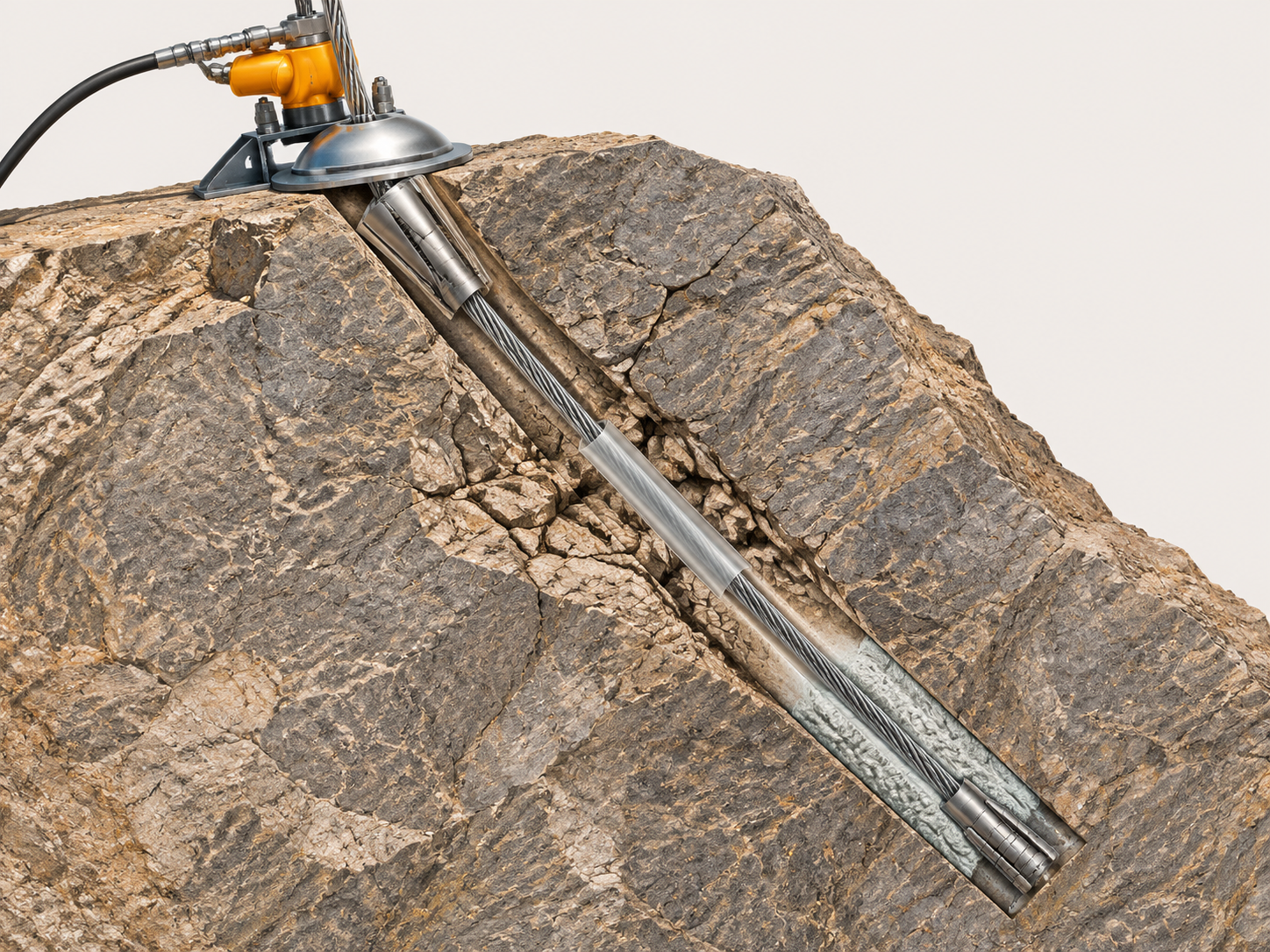
Not every cable bolt is tensioned. A fully grouted passive cable relies on bond along its length. The checks below focus on the prestressed cable system described on CQ's product page, because tensioning and lock-off add their own procurement requirements.
A cable bolt is not simply a long rock bolt. The strand is flexible, so it can be coiled and installed in confined spaces. Its free length gives it different stiffness and deformation behavior from a rigid bar. Its capacity comes from the strand and the anchor, not from surface friction along the whole length.
Where it fits
Cable bolts are a good fit for:
- thick loosening zones beyond the reach of normal bolts;
- large-span openings, intersections and chambers;
- high-stress or deep mining conditions where a high-capacity tendon is needed;
- long-term reinforcement where the anchorage can be protected;
- combined support with shorter bolts, mesh, straps, shotcrete or arches.
They are a poor fit for:
- surface-only support where a short bolt is sufficient;
- very broken ground that cannot hold a long hole;
- sites without access for long-hole drilling, grouting and tensioning;
- aggressive corrosion conditions without a specified protection system;
- dynamic or bursting conditions unless the cable system has been designed and tested for that load.
What to confirm before ordering
- Strand: diameter, construction, grade, minimum breaking load, elongation and coating.
- Anchor: anchor type, anchor length, grout or mechanical system, and the interface with the strand.
- Hole: diameter, depth, deviation and cleanliness.
- Grout: mix, volume, pressure, temperature and cure time, if grouted.
- Head: wedge, bearing plate, spherical seat and the compatibility of all three.
- Tensioning: required load, jack, gauge calibration, elongation and lock-off procedure.
- Corrosion: galvanizing, epoxy, unbonded sheath, full-length grout or a combination.
- Testing: tendon certification, grout records, lift-off or pull tests and acceptance criteria.
CQ Rockbolt's steel strand anchor cable page lists 1×7 strand in 15.2 mm, 17.8 mm and 21.6 mm diameters, a 1860 MPa grade, minimum breaking loads of 260 kN, 353 kN and 530 kN, and elongation of at least 3.5%. It also gives a design rule of thumb: anchorage section of at least 2–3 m, free section according to the loosening zone, and 200–300 mm exposed for tensioning. Those are catalogue guidelines, not a substitute for project design.
The page also states that the strand is manufactured to GB/T 5224 and ASTM A416. Ask for the certificate that applies to the actual strand batch and confirm whether the project requires one standard or the other.
Installation checks that matter
- Confirm the hole is long enough and straight enough to reach the anchor zone.
- Record the actual anchor length and the grout volume used.
- Confirm the grout has reached the required strength before tensioning.
- Check the wedge and bearing plate seat correctly and the strand is not damaged.
- Tension in stages, record pressure and elongation, and lock off at the specified load.
- Protect the exposed head and the free length against corrosion.
- Cut the surplus strand with the specified method; do not use a method that damages the strand or the wedge.
Choosing them together
The three systems are often complementary. A typical pattern is:
- Split set + mesh: fast primary support in a development heading, with the mesh catching small blocks between bolts.
- Resin bolts + mesh or steel straps: bonded support in broken or laminated ground, with the surface system distributing load.
- Cable bolts + shorter bolts + surface support: deep reinforcement in large spans or high-stress ground, with the shorter bolts clamping the surface and the cables anchoring the deep zone.
- Cable bolts + shotcrete or arches: combined support in tunnels and large chambers, where the cable carries deep load and the surface lining controls ravelling.
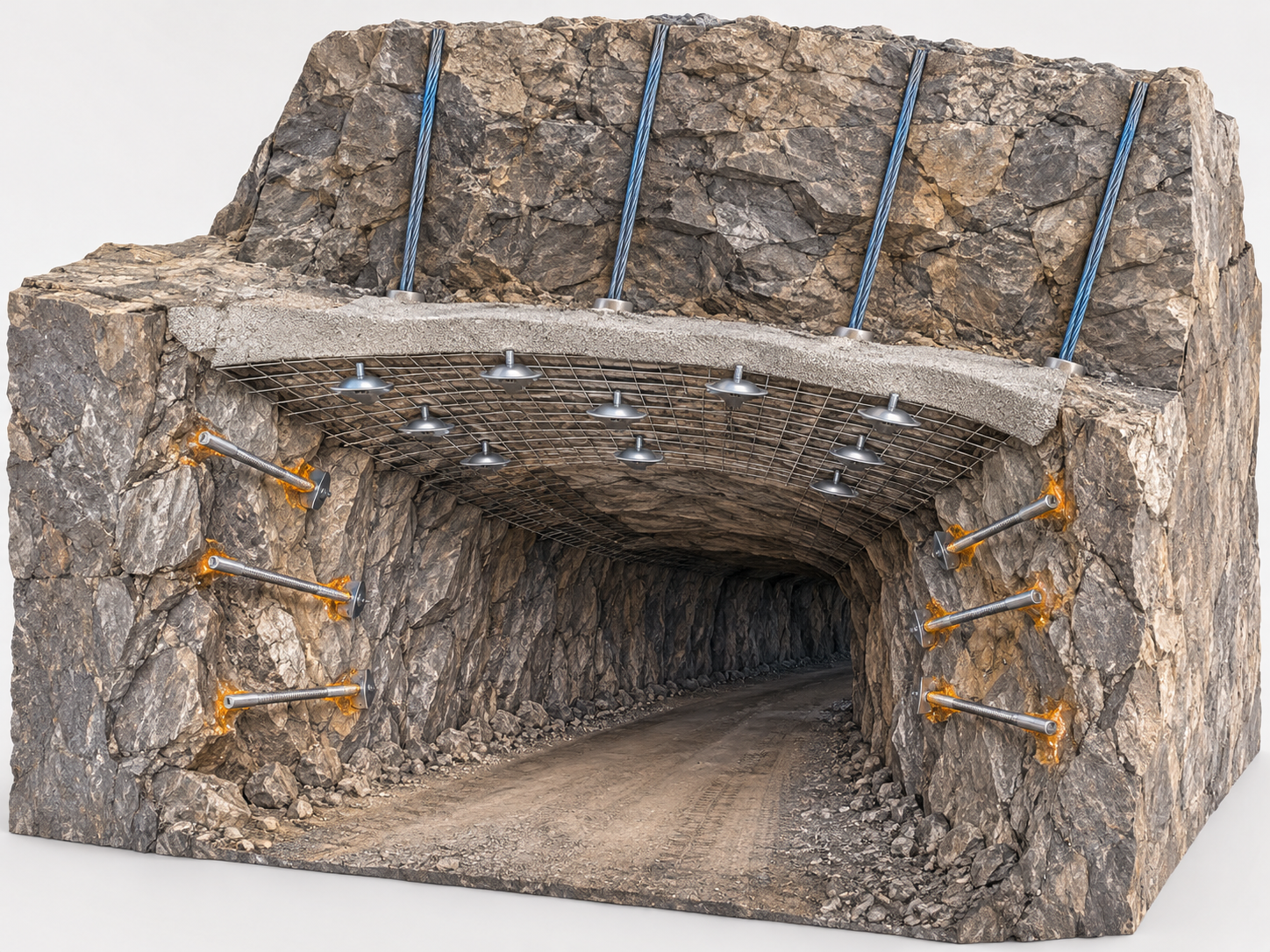
The sequence is a design decision. In some headings, primary bolts and mesh are installed first and cables are added later as the excavation advances. In others, cables are installed as part of the initial support. The important point is that the system is designed as a sequence, not as a shopping list.
A simple selection table
| Condition | First element to evaluate | Why |
|---|---|---|
| Competent rock, fast cycle, shallow loosening | Split set | Immediate friction anchorage, no grout, simple installation |
| Broken or laminated rock, hole stands, tension required | Resin bolt | Bonded load transfer and ability to tension |
| Thick loosening zone, large span, high stress | Cable bolt | Deep anchorage and high tendon capacity |
| Very soft or ravelling ground | Self-drilling or forepoling system | The hole may not stand for a split set or cartridge |
| Rockburst or squeezing ground | Yielding or dynamic system | Standard rigid bolts may be too stiff or brittle |
| Wet hole | Water-compatible resin or grouted system | Resin selection and hole condition govern |
This table is not a design method. It is a way to start the conversation with the engineer and the supplier.
Comparing offers on the same basis
A price per bolt is not a support cost. The three systems differ in:
- meters drilled per support element;
- installation time and rig utilization;
- grout, cartridges, tensioning and consumables;
- accessories: plates, nuts, wedges, collars, centralizers, grout tubes;
- testing and documentation;
- rework and failure risk;
- corrosion protection and service life.
A useful comparison normalizes the offer to the support function:
- cost per meter of supported opening;
- cost per unit of design capacity, with the test basis stated;
- cost per installation cycle, including labor and equipment;
- cost over the design life, including coating and maintenance;
- cost of the evidence the project requires.
A split set may be cheaper per unit but require a denser pattern. A cable may cost more per unit but cover a larger area with fewer installation points. A resin bolt may cost more than a split set but reduce the number of bolts or the need for rework in broken ground. The lowest unit price is not necessarily the lowest installed cost.
Common comparison errors
- Comparing bolt diameter without comparing hole diameter and installation equipment.
- Comparing tensile strength without comparing cross-section, test standard and minimum versus typical values.
- Comparing a bolt price with a complete cable system that includes anchor, plate, grout and tensioning.
- Comparing a catalogue capacity with an installed pull-test result.
- Ignoring the surface support that makes the bolts work as a system.
RFQ and trial acceptance
A quotation is comparable only when every supplier is quoting the same scope. Send one technical package with the following information.
| Item | What to state |
|---|---|
| Ground condition | Rock type, strength, fracture pattern, water, stress, expected deformation |
| Support design | Failure mode, design load, bolt pattern, surface support, sequence |
| Geometry | Hole diameter range, depth, deviation, bolt or cable length |
| Product | Type, diameter, grade, coating, thread or strand construction |
| Accessories | Plate, collar, nut, washer, wedge, grout tube, centralizer |
| Installation | Rig, adapter, thrust, spin/hold, grout mix, tensioning method |
| Testing | Material certificate, dimensional check, tensile test, pull test, lift-off test |
| Documentation | Drawing, TDS, MTC, batch traceability, SDS, shelf life, packing list |
| Commercial | Quantity, delivery destination, required date, marking and packaging |
Ask each supplier to state exceptions, included accessories, test scope and document scope. Compare the offers on the same basis, not only on price per bolt.
Before accepting a batch, run a trial in representative ground. Record:
- actual hole diameter and depth;
- installation time and any difficulties;
- plate or bearing seat condition;
- resin spin/hold or cable grout/tensioning records;
- pull-test or lift-off result and failure mode;
- any deviation from the drawing or procedure.
Define the acceptance criteria before the trial. Review the results as a set. A single good pull test does not prove that the installation process is under control, and a single failure does not identify the cause without the record.
What to send to CQ Rockbolt
CQ Rockbolt supplies split set friction bolts, resin cartridges, threaded anchor bars, steel strand anchor cables, dome plates and mining mesh for underground mining and tunneling. To review a project-specific system, send:
- the ground condition and failure mode;
- the approved support design and design load;
- hole diameter, depth and drilling method;
- the required bolt or cable length and surface support;
- the installation equipment and cycle time;
- the coating and design life;
- the test and documentation requirements;
- the quantity, destination and required delivery date.
The team can then confirm the exact model, drawing, accessories and available documentation in the quotation. Contact CQ Rockbolt with the project details, or review the split set catalogue, the resin cartridge page, the steel strand anchor cable page and the dome plate page before sending the enquiry.
The right ground support system is not the strongest bolt in the catalogue. It is the combination that reaches the right ground, carries the required load with a verified minimum, installs reliably with the available equipment, and can be inspected and accepted on site. Split sets, resin bolts and cable bolts each answer a different part of that requirement.
Related News
Other news you might be interested in

Self-Drilling Anchor Bolts for Water-Conveyance Tunnel Reinforcement
Self-drilling anchor bolts are useful for water-conveyance tunnel reinforcement when broken or water-bearing ground makes conventional drill-and-insert bolting difficult. By using a hollow threaded bar as both the drilling member and the permanent reinforcement, the system removes the separate bolt-insertion step and provides a channel for grouting through the same bar.For a water-conveyance tunnel, that installation advantage matters. Headrace, tailrace, diversion, irrigation and water-supply tunnels can pass through fault zones, weathered rock, weak interlayers and interconnected fractures. Groundwater may enter the excavation, boreholes may deteriorate after drilling, and support must be coordinated with drainage, waterproofing and the final lining.

What Is a Split Set Mining System and How Is It Different from Other Rock Bolts?
A split set is often described as a rock bolt, but in mining it is more useful to think of it as a support system. The steel tube is the most visible part. The way it performs also depends on the drilled hole, the bearing plate, the installation adapter, the drilling equipment, the surface support and the checks made underground. That distinction matters when a project compares rock bolts. Two quotations can list a similar diameter and length, yet propose different load-transfer mechanisms, different hole requirements and different installation procedures. A split set is not a resin bolt with the resin removed. It is not a mechanical expansion-shell bolt, a self-drilling hollow bar, a water-inflatable tube or a cable bolt. Each product family solves a different part of the ground-support problem.
Want to know more?
Get in touch with us for more information about our services and products.