

Water in the Borehole: Why a Resin Bolt Can Be Installed but Still Fail to Anchor

Dayang Yang
AuthorWith over 15 years of experience in the production and sales of ground anchoring and mining support products, we operate our own rock bolt and accessory manufacturing facility with stable large-scale production capacity. We are specialists in rock bolts, resin cartridges, anchor cables, bearing plates, and customized ground anchoring products for mining support and geotechnical anchoring solutions.
A resin bolt can pass every visual test at the collar and still fail to develop the anchorage expected by the design. The bolt may be in the hole, the plate may be tight, and resin may be visible at the surface. None of those observations proves that the resin filled the intended bond length, mixed properly, or formed a sound interface with the rock.
Water makes that distinction more important.
In underground mining and tunneling, water may be present as residual drilling fluid, seepage, standing water, or a flowing inflow through fractures. The consequences are not the same in every hole. Many resin systems can perform in wet conditions when the product and installation method are selected for them. The problem is not simply that water is present. It is that uncontrolled water can change the resin chemistry, the borehole wall, the amount of resin that remains in the annulus, and the way the bolt transfers load into the rock.
This article explains why a resin bolt can appear installed while the anchorage remains incomplete. It is written for mining and tunnel engineers, contractors, supervisors, quality teams, and technical buyers who need to understand what happens between the cartridge and the installed support system.
Installed is not the same as anchored
A resin-anchored bolt is a load path, not a steel bar held in a hole by hardened glue.
Load moves from the rock into the resin, from the resin into the bar, and back through the resin into the rock along the bonded length. The practical capacity of the installation depends on the condition of each part of that path:
- the actual borehole diameter and wall condition;
- the bar diameter, profile, and surface condition;
- the resin product, cartridge size, mixing, and cure;
- the length and continuity of the resin annulus;
- the strength and condition of the rock at the bond zone;
- the plate, nut, and surface support that transfer load at the collar.
A bolt can be mechanically present while one or more of these conditions are unsatisfactory. It can also appear to hold when tested, yet have an effective bond length much shorter than the design assumed.
This is why “the bolt is installed” is not a sufficient quality statement. The useful question is: which part of the load path has been demonstrated to be continuous and reliable?
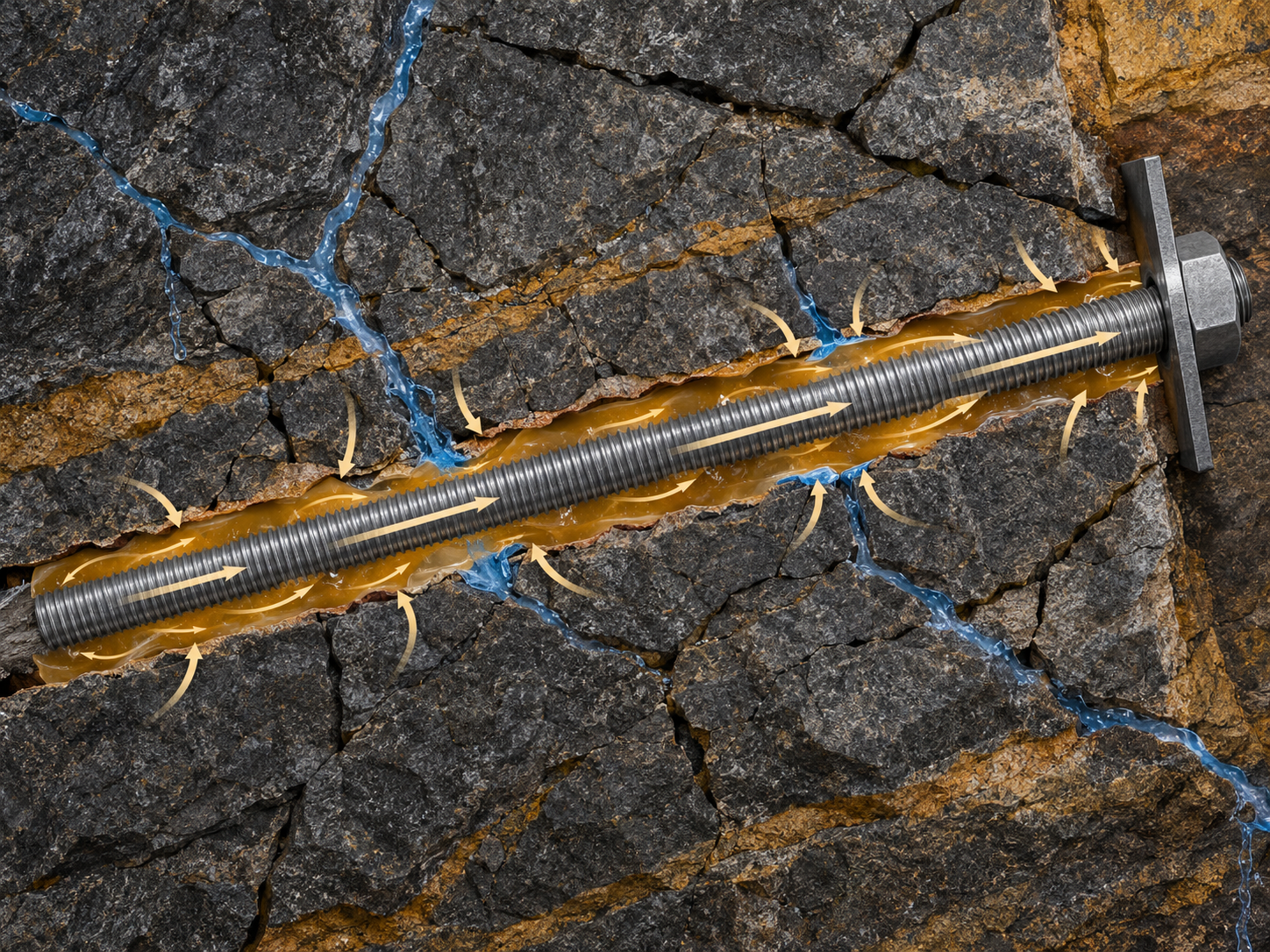
Water is a condition, not one problem
The word “wet hole” is too broad to support a technical decision.
A hole can be:
- wet from drilling or flushing, with water still present when the cartridge is inserted;
- damp, with a wet rock surface but no standing column of water;
- seeping, with water entering through joints or pores;
- flowing, with enough movement to wash material or carry resin away;
- deteriorating, with weak rock swelling, softening, or closing after drilling.
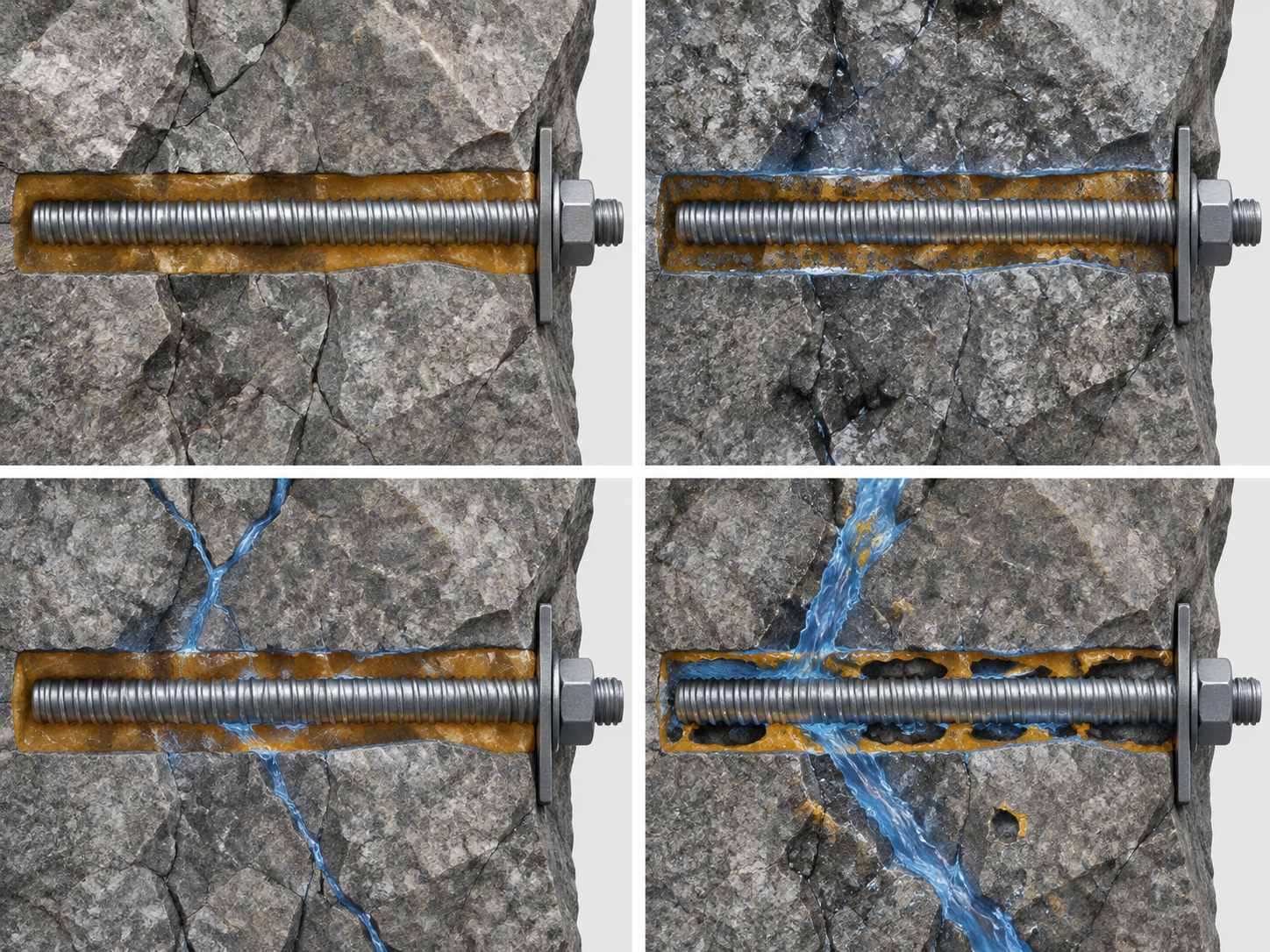
These conditions can produce different risks. A small amount of residual water in a stable hole is not equivalent to a flowing fracture that carries resin out of the annulus. A system that is suitable for one case may not be suitable for another.
That is also why “waterproof resin” is not a complete specification. The relevant questions are:
- Which product is proposed?
- What water condition was it evaluated against?
- What installation method and borehole condition were used?
- What happens to the resin if water is flowing rather than standing?
- Which evidence applies to the actual bar, hole, rock, and service condition?
Manufacturers do offer resin systems for wet environments, and some resin capsules are described as suitable for wet or underwater conditions. That demonstrates capability at the product level, not automatic suitability for every wet borehole.
How water changes the anchorage system
Water can affect the installation through several linked mechanisms. They should be considered together rather than treated as separate laboratory effects.
Water can interfere with curing
Resin capsules contain a resin and a catalyst that must be mixed in the correct proportions. Water can affect the curing reaction and the strength that develops. A 2022 study of borehole water content in soft surrounding rock concluded that increasing water content weakened the anchorage system and reduced pull-out resistance. The study linked the effect to changes in the anchoring agent and the surrounding rock, not to a single universal failure mechanism.
A 2025 laboratory study went further by testing conventional and modified resin formulations at different borehole water contents. It reported that increasing water content to 30% of the borehole volume reduced the compressive strength of conventional resin by more than 40%, and peak pull-out force also fell. The modified formulation performed better under the tested conditions. These are laboratory results for specific materials and borehole conditions, but they show why water cannot be treated as a cosmetic condition at the collar.
The practical point is not that every wet hole will lose 40% of its capacity. It is that water can change the material that is supposed to transfer the load. A product that was not evaluated for the actual water condition cannot be assumed to perform like its dry-condition data.
Water can contaminate the resin–rock interface
The resin must grip the borehole wall. Cuttings, mud, clay smears, loose particles, or a weak surface layer can prevent that contact.
Water is part of this problem when it keeps fine material suspended or allows it to be deposited on the wall. In weak or argillaceous rock, drilling can produce a clay-coated surface that makes the cartridge slip, reduces mixing, and leaves an unsatisfactory bond. Practical rock-engineering guidance notes that this can occur even when the hole is nominally the correct size.
The issue is not only “water vs no water.” It is the condition of the surface that the resin reaches:
- Is the hole clear of loose cuttings?
- Is the wall stable enough to remain open?
- Is the water clear, or is it carrying fine material?
- Is water flowing across the bond zone after cleaning?
- Does the rock soften or swell when exposed to water?
These questions matter because the resin–rock interface is part of the load path. A strong bar and a well-mixed resin cannot compensate for an interface that never formed properly.
Water and fractures can remove resin from the hole
In fractured or broken ground, resin can escape into open joints and voids before it gels. The result may be a resin column that looks adequate at the collar but is incomplete along the intended bond length. Water can make this worse by carrying material, keeping fractures open, or indicating a more permeable and unstable borehole.
Practical guidance also notes that in highly fractured ground, resin can seep into the surrounding rock and leave voids around the bolt. The design may call for a certain encapsulation length, but the actual installed anchor may have less resin in the critical zone than assumed.
This is one reason a cartridge count alone does not prove full encapsulation. The required resin volume depends on the actual hole, the bar, the annulus, and the ground. In a wet or fractured hole, those conditions can change after the cartridge is selected.
Water can change the borehole itself
Water can soften or erode weak rock, promote hole closure, or contribute to instability after drilling. If the hole changes shape or diameter before the bolt is installed, the resin annulus and the load-transfer geometry change with it.
A poorly cleaned or deteriorating hole can also create an oversized or irregular annulus. The bolt may run along one side, the cartridge may not rupture or mix as intended, and the resin may not fill the space evenly. These are installation mechanisms, but they are triggered by the ground and water condition rather than by the cartridge alone.
Why the collar can look normal
The most dangerous wet-ground failures are not always obvious from the outside.
At the collar, an operator may see:
- the bolt inserted to the expected depth;
- resin visible around the bar;
- a plate seated against the rock;
- a nut tightened;
- no obvious movement after installation.
None of these observations confirms that the resin is continuous from the collar to the intended toe, or that it mixed correctly along the full bonded length.
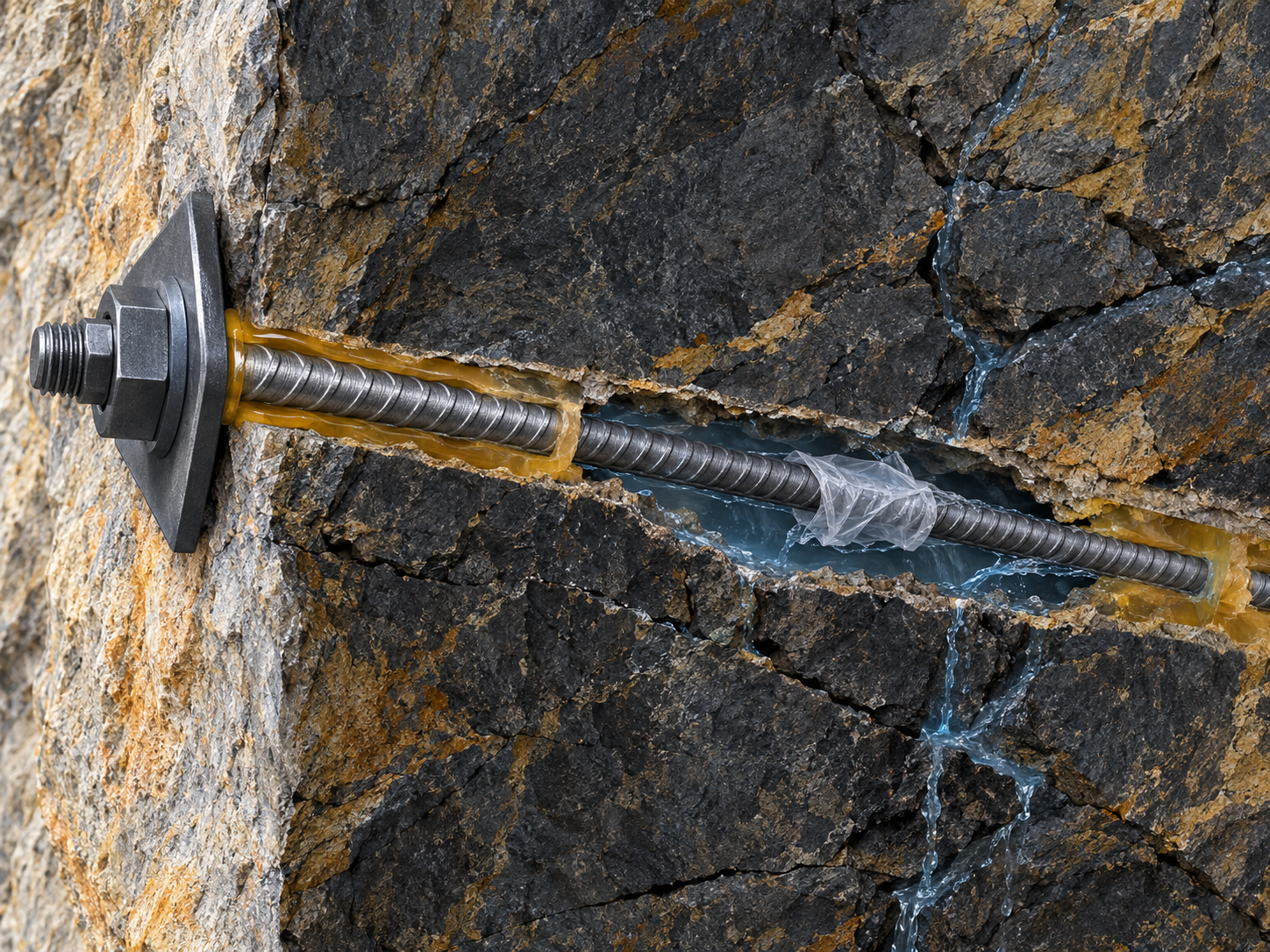
Resin at the collar is not proof of encapsulation
Resin can reach the collar while voids remain farther along the hole. It can also be pushed out through a fracture, leaving a shorter effective bond zone. A visible collar tells the operator that some resin moved in that direction; it does not tell the full story of the annulus.
A tight plate is not proof of anchorage
The plate can be tight against the surface even when the load path below it is incomplete. The plate and nut provide surface restraint only if the bar is anchored and the surface support is connected. A tight plate can therefore hide a weak or short anchorage rather than reveal it.
One successful pull test is not proof of every installation
A pull test measures a particular installed arrangement under particular conditions. Its result depends on the bonded length, the rock, the borehole, the resin, the curing time, and the test method. A result from one hole does not prove that every production bolt has the same encapsulation, mixing, or water exposure.
This does not make testing unimportant. It makes the test record important. The useful information is not only the peak load, but what was tested and what failed. Was the test a short encapsulation test, a full-length test, or a proof test? Which interface carried the load? What was the condition of the hole and the resin?
What to observe when wet-ground anchorage underperforms
When a resin bolt does not develop the expected anchorage, “the resin is bad” is rarely a sufficient diagnosis. The useful investigation starts with the installation conditions.
Check the water condition
Record whether water was:
- present before cleaning;
- still present when the cartridge was inserted;
- standing, seeping, or flowing;
- clear or carrying fines;
- coming from the rock, the drilling system, or both.
If water is flowing through the bond zone, the installation method may need to change. Adding more resin without controlling the water can increase loss without restoring the intended bond.
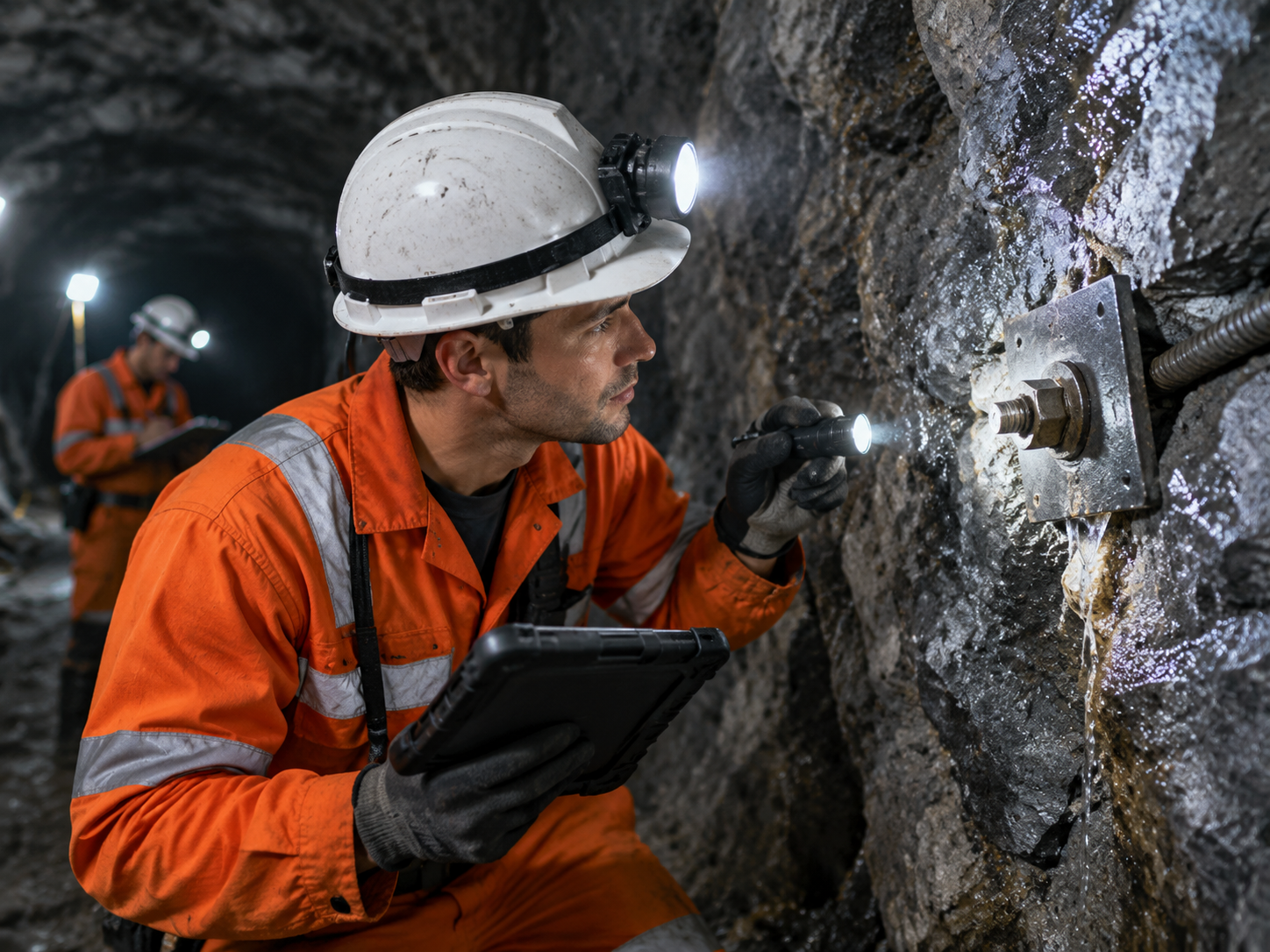
Check the hole, not only the bit size
The nominal bit diameter is not the actual hole diameter. Reaming, overbreak, breakouts, bit wear, soft rock, and hole closure can change the annulus. A hole can also be clean at the collar and obstructed farther in.
In wet or weak ground, the hole should be assessed for:
- diameter and regularity;
- loose material and clay coating;
- stability before and during insertion;
- water movement;
- fractures that can accept resin.
The actual condition matters because the cartridge and the resin volume must match the hole that exists, not the hole shown on the drilling plan.
Check the cartridge and the installation sequence
Confirm the exact resin product, cartridge dimensions, quantity, and expiry or storage condition. Then check whether the installation sequence matched the product instructions:
- Was the cartridge inserted fully?
- Was the bolt pushed and rotated through the complete cartridge?
- Did the bolt reach the intended depth?
- Was the spin period appropriate for the product and temperature?
- Was the bolt held undisturbed for the required period?
- Was excessive rotation continued into the gel phase?
Under-mixing and over-mixing can both damage the result. The right timing is product-specific and depends on temperature, equipment, and the bar–hole arrangement.
Look for signs of gloving or resin loss
Gloving is the incomplete destruction of the cartridge film. The film can become wrapped around the bar or pressed against the rock, creating a low-friction layer instead of a resin bond. Field investigations have found that gloving can reduce load transfer, and that the effect varies with severity and local conditions.
Resin loss into fractures is a different mechanism with a similar outcome: the installed anchor may have less continuous resin than the design assumed. The collar can look normal while the effective bonded length is shorter than expected.
What a project team should verify before relying on a wet-ground system
The objective is not to find one resin that is “good for water.” The objective is to establish a complete installation system that matches the ground and the required support function.
Define the water condition in the enquiry
Tell the supplier and the project technical team:
- whether water is residual, seeping, standing, or flowing;
- whether it is present before, during, and after hole cleaning;
- whether the rock softens, swells, or breaks down;
- whether fractures accept water or resin;
- the drilling method and hole-cleaning procedure;
- the bar, hole, and required bond length;
- the installation equipment and expected temperature.
A supplier cannot assess compatibility from the phrase “wet ground.” The actual water behavior is part of the design input.
Ask for evidence for the exact product and condition
Request product-specific information showing:
- the intended wet-condition application;
- the tested bar, hole, and resin combination;
- the installation method and curing conditions;
- what the test measured and what it did not measure;
- the failure mode observed in testing;
- how the product should be stored and handled before use.
Do not accept a generic “water-resistant” statement as evidence that the product will form a reliable anchor in a flowing or fractured hole.
Control the hole before the cartridge goes in
Drilling and cleaning are part of the anchoring system. If the installation procedure calls for water or air flushing, the purpose is to remove cuttings and debris—not to leave an uncontrolled water column behind. The hole must be suitable for the selected cartridge and installation method.
Where water cannot be controlled, the project should consider whether the installation method remains appropriate. A pumpable resin or self-drilling system may be more suitable in some wet, fractured, or unstable ground, but it is not a universal replacement. Its own installation requirements, mixing, injection control, and evidence still need review.
Verify performance with the actual system
Where conditions differ from standard product data, a site-specific trial may be needed. The trial should record:
- the water condition;
- the actual hole diameter and condition;
- the cartridge or resin system;
- the installation sequence and parameters;
- the curing time;
- the test arrangement and failure location;
- the condition of the recovered or exposed anchorage where available.
The purpose is not to produce a universal number. It is to show whether the proposed bar–resin–rock–installation system works under the conditions that will exist in production.
A practical way to think about water
Water is not a housekeeping detail that can be ignored once the bolt is in the hole. It is part of the ground condition and therefore part of the support-system design.
The most useful sequence is:
- Describe the water condition.
- Confirm the borehole condition.
- Select a resin and cartridge for that condition and the specified bar–hole combination.
- Control cleaning, insertion, mixing, and curing.
- Verify the installed system with evidence appropriate to the project.
If a resin bolt appears installed but does not develop the expected anchorage, do not begin by adding more resin or blaming one component. First establish what the water was doing, whether the hole remained suitable, whether the cartridge mixed and stayed in the intended bond zone, and what the test actually demonstrated.
The difference between an installed bolt and a reliable anchor is the difference between a visual result and a verified load path.
Prepare a project-specific review
CQ Rockbolt supplies resin anchoring materials and rock bolts for underground mining and tunneling. For a wet-ground application, send the proposed bar and borehole dimensions, the water condition, drilling and cleaning method, installation equipment, required bond length, and the project’s test requirements. The product and evidence can then be reviewed against the actual installation conditions rather than against a generic dry-hole assumption.
Related News
Other news you might be interested in

Where a Rock Bolt Fails Matters: Reading Failure Location in Underground Support
A failed rock bolt is often described in one sentence: the bolt broke, pulled out, or came loose. That description records an outcome, but it does not explain the problem.The location of the failure is more useful. Did the steel rupture in the bar body, at the thread, inside a coupler, behind the plate, at the resin–rock interface, or in the rock mass itself? Did the bolt survive the ground movement but lose surface restraint when the plate punched into weak rock? Did a delayed fracture begin at a corroded pit far from the collar?Those are different load-path events. They point to different parts of the support system and require different evidence before anyone can decide whether the cause was material, design, installation, environment, loading, or a combination.This article explains how mining and tunneling teams can read failure location in underground support. It is written for rock-mechanics and geotechnical engineers, contractors, supervisors, quality personnel, and technical buyers who need to turn a failed bolt into useful engineering information rather than an immediate argument about product quality.

Resin Anchor Bolt Anchorage Force Formation: Resin Annulus Thickness, Mixing Quality and Interfacial Bonding
A resin anchor bolt is often evaluated as though anchorage were a single number printed on a resin cartridge. In service, anchorage is a load path. The bolt must grip the resin, the resin must remain continuous and sound, the resin must grip the borehole wall, and the rock must accept the load. A weakness anywhere in that chain changes the result, even when every component meets its own specification.
Want to know more?
Get in touch with us for more information about our services and products.