

What Is a Split Set Mining System and How Is It Different from Other Rock Bolts?

Dayang Yang
AuthorWith over 15 years of experience in the production and sales of ground anchoring and mining support products, we operate our own rock bolt and accessory manufacturing facility with stable large-scale production capacity. We are specialists in rock bolts, resin cartridges, anchor cables, bearing plates, and customized ground anchoring products for mining support and geotechnical anchoring solutions.
A split set is often described as a rock bolt, but in mining it is more useful to think of it as a support system. The steel tube is the most visible part. The way it performs also depends on the drilled hole, the bearing plate, the installation adapter, the drilling equipment, the surface support and the checks made underground.
That distinction matters when a project compares rock bolts. Two quotations can list a similar diameter and length, yet propose different load-transfer mechanisms, different hole requirements and different installation procedures. A split set is not a resin bolt with the resin removed. It is not a mechanical expansion-shell bolt, a self-drilling hollow bar, a water-inflatable tube or a cable bolt. Each product family solves a different part of the ground-support problem.
- A split set mining system is a pre-drilled, slotted-tube friction bolt together with its matched borehole, bearing or domed plate, installation equipment and, where required, mesh, straps and other surface support.
- It develops radial contact and friction along its embedded length when a slightly oversized steel tube is driven into a smaller hole.
- It normally uses no resin or grout in the load path.
- It is not actively tensioned like a threaded bolt. Once installed, rock movement loads the bolt and its plate.
- It is different from other rock bolts mainly in how load is transferred, how the bolt is activated, what the borehole must do and what equipment is required.
- Its advantages depend on suitable ground and correct installation. It is not a universal replacement for resin, mechanical, self-drilling, inflatable or cable systems.
This article explains the system, the installation path and the practical differences. It is not a ground-support design; the mine's approved design, ground-control plan and testing requirements govern.
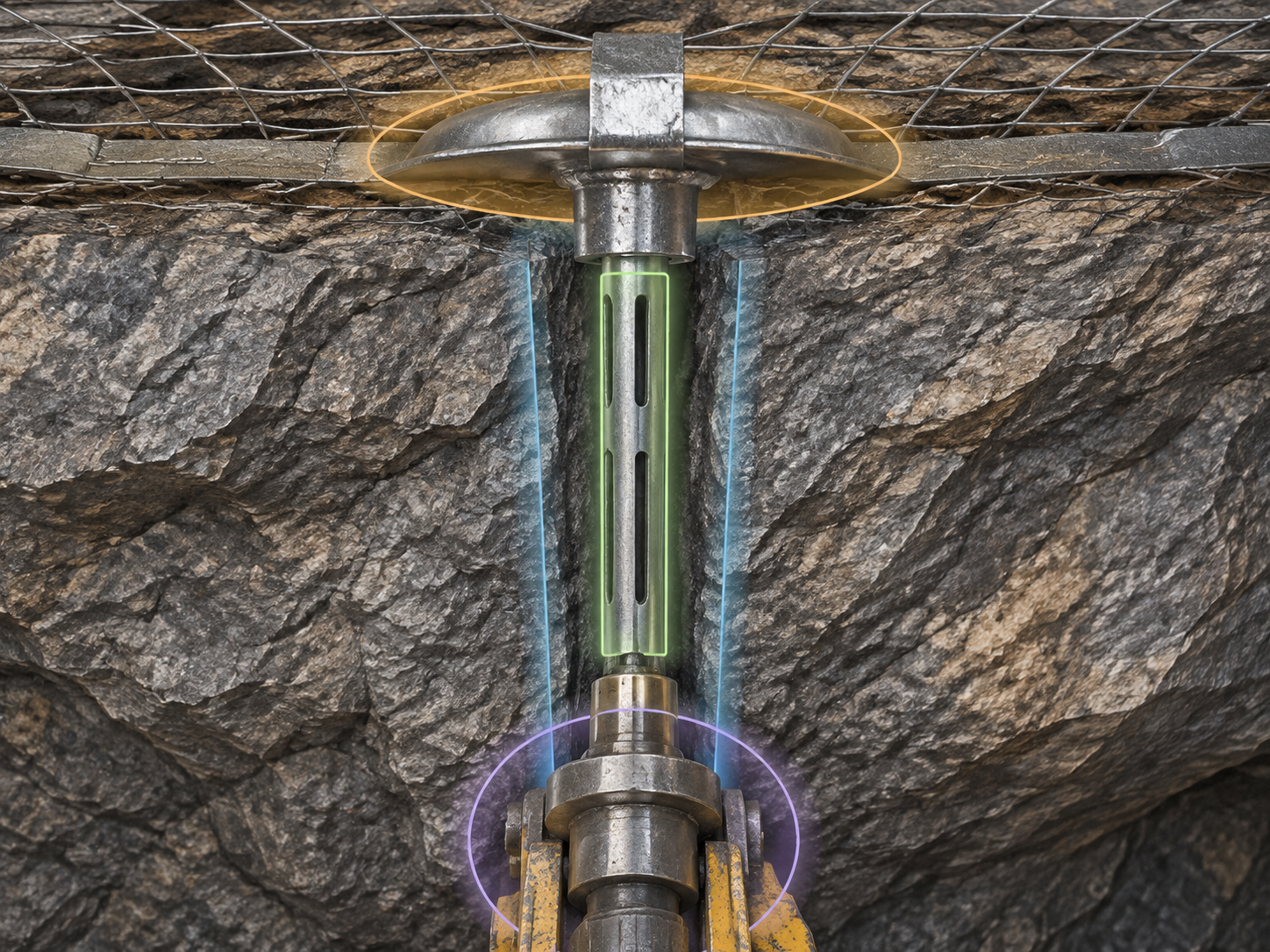
Why "Split Set Mining System" Is More Accurate Than "Bolt"
A split set is a steel tube with a longitudinal seam. It is manufactured to be slightly larger than the specified borehole. When it is driven in, the seam allows the tube to compress. The tube presses outward against the hole wall, and friction develops along the contact length. No resin mixing, grout pumping or chemical curing step is required for that load path.
In this article, split set is used in the mining generic sense: a pre-drilled, driven, slotted-tube friction bolt. It is not a reference to one manufacturer's company name. Products described as split pipe seam anchors, slotted-tube bolts or friction bolts may use a similar principle, but the exact assembly and terminology should always be confirmed from the supplier's drawing rather than assumed from the name.
However, the tube does not install itself, and the tube alone does not provide complete surface support. A working system usually includes:
| System element | Function | Why it must be checked |
|---|---|---|
| Drilled hole | Provides the surface against which the tube develops radial pressure | Oversize or undersize holes change contact pressure and installation behavior |
| Slotted steel tube | Compresses in the hole and transfers load through friction | Diameter, length, wall thickness, seam geometry and steel properties matter |
| Collar and bearing plate | Transfer load to the rock surface and hold mesh or straps where specified | The plate must fit the tube, sit correctly and provide sufficient bearing area |
| Installation adapter and rig | Drive the tube without damaging it or the collar | "Standard equipment" does not prove compatibility with the exact bolt |
| Mesh, straps or other surface support | Cover the rock between bolts and distribute surface restraint | A bolt pattern without the designed surface support is incomplete |
| Design, installation records and testing | Show that the intended system was installed | A catalogue bolt is not evidence of installed capacity |
This is why a procurement discussion should not stop at "split set, 39 mm, 2 m." The diameter, length and unit price are necessary, but not sufficient. The matching hole range, plate assembly, adapter, coating, support pattern and acceptance requirements belong to the same decision.
In CQ Rockbolt's range, the product is listed as a split-set friction rock bolt. It should not be confused with a self-drilling hollow bar or with a resin-anchored or grouted rock bolt.
The four interfaces that make the system
The components can be grouped into four interfaces. If one interface is left unresolved in the quotation or installation plan, the other three cannot guarantee the intended support behavior.
| Interface | What must match | Typical responsibility to confirm |
|---|---|---|
| Product assembly | Tube, collar, plate, optional spherical seat and coating | Which parts are included, which are optional and which are supplied separately |
| Drilling interface | Drill bit, actual hole diameter, depth, line, cleanliness and wall condition | Who specifies the hole range, checks the hole and accepts deviation |
| Installation interface | Rig, feed, thrust, alignment and adapter | Whether the proposed machine can install the exact tube without damaging it |
| Support interface | Pattern, mesh or straps, sequence and surface preparation | How the bolt connects to the complete surface-support design |
This four-interface view is useful at both the design and purchasing stages. It separates a product supply question from a drilling, equipment or surface-support question, and it makes clear who must confirm each boundary before work starts.
How a Split Set Develops Support
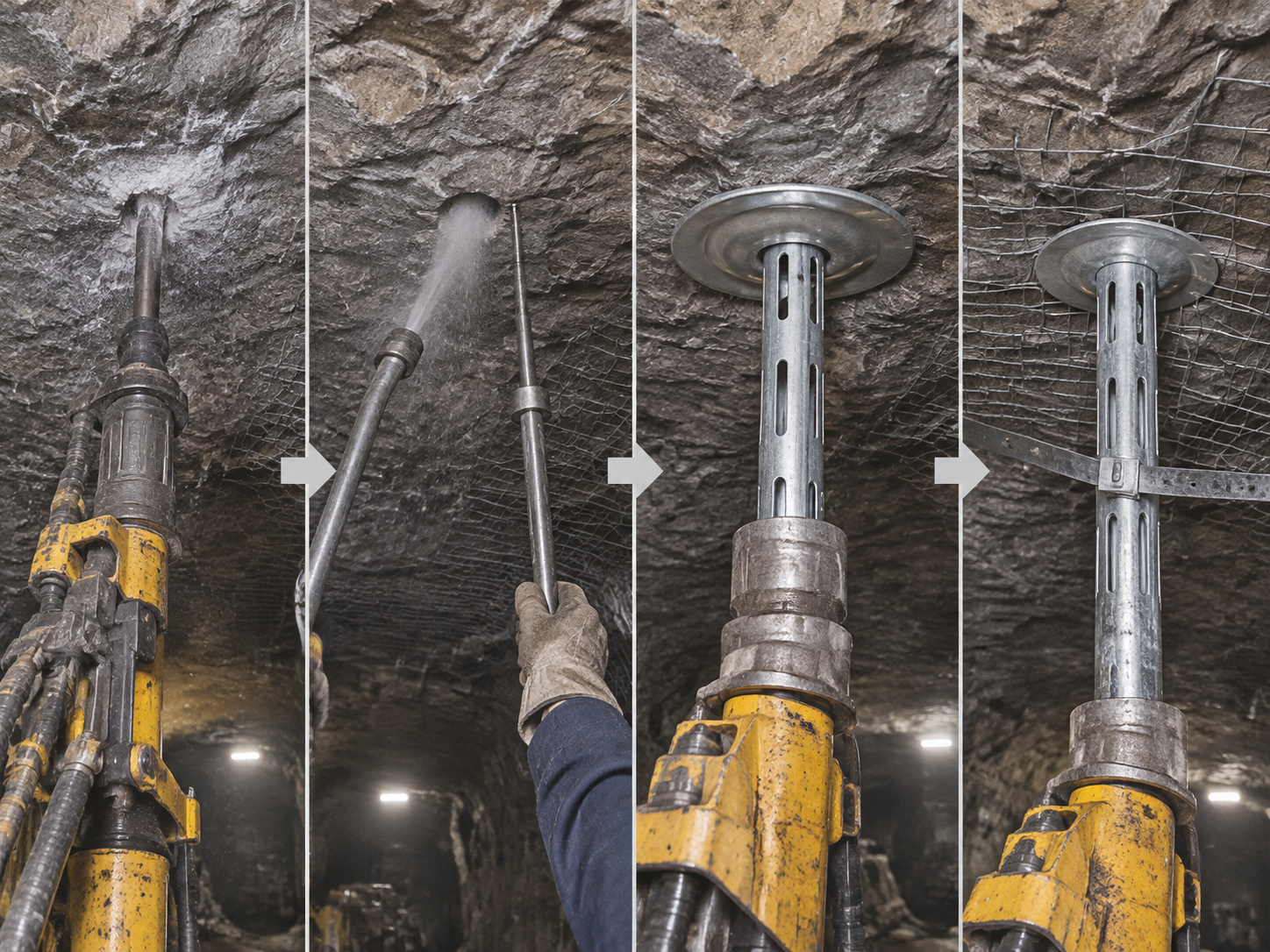
The principle is mechanical rather than chemical:
- A borehole is drilled within the range specified for the exact tube.
- The hole is cleaned and checked against the approved requirement.
- The split set is aligned with the hole and driven in with a compatible adapter and rig.
- The tube's diameter is reduced as the seam closes.
- The tube presses outward against the hole wall along the embedded length.
- The plate seats against the rock and begins to connect the bolt to the surface support.
The load path can be read as a chain:
diametral interference → partial closure of the seam → radial contact pressure → friction at the tube-to-rock interface → axial resistance to rock movement
If one link changes, the installed response changes. An oversize hole can reduce interference and contact pressure. An undersize, blocked or misaligned hole can prevent full insertion. A soft or damaged hole wall may yield before the tube develops the expected friction. A worn or mismatched installation adapter can damage the collar before the tube is fully seated.
The friction connection is distributed along the tube rather than concentrated at a single end anchor. "Distributed" does not mean "uniform." Roughness, local fracturing, hole deviation, wall damage and tube geometry can cause the effective contact pressure to vary along the length. That is why a nominal full-length contact assumption is not a substitute for a representative pull test or installation verification.
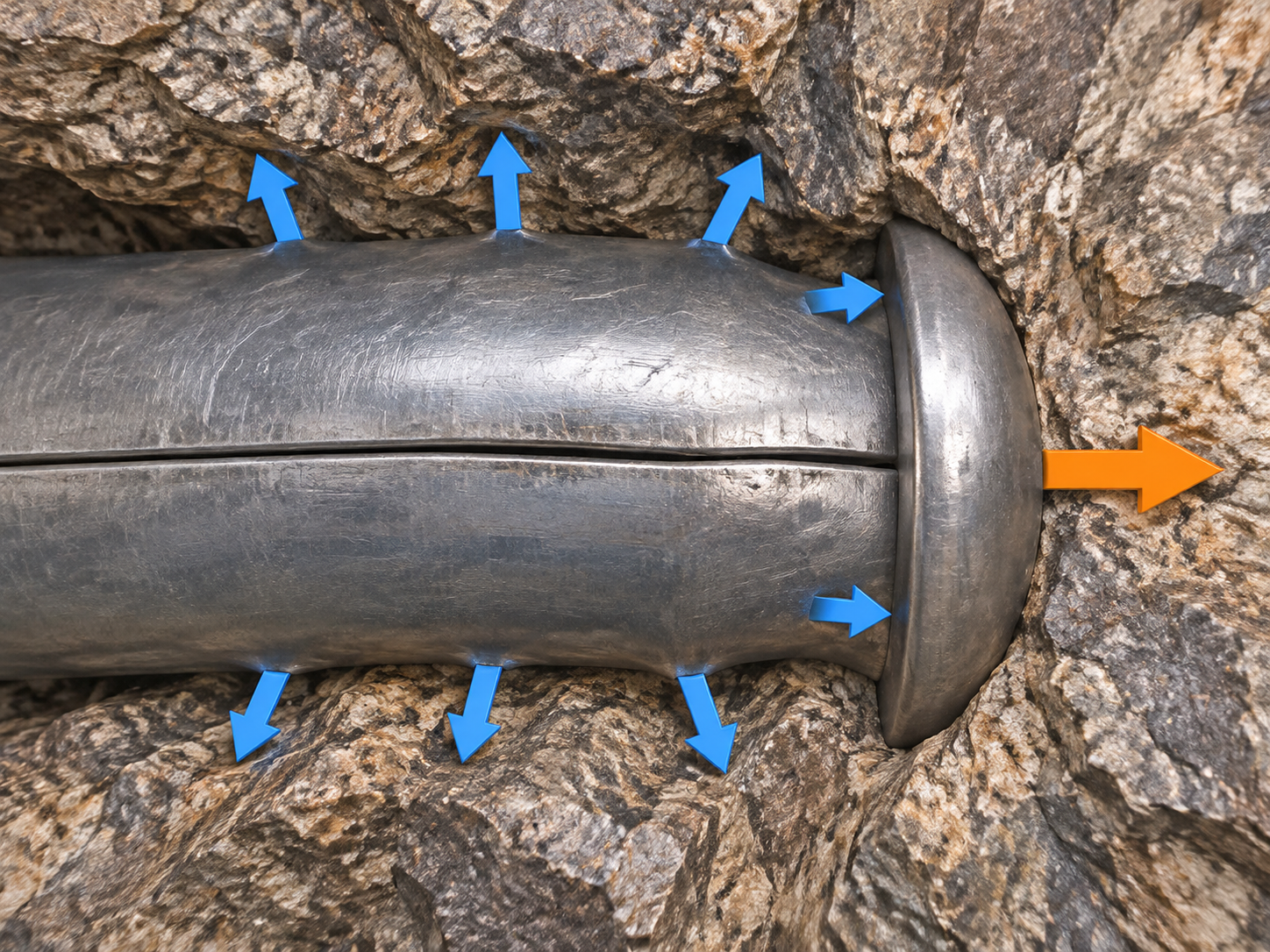
Because there is no resin or grout to mix and cure, the bolt can begin developing mechanical contact as soon as it is correctly installed. This is often described as immediate support, but "immediate contact" should not be confused with active preload or immediate achievement of a design capacity.
A conventional split set is not tensioned with a nut and does not impose a known preload in the same way as a tensioned threaded bolt. It responds as the rock moves and the load path develops. Some movement may occur as the tube and rock adjust. The amount and behavior depend on the exact product, borehole, rock and installation. A split set should not be called a dynamic support or a controlled-yielding bolt unless the proposed system has been specifically designed and tested for that role.
The friction connection also has limits. Contact is not necessarily uniform in a rough, irregular hole, and installed capacity should not be inferred from steel strength alone. Actual behavior depends on hole diameter, rock strength, fracture condition, embedment length and installation quality. A pull test in representative ground is more informative than a bolt-only headline number.
What the Installation Sequence Controls
The system approach becomes clear when the installation is broken down into control points.
The approved support design
The mine or project should define the support function, pattern, length, plate or mesh arrangement and acceptance requirements. A split set should not be chosen only because it is fast. It should be chosen because the failure mode, ground condition and design allow a friction bolt at that location.
The hole
The borehole is part of the product interface. Check:
- specified diameter and tolerance;
- depth and required embedment;
- drilling method and bit condition;
- hole straightness, alignment and entrance condition;
- wall strength, local fractures, loose blocks and hole stability;
- water, mud coating and rock flour on the contact surface;
- cleanliness before insertion.
A worn bit, oversize hole, collapsing hole or dirty hole can change the installation even when the correct box of bolts is on site. A rough hole is not automatically better. What matters is whether the wall can maintain effective contact and resist the radial pressure without excessive crushing or local collapse.
The tube and plate
The exact model should be traceable to a drawing and, where applicable, a batch record. Confirm the tube diameter, length, wall thickness, seam, collar, plate type and coating. The plate should seat on the rock and match the collar. A plate selected only by nominal bolt diameter is not a full compatibility check.
The installation equipment
The rig, feed, adapter and thrust must match the product. A system can appear simple and still fail at the interface between the drill head and the bolt collar. Ask for the proposed adapter and installation instructions, and confirm the equipment models used underground.
For mechanized installation, confirm the alignment, feed, thrust and stopping criteria in the approved procedure. Record refusal, abnormal vibration, incomplete insertion, damage at the collar or any other departure from normal driving. These observations help distinguish a ground problem from an equipment or product-interface problem.
The surface support
Where mesh, straps, shotcrete or other surface support is specified, the plate should connect the bolt to that system without cutting wires, creating an unstable point load or preventing the plate from seating. The bolt pattern and the surface system should be designed and installed together.
Records and testing
Record hole checks, installation difficulties, plate seating and any deviation from the procedure. Use the project's sampling and pull-test requirements. Record the test location, ground condition, installed length and failure mode, not only a peak value.
Useful installation evidence includes full insertion, condition of the visible collar, adapter engagement, plate seating and the pattern actually installed. A visible change at the collar can show that the tube has been compressed, but it does not by itself prove contact pressure, embedment or installed capacity.
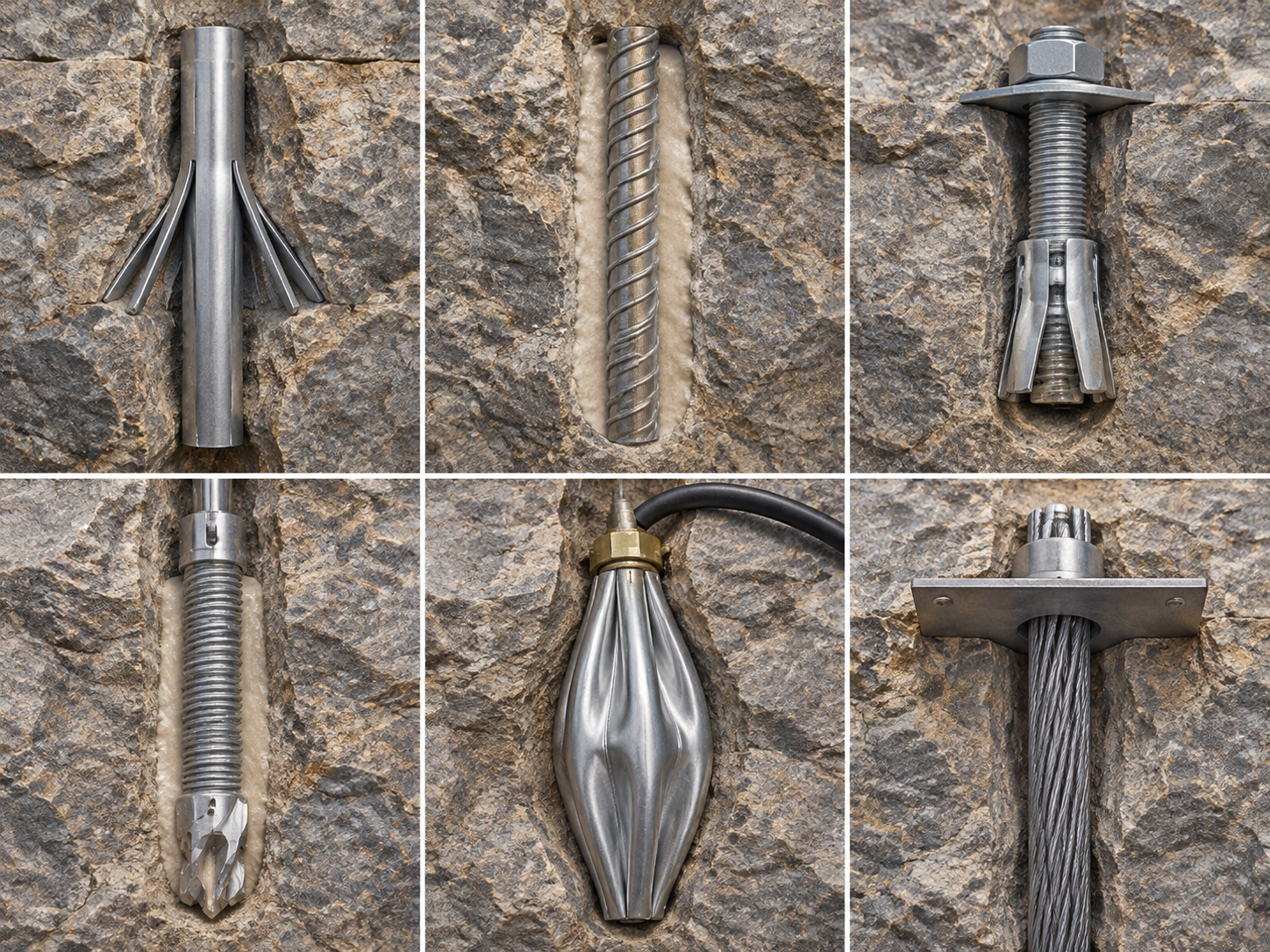
How a Split Set Differs from Other Rock Bolts
Rock bolts are often grouped by appearance. A more useful comparison is by load path.
Split set vs. resin or grouted bolts
A resin bolt uses a chemical cartridge that is mixed in the hole and cures around a bar. A grouted bolt uses cementitious or chemical grout to form a bond. The load path runs through the bar, the bonding material and the rock, and the finished system can behave as a stiff, bonded reinforcement element. Depending on the product and installation, a resin bolt may also be tensioned after the bond has developed strength.
That is a different system from a split set. The split set relies on radial friction at the tube-to-rock interface and has no chemical or cementitious bonding layer. It avoids resin storage, mixing, spin time, hold time, cure time and grout pumping. In ground that suits a friction bolt, those differences can simplify the cycle.
The absence of resin does not make the split set universally better. A resin or grouted bolt may be required for a stiff bonded system, for a specified anchorage condition, for tensioning or for other design reasons. The right comparison is the approved support function, not "resin versus no resin."
Split set vs. mechanical expansion-shell bolts
A mechanical expansion-shell bolt uses a shell near the end of the bolt. Tightening the nut pulls a wedge or cone into the shell, expanding it against the rock. The anchor is concentrated near the shell, and the plate and nut can apply tension to the bar.
A split set develops contact along the embedded tube and is normally installed by driving, without a nut-tensioning step. It is not an end-anchor system in the same sense. If the design requires a mechanically expanded end anchor, controlled torque or a specified preload, a split set is not a substitute.
Split set vs. self-drilling hollow bars
A self-drilling hollow bar is part of the drilling string. The bar and bit advance together, and the bar may remain in the hole as reinforcement, often with grout or another specified filling. This arrangement can be useful where the hole is unstable or where separate drilling and insertion would be difficult.
A split set still requires a pre-drilled hole. If the hole collapses before the tube can be inserted, the split set may not be suitable. A self-drilling system is not simply a hollow split set; the drilling function, bit, connection and grouting or filling arrangements are different.
Split set vs. water-inflatable expandable bolts
A water-inflatable expandable bolt is inserted as a folded tube and then expanded by water pressure. The pump, inflation head, hose and connections are part of the installation system. It may also develop friction against the borehole wall, but its installation method is not the same as a driven slotted tube.
Both products may be described loosely as friction bolts, so buyers should identify the exact product and installation method. "Expandable" does not automatically mean "split set."
Split set vs. cable and prestressing tendons
Cable bolts and prestressing bars are used for deeper or higher-capacity reinforcement. A cable can reach beyond a thick loosening zone; a prestressing bar can be tensioned and locked against a plate. These are not direct substitutes for a short split set. They answer different questions about depth, capacity, stiffness and active load.
A practical comparison table
| Question | Split set | Resin/grouted bolt | Mechanical shell bolt | Self-drilling hollow bar | Water-inflatable bolt | Cable/PT tendon |
|---|---|---|---|---|---|---|
| Main load path | Radial friction along embedded tube | Bond through resin or grout | Concentrated end-shell anchor plus bar/plate | Bar/grout or bar/rock system, depending on design | Expanded tube contact against rock | Tendon anchor and, where designed, tension |
| Installation method | Pre-drill, then drive | Pre-drill, insert cartridge or grout, then install | Pre-drill, insert, expand shell and tension | Drill with the bar, then grout/fill as specified | Pre-drill, insert, inflate with water | Long-hole drill, anchor, grout and/or tension |
| Typical reason to use | Fast friction support in suitable rock | Bonded or tensionable support in broken or laminated rock | Mechanical point anchor and preload | Hole-making difficulty or integrated drilling | Water-powered expansion in suitable ground | Deep or high-capacity reinforcement |
| Main limitation | Hole must stand; not a preloaded bolt | Mixing, cure, hole condition and annulus matter | End-rock condition and tensioning control | More complex equipment and installation | Pump and connection compatibility | Long-hole access, grouting and tensioning |
| What it is not | Not grouted, self-drilling or active preload by default | Not a friction-only bolt | Not a full-length friction bolt | Not a split set with a hole through it | Not the same as a driven split set | Not a surface-only bolt |
The table is a starting point for technical review, not a selection rule. Many underground support designs combine more than one element. A split set may hold mesh near the surface while a longer tendon or cable addresses a deeper instability. The system should be designed as a sequence.
Where a Split Set Mining System Fits
A split set is commonly considered for:
- development headings and mine roadways where the bolting cycle affects advance;
- primary or secondary support in competent to moderately jointed rock;
- local reinforcement of roofs, walls and broken ground around production areas;
- temporary or staged works where a simple, grout-free support element is useful;
- areas where a plate-and-mesh or plate-and-strap system is specified;
- underground mining and civil tunnels where a pre-drilled hole can be maintained.
It is not the first choice when:
- the hole will not stay open long enough for insertion;
- the rock is too soft or broken to develop useful radial contact;
- the design requires a known active preload;
- the instability extends well beyond the practical bolt length;
- the project requires a specific bonded, dynamic or energy-absorbing system;
- corrosion protection for the full service life cannot be demonstrated for the proposed assembly.
The boundary is important. A split set can be an excellent tool in the right ground and the wrong tool when a different mechanism is required. "Fast installation" does not answer a question about deep-seated instability, and "no grout" does not answer a question about long-term corrosion.
What a split set can and cannot do
| A split set system can | A split set system does not automatically provide |
|---|---|
| Establish mechanical contact when correctly installed | A specified active preload |
| Develop radial friction along the intended contact length | Uniform pressure over every part of the hole |
| Clamp a plate and connect to mesh, straps or another surface system | Surface support by itself |
| Accommodate some local movement without a chemical bond | Controlled yielding or energy absorption unless specifically designed and tested |
| Simplify the material and installation cycle in suitable ground | A universal support solution for broken, squeezing, bursting or collapsing ground |
| Reach a shallow to moderate embedded zone within the bolt length | Deep suspension or reinforcement beyond the practical bolt length |
| Be supplied with a selected coating system | Automatic corrosion protection for every service environment |
The table explains why the product name is not a design decision. The approved support function must first be clear.
Failure Modes and the Evidence They Leave
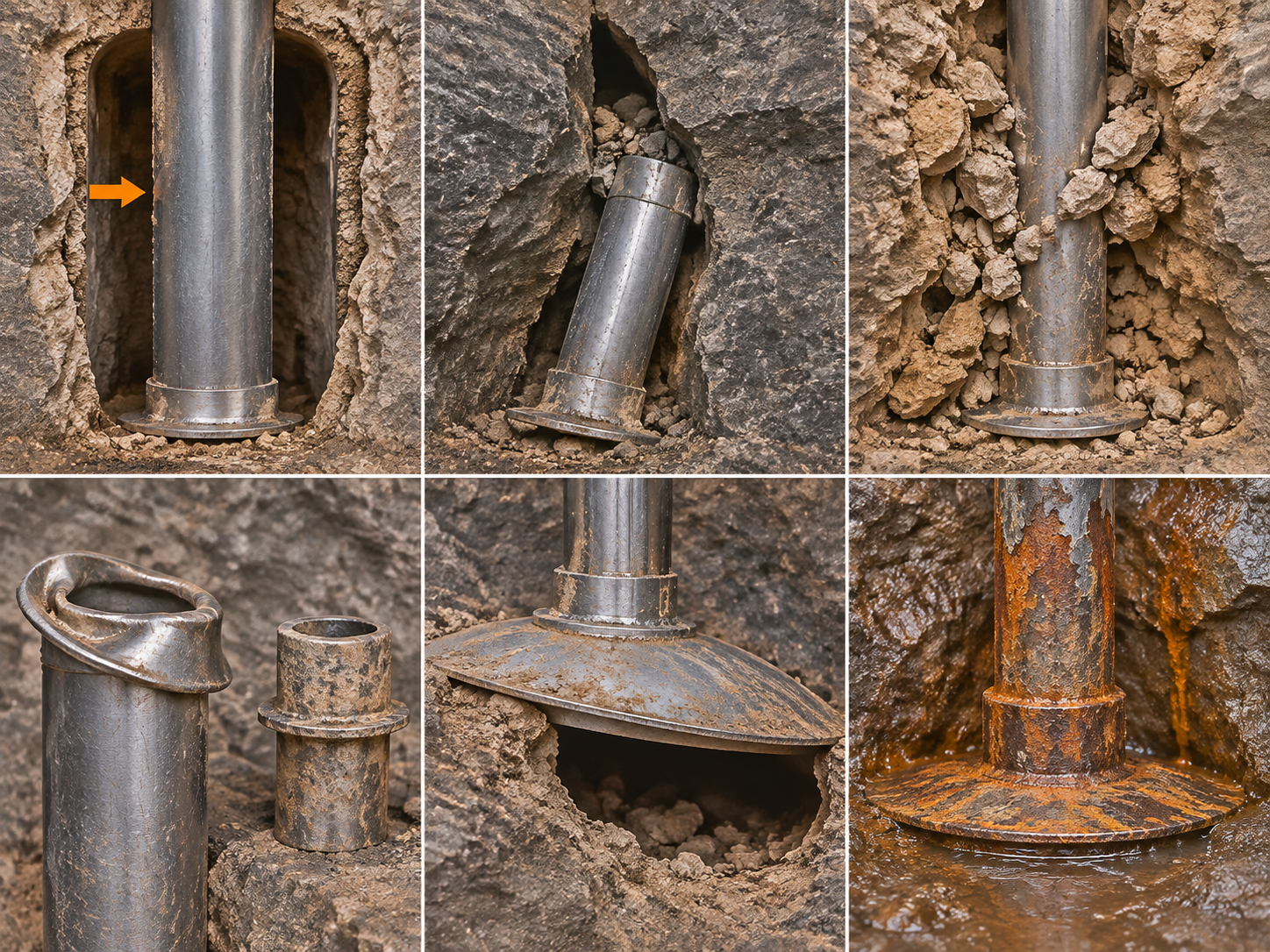
A split set is a simple product with several possible interfaces, so "the bolt slipped" is not a complete diagnosis. The location and nature of the failure help identify whether the problem belongs to the hole, the tube, the plate, the installation equipment, the rock or the support design.
| Observation | Possible interface problem | Evidence to record |
|---|---|---|
| Tube slides without developing useful resistance | Oversize hole, insufficient interference, smooth or damaged wall | Actual hole diameter, wall condition, insertion depth, slip load |
| Tube refuses to enter or stops before full embedment | Undersize hole, obstruction, hole deviation, adapter mismatch | Bit and gauge record, hole depth and line, insertion distance, adapter drawing |
| Hole closes or rock crushes around the tube | Soft, running or broken ground; unstable wall | Rock description, time from drilling to insertion, hole condition, water |
| Collar, weld or adapter is damaged | Misalignment, wrong adapter, excessive or uncontrolled feed, handling damage | Adapter model, rig settings, images of damage, installation record |
| Plate does not seat or punches into the surface | Void behind plate, wrong plate, unstable rock, incorrect collar fit | Plate type, rock surface condition, bearing area, installed pattern |
| Corrosion or coating damage appears | Inadequate coating, damaged galvanizing, aggressive water or long service exposure | Groundwater, coating specification, handling record, service life |
| Tube or rock fails during a pull test | Different failure mechanisms require different review | Failure location, pull load, displacement, ground and installed length |
A pull test is more useful when it reports where and how the system failed. A tube pulled from an oversize hole, a plate punched into a soft surface, a collar that failed because of an adapter mismatch and a rock-mass failure can all produce a low or unexpected result, but they do not have the same cause.
The Procurement Questions That Separate One Split Set System from Another
A quotation should make the complete system visible. Ask for:
- The exact product and drawing. Model, tube diameter, length, wall thickness, seam and collar arrangement.
- The approved hole range. The actual match between tube and borehole, including the drilling method and tolerances.
- The plate assembly. Plate type, center hole, bearing area, seat and coating.
- The installation arrangement. Rig, adapter, thrust and any product-specific installation instructions.
- The surface-support interface. Mesh aperture, strap type and plate seating.
- The corrosion system. Coating, exposed components, expected environment and service life.
- The evidence. Dimensional records, material certificates, product data, pull-test method and acceptance criteria.
- The supply scope. Quantities, lengths, mixed batches, packaging, identification, delivery and any exclusions.
This is more than a purchasing formality. It prevents two suppliers from quoting different assemblies under the same short product name. It also gives the project engineer a basis for deciding whether the proposed split set is genuinely equivalent to the approved product or is a different design that needs review.
Price should be compared on the same installed basis. A split set may remove resin, mixing, pumping and cure steps, but it still requires drilling, handling, an adapter, plates, surface support, inspection and the correct equipment. The cheapest tube per piece is not necessarily the lowest installed support cost. For a closer procurement guide, see How to Choose the Right Friction Bolt and Advantages of Split Pipe Seam Anchors.
What Good Installation Control Looks Like
The system is only complete when the tube, hole, plate and equipment work together underground. A practical control plan should include:
- checking the bit and a sample of drilled holes, not only the nominal bit size;
- confirming the hole is clean and deep enough for the specified embedment;
- checking the tube is straight and the seam and collar are undamaged;
- matching the adapter to the tube and using the approved driving procedure;
- confirming the plate seats on rock and does not bridge a void;
- checking the installed pattern and surface support against the drawing;
- performing the specified pull tests and recording the result and failure mode;
- recording any change in ground, hole condition or installation behavior.
The purpose of these checks is not to add paperwork. They show whether the installed system still matches the one that was designed and quoted. A split set that is installed in an oversize hole, with the wrong adapter or without the specified surface support, is not the same support element as the one described in the catalogue.
The Difference in One Sentence
A split set mining system is different from other rock bolts because it uses a pre-drilled hole, a compressed slotted tube and distributed radial friction to begin restraining the rock without resin or grout, while relying on a matched plate, installation arrangement and surface-support system to complete the support function.
That does not make it the strongest, most permanent or most suitable bolt in every ground condition. It makes it a specific tool with a specific load path, installation logic and set of boundaries. Engineers and buyers should compare it with resin, mechanical, self-drilling, inflatable, cable and prestressing systems on the basis of failure mode, depth, required preload, hole stability, equipment, service life and evidence.
Conclusion
The word "system" is not marketing language. It is the practical unit of split set support. The tube provides the friction mechanism, the hole provides the contact surface, the plate connects the bolt to the rock surface, the installation equipment controls how the tube is driven and the surface support completes the pattern. Each part has to match.
When those conditions are met, a split set can offer a fast, mechanically simple and grout-free support solution for suitable mining and tunneling ground. When they are not met, another rock bolt or a combined support system should be evaluated. The correct question is not simply "What is a split set?" but "What support function is required, and does this complete split set system provide it?"
To review a project-specific system, send CQ Rockbolt the mining or tunneling application, ground condition, hole requirements, plate and mesh arrangement, installation equipment, coating requirement, testing requirement and delivery destination. The team can then confirm the exact available product, accessories and documentation. Contact CQ Rockbolt with the project details.
Related News
Other news you might be interested in

Self-Drilling Anchor Bolts for Water-Conveyance Tunnel Reinforcement
Self-drilling anchor bolts are useful for water-conveyance tunnel reinforcement when broken or water-bearing ground makes conventional drill-and-insert bolting difficult. By using a hollow threaded bar as both the drilling member and the permanent reinforcement, the system removes the separate bolt-insertion step and provides a channel for grouting through the same bar.For a water-conveyance tunnel, that installation advantage matters. Headrace, tailrace, diversion, irrigation and water-supply tunnels can pass through fault zones, weathered rock, weak interlayers and interconnected fractures. Groundwater may enter the excavation, boreholes may deteriorate after drilling, and support must be coordinated with drainage, waterproofing and the final lining.

Advantages of split pipe seam anchors
Split pipe seam anchors, also called split-set friction anchors or slotted-tube rock bolts, are one of the simplest forms of underground rock support. They are made from a steel tube with a longitudinal seam. The tube is driven into a borehole slightly smaller than its outside diameter. During installation, the seam allows the tube to compress, creating radial pressure against the borehole wall. This pressure produces a friction grip along the embedded length and allows the anchor to begin restraining rock movement without resin or grout.
Want to know more?
Get in touch with us for more information about our services and products.