

Why Are Self-Drilling Anchor Rock Bolts Used in Mining?

Dayang Yang
AuthorWith over 15 years of experience in the production and sales of ground anchoring and mining support products, we operate our own rock bolt and accessory manufacturing facility with stable large-scale production capacity. We are specialists in rock bolts, resin cartridges, anchor cables, bearing plates, and customized ground anchoring products for mining support and geotechnical anchoring solutions.
Mining engineers do not choose self-drilling rock bolts because they are new or because they are marketed as a universal solution. They choose self-drilling anchor rock bolts when the ground, the support cycle or the access conditions make a conventional drill-then-insert sequence difficult to control.
A self-drilling anchor rock bolt is a hollow threaded bar that acts as part of the drill string, provides the injection path, and remains in the hole as reinforcement. In supplier literature, the same product family may be called a self-drilling hollow bar or an SDA bolt. A sacrificial drill bit is fitted to the leading end. The bar is advanced with the bit, grout or resin is delivered through the hollow core where the system is designed for that method, and the bar stays in place as the load-bearing element. This can create a more continuous drilling, anchoring and, where specified, grouting sequence rather than three separate operations.
That is the practical reason self-drilling anchors are used in mining: they reduce the gap between drilling a hole and installing support in ground that may not hold a stable hole. They are not, however, the best choice for every tunnel or mine roadway. The selection depends on ground condition, design load, borehole diameter, equipment, grout system, corrosion requirement and the project's acceptance criteria.
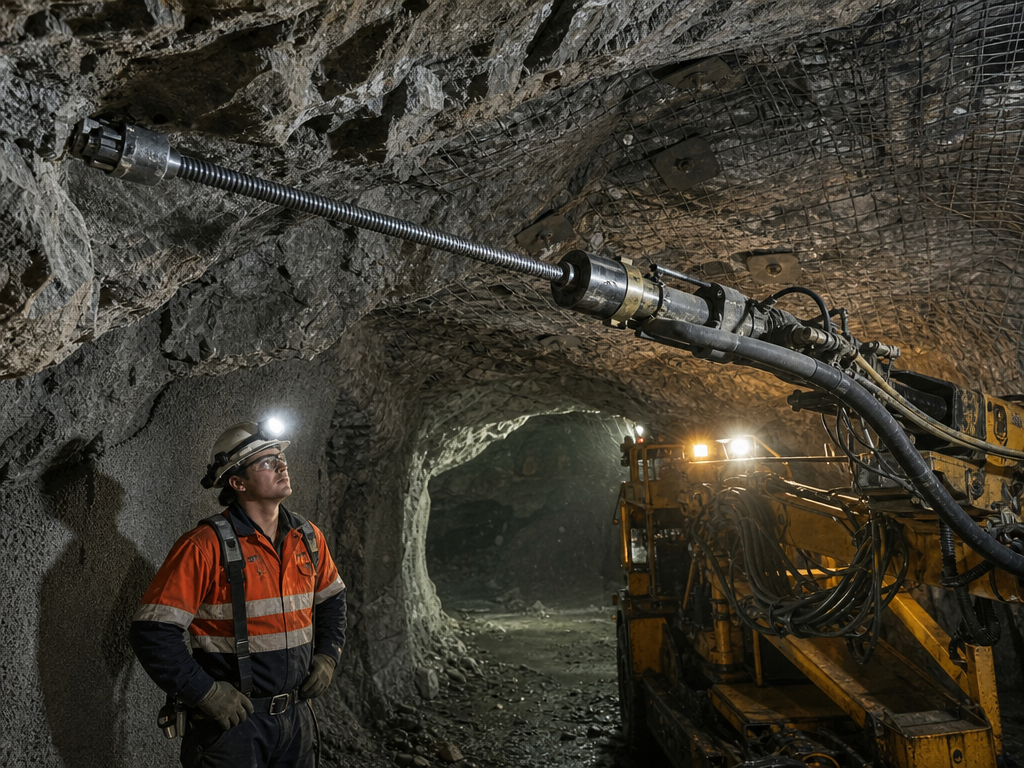
The mining problem: the hole may not wait for the bolt
In competent rock, a conventional sequence can work well: drill the hole, withdraw the drill string, insert the bolt, and grout or tension it. The hole remains open long enough for the installation.
In fractured, weak, collapsible or squeezing ground, that sequence can break down. The borehole may close, slough or deviate before the bolt is inserted. The roof or rib may continue to move while the drill rig is withdrawn and the bolt is handled. In a development heading, that lost time can leave people and equipment working closer to unsupported ground.
A self-drilling anchor changes the sequence. The bar is part of the drill string, so it is already in the hole when drilling is finished. There is no separate insertion step through an unstable borehole. Grout can be delivered through the same bar, including simultaneous drilling and grouting in systems designed for that method. The bar then remains as reinforcement.
This is why self-drilling rock bolts are often considered for weak, broken or faulted ground, and for locations where the support cycle needs to be kept continuous. It is also why the method is used in underground mining ground support, including development, rehabilitation and local reinforcement, not only in civil tunneling.
The method does not replace support design. It changes how the support element is installed. The required bolt capacity, pattern, length, orientation and interaction with mesh, straps, cable bolts or shotcrete still have to come from the approved ground control design.
What a self-drilling anchor system actually includes
The product name can hide important differences in supply scope. A self-drilling anchor rock bolt is normally described as a system because the bar alone does not complete the installation.
| Component | Function | What the buyer should confirm |
|---|---|---|
| Hollow threaded bar | Acts as drill string, grout channel and reinforcement | Bar diameter, wall thickness, steel grade, thread type, length and coating |
| Sacrificial drill bit | Forms the hole and remains downhole | Bit type, nominal hole diameter, ground suitability and quantity |
| Coupler | Connects bar sections and transmits drilling energy | Thread match, coupler type, length, sealing and maximum make-up |
| Grout adapter or swivel | Connects the bar to the grout line while allowing rotation | Connection thread, pressure rating, compatibility with the rig and pump |
| Plate and nut | Transfer load from the bar to the rock surface | Plate size and profile, hole diameter, nut type and spherical seat if required |
| Centralizer or spacer, where specified | Helps position the bar and grout annulus | Whether it is required, supplied or site-fabricated |
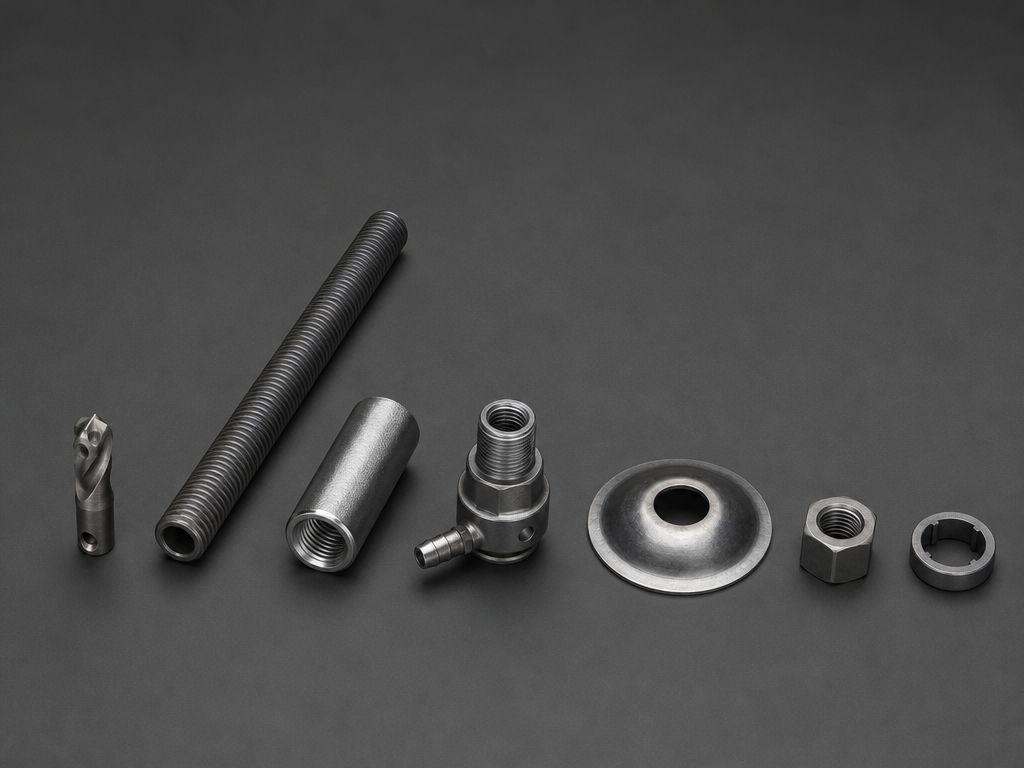
Not every hollow bar is a self-drilling anchor. Some hollow-core bolts are designed to be inserted into a hole drilled by separate equipment. The distinction is not cosmetic: it changes the bit, coupler, grout path, rig interface and installation sequence. If the proposal only says “hollow rock bolt,” ask the supplier to state which installation method the product is designed for.
Some self-drilling anchor bolts use a cementitious grout; others are designed around a resin system. That difference affects the drill bit, installation sequence, working time and the evidence a supplier should provide. It should be stated in the proposal, not left to the site to infer.
For a direct comparison of the two arrangements, see our guide to self-drilling vs. pre-drilled hollow-core rock bolts.
Where self-drilling anchors fit in mining
Self-drilling anchor rock bolts and other mining rock bolts are commonly compared in the following situations. These are starting points for technical review, not automatic selection rules.
| Mining situation | Why self-drilling may fit | What still needs project review |
|---|---|---|
| Development headings in broken ground | The bar stays in the hole while drilling, reducing the risk of borehole collapse before installation | Required support pattern, bolt length, cycle time and compatibility with the development rig |
| Roof and rib support in weak or fractured rock | Continuous installation and injection delivery can suit ground that will not hold a clean hole | Design load, spacing, plate/mesh arrangement and corrosion requirement |
| Fault zones and rapidly changing ground | The system can be adapted at the face without a separate pre-drilling step | Ground characterization, grout volume, bit selection and possible need for complementary support |
| Intersections, portals and rehabilitation areas | Limited access or irregular geometry can make separate drilling and bolt handling difficult | Access, working height, rig reach, surface preparation and interaction with existing support |
| Low-headroom or limited-feed conditions | Couplers allow the bar to be extended when the rig cannot handle the full length in one pass | Coupler strength, make-up procedure, feed length and handling space |
| Layered support with mesh, straps or cable bolts | Self-drilling anchors can form one layer within a combined support system | How the layers interact, who designs the system, and how installation sequence affects the face |
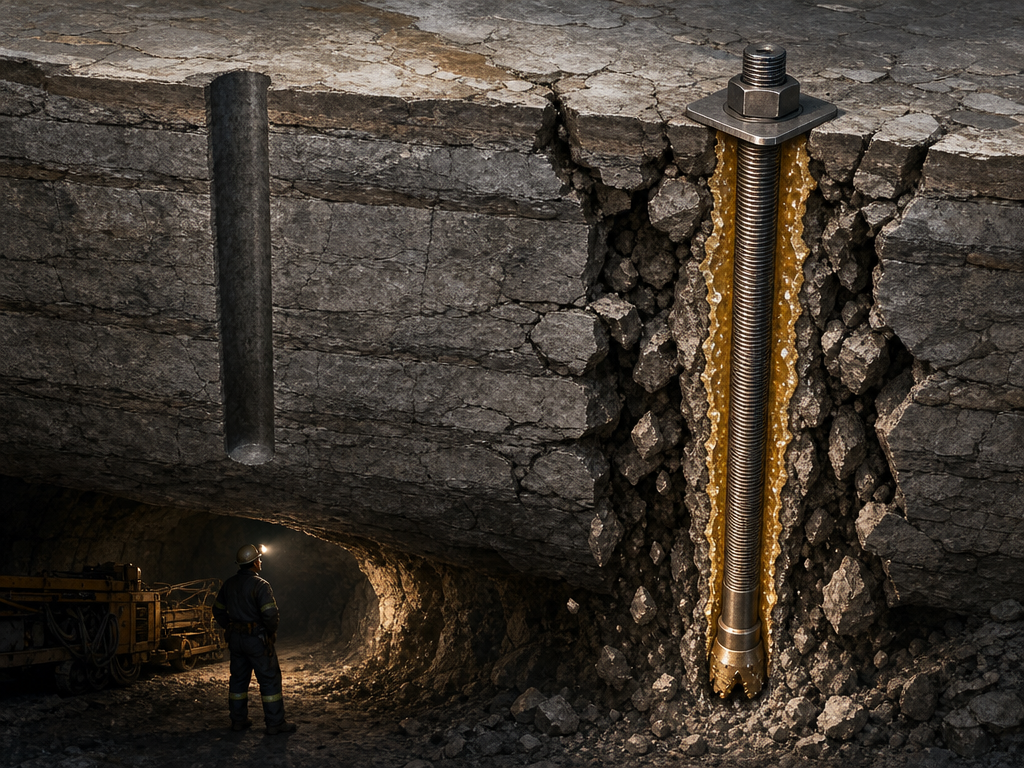
The common thread is not “self-drilling is stronger.” It is that the installation method may fit a ground or access problem that conventional bolting handles poorly.
When self-drilling is not the first choice
A self-drilling anchor is not automatically faster, cheaper or safer than every alternative. It adds its own requirements: compatible drill bits, couplers, grout mixing and pumping, cleaning, trained operators and quality control. The method can be the wrong choice when:
- The borehole is stable and a conventional pre-drilled bolt can be installed reliably.
- The support design calls for a different anchorage mechanism, such as a friction bolt, expandable bolt, resin-anchored bar or cable bolt.
- The site does not have the rig, grout equipment or utilities needed for the proposed system.
- The project cannot accept a sacrificial bit left downhole or the specified grout or resin system.
- The corrosion protection and design life have not been addressed.
- The team cannot control grout mix, injection volume, return or installation records.
- The project has no agreed method for verifying installed anchorage.
In those cases, a self-drilling anchor may create a more complex operation without solving the actual ground-control problem. The right question is not “Why not use self-drilling?” but “Which installation method fits this ground, this design and this site?”
The buyer questions that decide the selection
The following questions are useful for a technical buyer, estimator or ground control engineer comparing proposals. They are also useful for separating a genuine self-drilling system from a hollow bar that is intended for a different installation method.
| Buyer question | Why it matters | Evidence to request |
|---|---|---|
| Is the proposed product truly self-drilling, or is it a hollow-core bolt for a pre-drilled hole? | The two products have different bits, couplers, rig interfaces and installation sequences | Product drawing, installation method statement and component list |
| What exactly is included in the quotation? | A bar-only price cannot be compared with a complete system price | Itemized bill of materials with included, excluded and separately priced items |
| What bar diameter, thread, steel grade and length are proposed? | These determine the connection, drill bit, grout annulus and installed capacity | Drawing, material specification and thread definition |
| Which drill bit is proposed, and for what ground condition? | Bit type affects penetration, hole diameter, grout annulus and downhole performance | Bit drawing or data sheet, recommended ground range and quantity per bar |
| What grout or resin system is specified? | The anchorage material is part of the system, not an afterthought | Grout/resin data sheet, mix or ratio, working time, strength and compatibility with the bar |
| What injection pressure, volume and sequence are required? | Incorrect grout volume or pressure can leave voids or damage the connection | Installation instructions and project-specific method statement |
| What rig and grout interface are required? | A product that fits the hole may not fit the feed, rotation, adapter or pump | Rig make/model, feed length, torque, adapter drawing and utility requirements |
| What evidence supports the installed capacity? | Bar tensile data alone does not prove anchorage in the ground | Test reports for the exact bar, assembly and installation method; project pull-test requirements |
| What corrosion protection is proposed? | Mining service life may require galvanizing, coating or other protection | Coating specification, thickness, damage repair and compatibility with the grout |
| What is excluded or dependent on another party? | Missing couplers, bits, adapters or testing can stop the job | Written exclusions, responsibilities and document list |
If a supplier cannot answer these questions for the exact proposed configuration, the quotation is not yet technically comparable.
Selection conditions to confirm before quoting
Self-drilling anchor selection is a system decision, not a catalogue lookup. Before asking for a price, confirm the following inputs with the project technical team.
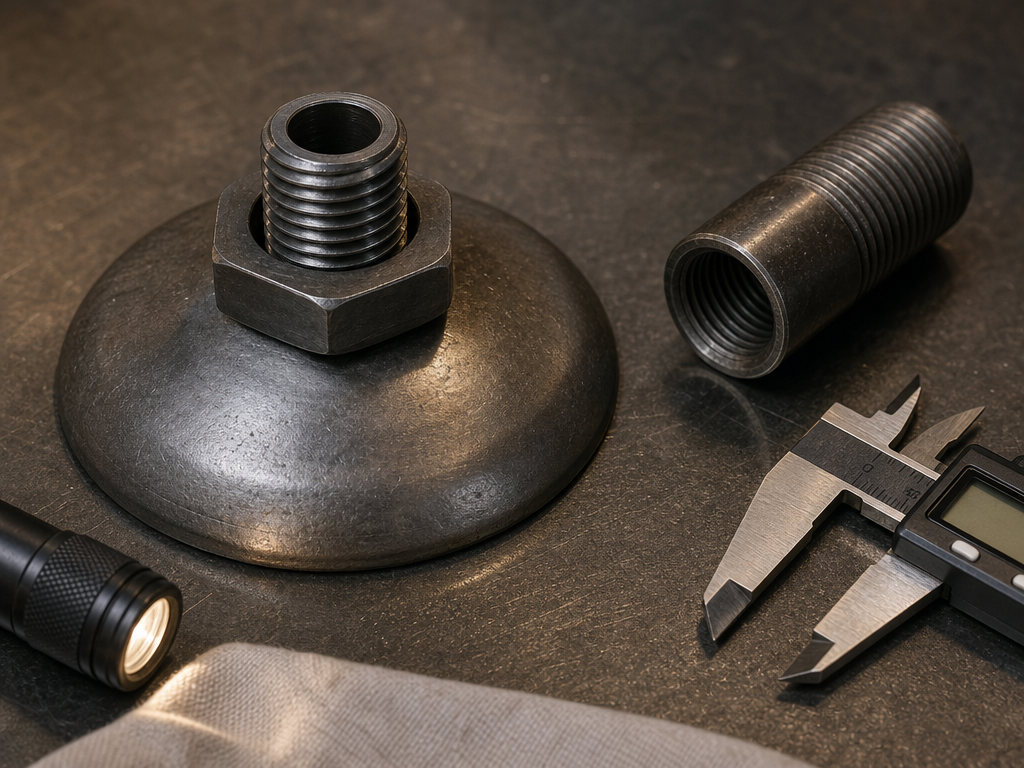
1. Ground condition and borehole stability
Describe the rock type, strength, fracturing, weathering, water inflow, squeezing or swelling potential, and the expected stand-up time of the borehole. The same bar can behave differently in a stable hole and a hole that collapses within minutes.
2. Support function and design load
Confirm whether the bolt is for roof support, rib support, face stabilization, forepoling, rehabilitation or another function. Provide the design load, spacing, length and interaction with mesh, straps, shotcrete or cable bolts. Do not ask a supplier to select the support pattern from a product catalogue.
3. Borehole and drill bit diameter
The bit creates the hole and the annulus around the bar. Confirm the specified hole diameter, the proposed bit diameter, the expected overbreak and the grout annulus. A bit that is too small or too large can affect installation and grout coverage.
4. Bar, thread and coupler
Confirm bar diameter, wall thickness, steel grade, thread type, coupler type and length. Thread names that sound similar are not proof that two components form an approved assembly. Ask for the drawing and the mating component reference.
5. Length, headroom and feed arrangement
Confirm the required installed length, the rig feed length, the available headroom and the handling space. Where the full length cannot be fed in one pass, the coupler and make-up procedure become part of the selection.
6. Grout or resin system
Confirm whether the project requires cementitious grout, a resin system or another approved material. Ask for the mix, ratio, working time, injection pressure, volume and cleaning requirements. The grout is part of the anchorage system; it is not a generic site consumable.
For a more detailed comparison of resin cartridges, pumpable resin and hollow-core bar systems, see our guide to choosing by ground condition.
7. Corrosion protection and design life
Confirm the environment, design life and required coating or protection. Water, chloride, acid, stray current and permanent versus temporary support can change the requirement. Do not assume that a standard finish is adequate for every mine.
8. Equipment and utilities
Confirm the rig make and model, feed, rotation, torque, adapter, grout pump, water or air supply, and available power. A self-drilling system is an interface, not only a bar. For mechanized bolting, the interface review should include the magazine, feed, rotation, injection and control system.
Our mechanized rock bolting compatibility checks set out the bolt, resin and rig interfaces to review before standardization.
9. Testing and acceptance
Confirm the project's test standard, test type, frequency, acceptance values, witness and record format. A supplier's internal test certificate may support product quality, but it does not automatically satisfy a project's pull-test or acceptance requirement. The project specification decides the test plan.
10. Supply scope and delivery
Confirm the quantity of bars, bits, couplers, plates, nuts, adapters and any centralizers. Confirm packing, labeling, batch identification, delivery point and document language. A complete technical proposal should also state what is excluded.
What good installation control looks like
The advantage of self-drilling is lost if the installation is not controlled. Key checks usually include:
- The bit is the specified type and is in suitable condition before drilling.
- The hole is drilled to the specified depth and alignment.
- The coupler is clean, correctly engaged and made up to the specified procedure.
- The grout mix, working time and injection volume match the approved method.
- Grout return or other specified verification confirms that the annulus is filled.
- The plate and nut are installed correctly, with the specified seat and tension where required.
- Pull testing, displacement monitoring or installation records are completed where the project requires them.
- Any deviation, damaged component or incomplete grout run is recorded and reviewed.
These controls should come from the project's method statement and the supplier's installation instructions for the exact system. They should not be copied from a generic article or another site.
Next step: send the information a supplier actually needs
If you are evaluating self-drilling anchor rock bolts for a mining project, send a single selection package rather than a one-line request for “self-drilling bolts.” Include:
- Mining application and location: development heading, roof, rib, fault zone, portal, rehabilitation or other.
- Ground description: rock type, strength, fracturing, water, squeezing or swelling, and borehole stand-up time.
- Support design: required bolt length, diameter, spacing, pattern and design load.
- Borehole and bit requirements: specified hole diameter, drilled depth and any project-specific bit requirement.
- Equipment: rig make and model, feed length, rotation, torque, adapter and grout pump.
- Grout or resin: specified material, mix or ratio, working time, pressure and volume.
- Corrosion and service life: environment, temporary or permanent support, and required coating.
- Commercial and documentation: quantity, delivery point, required documents, test plan and acceptance records.
For a project-specific review, send these details to CQ Rockbolt. We will identify the self-drilling anchor products within our supply scope, confirm the available bar, bit, coupler, plate and nut options, and state which items require project or rig OEM confirmation. If your project is comparing self-drilling with pre-drilled hollow-core bolting, say so at the start; the two arrangements should not be substituted without a technical review.
If you are still building the inquiry, the rock bolt RFQ checklist for tunneling contractors can be used alongside the list above.
The goal is not to buy the most adaptable-looking bolt. It is to select an installation system that matches the ground, the support design, the equipment and the evidence your project will accept.
Related News
Other news you might be interested in

Self-Drilling Anchor Bolts for Water-Conveyance Tunnel Reinforcement
Self-drilling anchor bolts are useful for water-conveyance tunnel reinforcement when broken or water-bearing ground makes conventional drill-and-insert bolting difficult. By using a hollow threaded bar as both the drilling member and the permanent reinforcement, the system removes the separate bolt-insertion step and provides a channel for grouting through the same bar.For a water-conveyance tunnel, that installation advantage matters. Headrace, tailrace, diversion, irrigation and water-supply tunnels can pass through fault zones, weathered rock, weak interlayers and interconnected fractures. Groundwater may enter the excavation, boreholes may deteriorate after drilling, and support must be coordinated with drainage, waterproofing and the final lining.

What Is a Split Set Mining System and How Is It Different from Other Rock Bolts?
A split set is often described as a rock bolt, but in mining it is more useful to think of it as a support system. The steel tube is the most visible part. The way it performs also depends on the drilled hole, the bearing plate, the installation adapter, the drilling equipment, the surface support and the checks made underground. That distinction matters when a project compares rock bolts. Two quotations can list a similar diameter and length, yet propose different load-transfer mechanisms, different hole requirements and different installation procedures. A split set is not a resin bolt with the resin removed. It is not a mechanical expansion-shell bolt, a self-drilling hollow bar, a water-inflatable tube or a cable bolt. Each product family solves a different part of the ground-support problem.
Want to know more?
Get in touch with us for more information about our services and products.