

South African Mining Sector Continues to Recover, Presenting Growth Opportunities for Mining Support Products

Dayang Yang
AuthorWith over 15 years of experience in the production and sales of ground anchoring and mining support products, we operate our own rock bolt and accessory manufacturing facility with stable large-scale production capacity. We are specialists in rock bolts, resin cartridges, anchor cables, bearing plates, and customized ground anchoring products for mining support and geotechnical anchoring solutions.
South Africa's mining sector entered the fourth quarter of 2026 with two signals that appear contradictory. Balance sheets are stronger: PwC's SA Mine 2026 reports that revenue among the companies it analysed rose 38% to R786-billion, EBITDA rose 74% to R214-billion, and free cash flow increased 147% . Yet national mining production fell 12.7% year on year in August, the fourth consecutive monthly decline.
Both signals are real. The recovery is a recovery in cash flow, reserves and investment — not yet a recovery in tonnage. For suppliers of rock bolts, resin capsules, mesh, cable bolts and plates, that distinction matters more than the headline. Mines with stronger balance sheets are not automatically buying more bolts per tonne. They are buying differently: more selectively, with more attention to installed cost, compatibility, documentation and supply continuity.
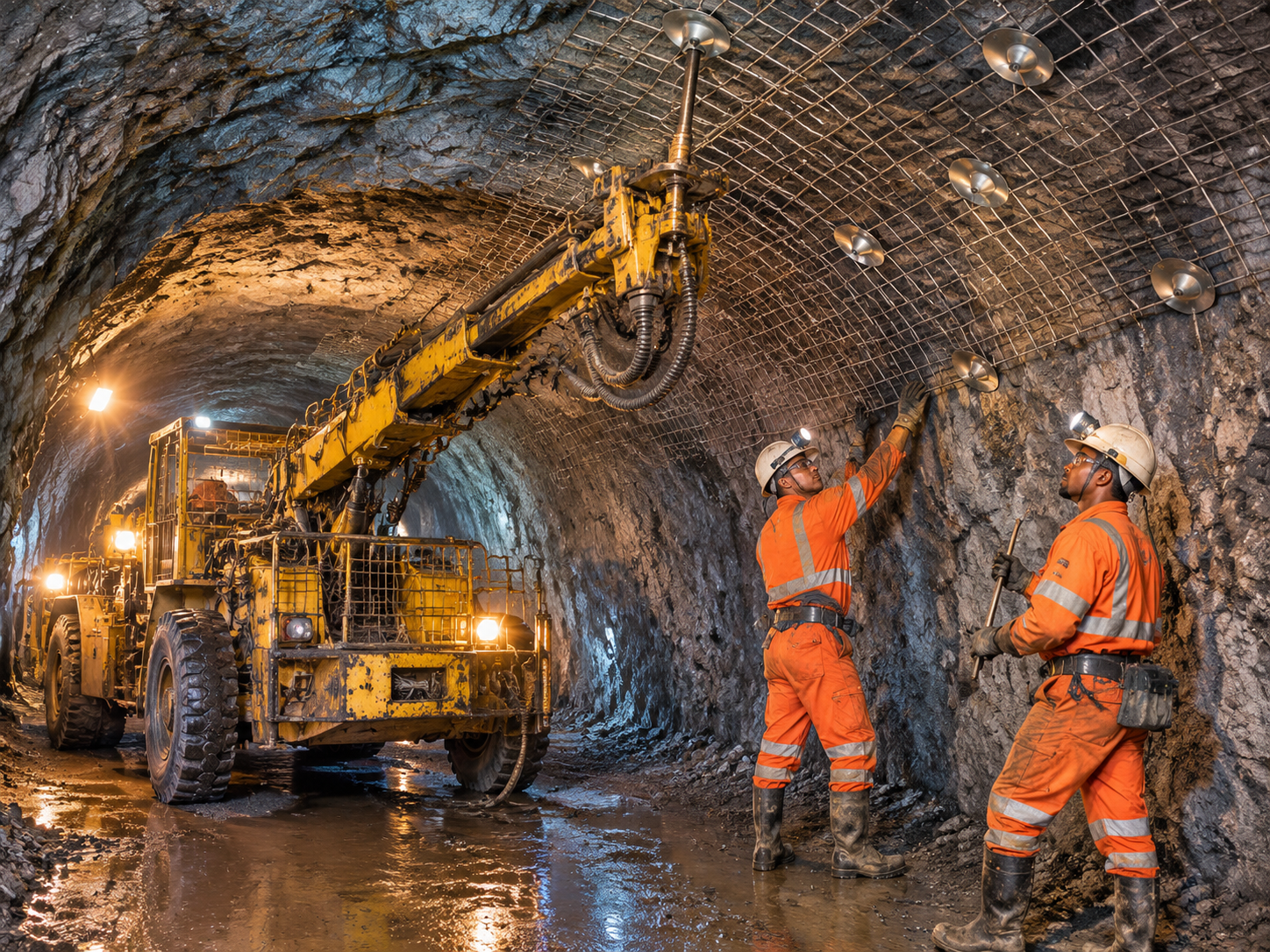
The recovery is real — but it is a balance-sheet recovery
PwC's figures explain why the word "recovery" is justified. Average dollar gold and platinum prices were 50% and 80% higher respectively during the reporting period, transforming margins at a time when production was broadly flat. PGM revenue rose 59% to R429-billion and gold revenue rose 41% to R185-billion. PGMs accounted for 28% of revenue, up from 21%, while coal's share fell from 25% to 20%.
| Indicator | 2026 reading | What it means for support demand |
|---|---|---|
| Revenue (analysed companies) | R786-billion, +38% | More cash for consumables, rehabilitation and project preparation |
| EBITDA | R214-billion, +74% | Margins support brownfield investment |
| Free cash flow | +147% | Capacity to fund life extension and restarts |
| Production | +2% year on year to June; about 5% below 2019 | Volume is not the main growth driver |
| Capital expenditure | R121-billion; project commitments above R120-billion | A real but phased project pipeline |
| Gold and platinum prices | +50% and +80% | A revenue windfall concentrated in gold and PGMs |
The cash is being deployed. Capital spending by the analysed companies reached R121-billion, and commitments to projects under way exceeded R120-billion. Reserves also increased: gold reserves rose from 68 million to 77 million ounces, PGM reserves from 261 million to 298 million 4E ounces, and iron ore reserves from 696 million to 1.1 billion tonnes. Average mine life extended from 27 to 29 years for gold, 38 to 43 years for PGMs, and 13 to 23 years for iron ore.
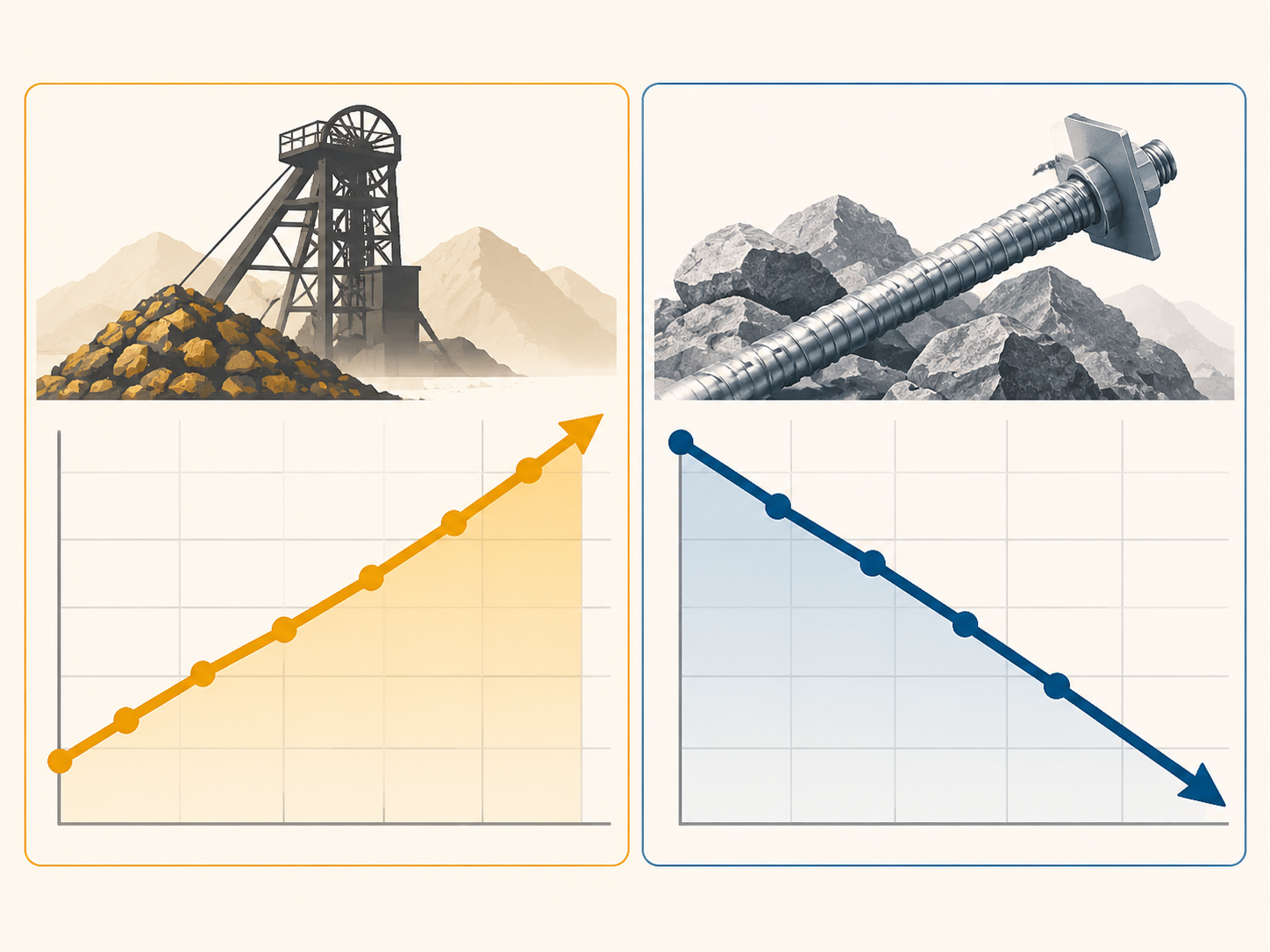
That is the core of the recovery story: existing mines are being kept alive longer, and capital is going into brownfield optimisation, life extension and selective growth rather than a wave of new greenfield tonnage. For support-product suppliers, this is a more relevant signal than a single month's production index. Mine-life extension means more development, more rehabilitation and more recurring consumption of bolts, resin, mesh and plates.
The sector is not a marginal part of the economy. The Minerals Council South Africa estimates that mining and its direct suppliers support nearly 900,000 jobs and the livelihoods of 3.6 million people. That scale is one reason why small changes in mine economics can move procurement budgets across a long supply chain.
Production is still lagging — and that changes the demand mix
The August print was weak across the three largest contributors: PGM output fell 22.5%, iron ore 16.2% and coal 11.7%. Seasonally adjusted output was 11.9% lower than a year earlier. Production for the year to June was still about 5% below 2019 levels. The Minerals Council noted that mineral sales held up even as production fell, which helps explain why revenue and cash flow have recovered faster than tonnage.
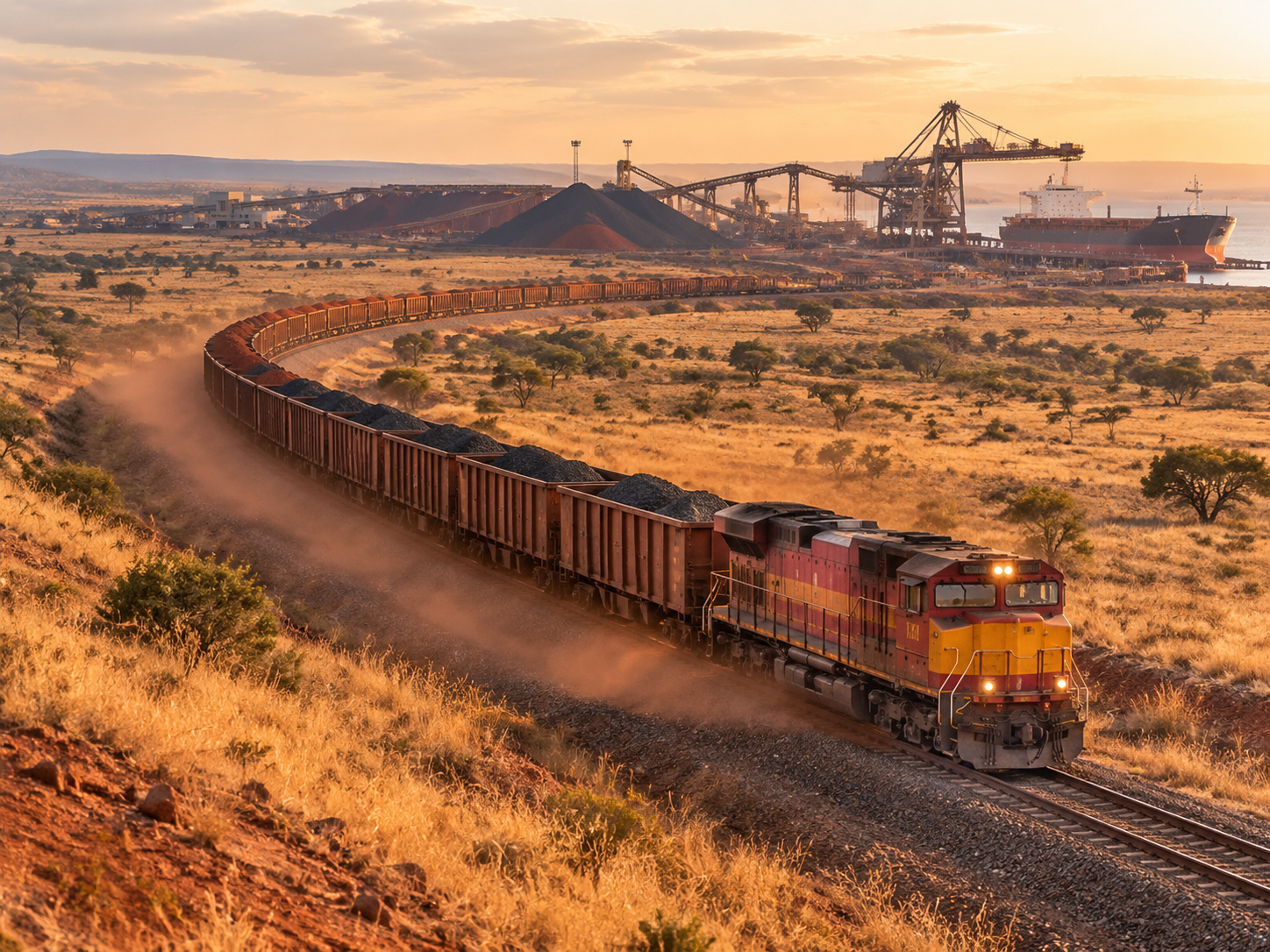
The reasons are structural as well as cyclical. Transnet Freight Rail moved 167.9 million tonnes in the year to March, up 4.9% but still far below the 226 million tonnes moved in 2017/18; coal deliveries reached 58.5 million tonnes against a 65-million-tonne export-corridor target. The Minerals Council has welcomed the stabilisation of rail performance and the improvement in electricity supply — no load-shedding since May 2025 — but regulatory uncertainty remains, including the Mineral Resources Development Bill and the national rollout of the new mining cadastre. In October 2026 the Council launched an investment and growth strategy for the sector, arguing that regulatory certainty and exploration are prerequisites for a durable recovery .
Exploration is another reminder that the recovery is incomplete. Exploration expenditure was R781-million in 2024, down from a peak of R6.2-billion in 2006. A durable recovery would need that trend to reverse. If it does, it would create a later wave of project demand — but it is not yet a source of near-term consumable volume.
The recovery is also uneven by asset. De Beers paused mining at Venetia for two years in 2026, while African Rainbow Minerals approved R15.2-billion for the Bokoni platinum project and R753-million to restart Nkomati. A national recovery narrative can hide very different project-level realities.
For support demand, the important point is that consumption is not a simple function of tonnes hoisted. It is driven by:
- metres of development and rehabilitation;
- depth, stress and ground condition;
- the support design approved for each mining area;
- replacement and consumption cycles for bolts, resin, mesh and accessories;
- safety and compliance requirements; and
- the number of active headings and the installation method used.
A mine that produces flat tonnage from deeper, older workings can consume more support per tonne than a younger, shallower operation. That is why a flat production year can still be a growth year for the right support products.
Safety is part of the demand story
The recovery in prices has not been matched by a recovery in safety performance. South Africa recorded 41 fatalities in 2025, the lowest annual total on record. But between January and August 2026, 44 mineworkers died, compared with 32 in the same period of 2025 — an increase of 37.5% — and platinum alone recorded 17 deaths, above its full-year 2025 total of 11. Falls-of-ground fatalities fell from 12 to five, and reportable injuries fell 13.9%, but general-accident fatalities rose from seven to 21. Only 27% of 111 registered mines reported full implementation of risk-management systems.
For support-product buyers, the implication is not that ground support has failed. It is that safety performance is uneven, and the mines and contractors under scrutiny will need to demonstrate that the support installed is the support specified. That favours suppliers who can provide batch traceability, test records, consistent dimensions and installation data — not just a low unit price.
Five opportunity areas in South Africa
1. Deep-level gold and PGM development
South Africa's gold and PGM sectors include some of the world's deepest underground operations. High stress, seismicity and poor ground conditions place a premium on support systems that are designed, tested and installed as a system — not as a collection of interchangeable parts. Cable bolts, mesh, resin-anchored bars, friction bolts and plates all have a role, but the selection must follow the mine's rock-engineering design. Where the design calls for dynamic or energy-absorbing support, the supplier must be able to demonstrate that the proposed product and assembly have the relevant evidence; a standard static bolt should not be presented as a substitute.
2. Mine-life extension and brownfield optimisation
The increase in reserves and mine life is one of the most under-reported parts of the recovery. Life extension means rehabilitation of older roadways, new development to access deeper or lateral reserves, and replacement of worn support. This is recurrent, specification-heavy demand: split sets, mesh, plates, nuts, resin and cable bolts, often in mixed quantities and with short lead times.
3. Restarts and expansions
Bokoni is the clearest current example: a R15.2-billion underground PGM development that is expected to require development headings, support consumables and a procurement programme long before first production. Restarts are demanding for suppliers because they combine project quantities with an installed base that may still be running older equipment and standards.
4. Mechanised bolting and installation productivity
As mines push productivity, the interface between bolt, resin and rig becomes a procurement issue. A bolt that meets the drawing but does not feed, spin or hold correctly in the available rig can cost more in downtime than it saves in unit price. Buyers are likely to ask for coupler compatibility, resin working time, thread definition, bar straightness and packaging that suits the machine — not just a diameter and length.
5. Logistics and supply security
Rail and port constraints have made supply continuity a planning issue. Buyers are more likely to consolidate orders, hold buffer stock and ask suppliers to plan around port congestion and inland transport. For an export supplier, that means quoting a realistic delivery programme, stating the Incoterm clearly, and being able to ship mixed product families in one container without compromising packaging or traceability.
What South African buyers are likely to prioritise
For many buyers, the procurement conversation is shifting from "price per bolt" to "cost per installed metre". That does not mean price is unimportant; it means price is evaluated together with installation time, rework, stockouts and documentation.
| Priority | Why it matters | What to ask |
|---|---|---|
| Installed cost per metre | Labour, resin and downtime can outweigh the bolt price | Cycle time, installation method, accessories included |
| Compatibility | Bolt, resin, plate, coupler and rig must work as a system | Drawings, thread data, rig interface, working time |
| Traceability | Mine approval and quality systems require batch and test records | MTC 3.1, batch marking, test report scope |
| Corrosion protection | Design life and water chemistry vary by mine | Coating type, thickness, repair of damaged coating |
| Supply continuity | Rail and port constraints can disrupt schedules | Stock policy, lead time, mixed-container capability |
| Technical support | Site teams need answers, not just a catalogue | Selection support, installation guidance, response time |
Product families that fit the current cycle
The table below summarises the CQ Rockbolt catalogue ranges that are most relevant to South African underground mining. The ranges are catalogue references, not a substitute for the mine's approved design.
| Product family | Typical CQ range | Where it fits | Buyer checks |
|---|---|---|---|
| Split Set friction bolts | 33/39/46 mm; 0.9–3.0 m | Development headings, roof and rib support where immediate load-bearing is required | Hole diameter, tube length, plate, installation method |
| Swellex-type expandable bolts | 22–32 mm; 1–6 m; 0.5–2.5 MPa expansion | Fractured ground where water inflation suits the cycle | Pump and head compatibility, expansion pressure, coating |
| Self-drilling hollow bars | R25/R32/R38/R51/T76; 550 MPa tensile, 350 MPa yield; 2–6 m | Broken, weak or faulted ground; simultaneous drilling and grouting | Bit diameter, coupler, grout pressure, rig torque |
| Cable bolts | 15.2/17.8/21.6 mm; 1860 MPa; 260–530 kN breaking load | Large spans, high-stress hangingwall, reinforcement of deep workings | Anchorage type, grout, tensioning, corrosion protection |
| Resin capsules | 28–45 mm holes; fast/medium/slow; at least 60 MPa compressive strength | Resin-anchored bolts in development and rehabilitation | Working time, temperature, shelf life, borehole condition |
| Plates, nuts, mesh, straps, couplers, PT bars | Dome/hex/flange nuts; welded or woven mesh; 25/32/40 mm PT bars up to 830 MPa | Complete system supply and mixed consignments | Drawing, coating, thread match, packaging, batch marking |
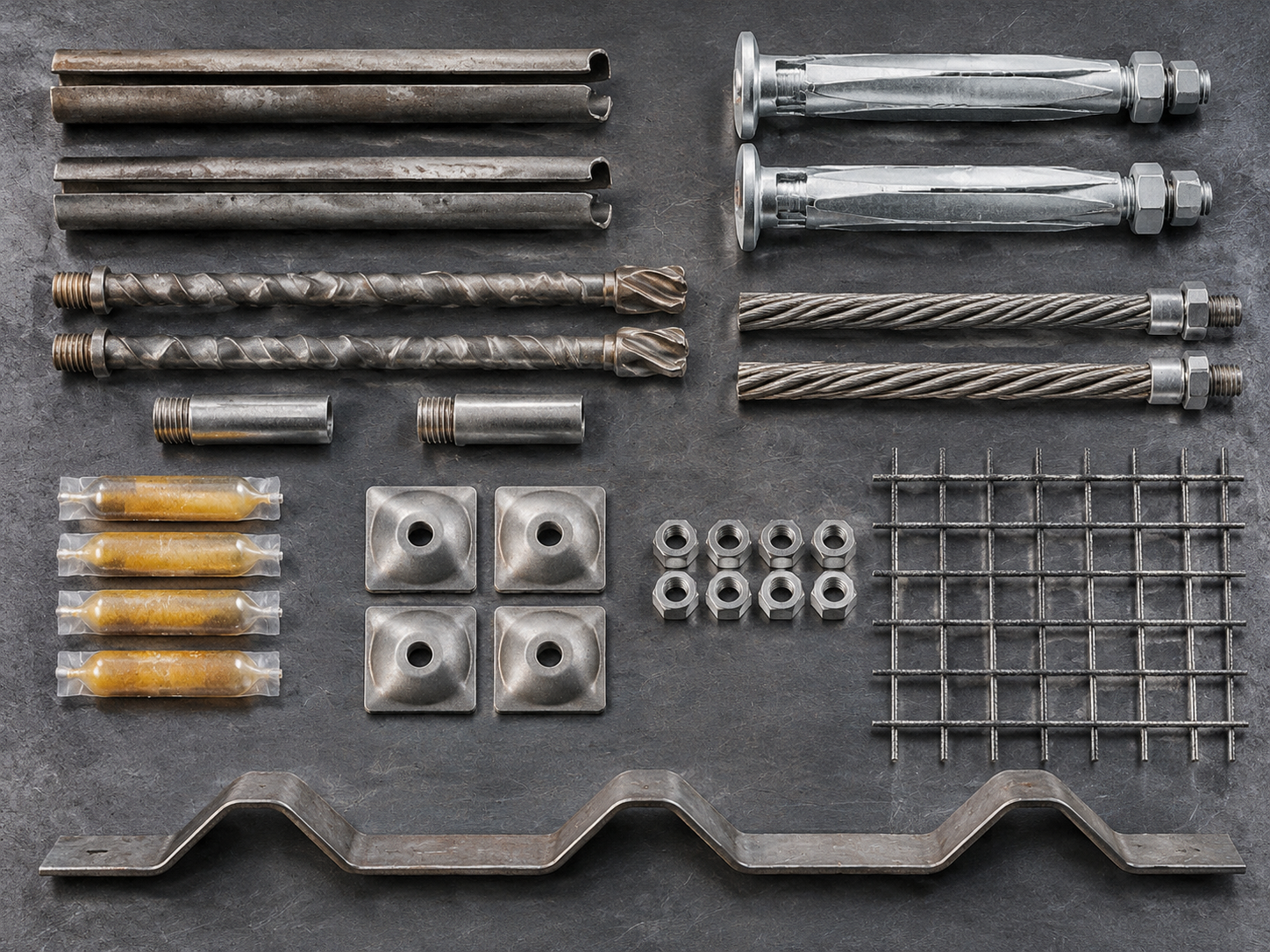
The value of a multi-family catalogue is not that one supplier can quote everything. It is that the interfaces can be checked together: a bolt with the right plate, a coupler with the right thread, a resin with the right working time for the rig, and a mesh and strap arrangement that matches the support design. For a closer look at the rig interface, see our guide to mechanised rock bolting compatibility.
A practical RFQ checklist for South African projects
A quotation is only comparable when it is based on the same inputs. Before requesting prices, send:
- The mining area and ground condition: rock type, strength, fracturing, water, stress and any history of falls of ground.
- The approved support design: bolt type, pattern, length, orientation and accessories. Do not ask a supplier to design the support system from a catalogue.
- Borehole diameter and drilling method, including any specified bit diameter.
- The installation equipment: rig make and model, feed length, torque, pump and grout or resin system.
- The required bar, thread, coupler and plate specification, with drawings where available.
- Corrosion protection and design life: galvanising, epoxy, coating thickness and repair requirements.
- Test and documentation requirements: material certificate, tensile test, pull test, coating test and batch traceability.
- Packaging, marking and shipping marks, including mixed-container or pallet requirements.
- Quantity by item, delivery schedule, destination port and Incoterm.
- Any mine approval, vendor registration or local-content requirement that the supplier must meet.

A supplier that cannot answer these questions for the exact configuration is not yet offering a comparable quotation. For a broader view of when self-drilling systems suit broken ground, see our article on why self-drilling anchor rock bolts are used in mining.
How CQ Rockbolt can support the programme
CQ Rockbolt is the international brand of Handan Changqi Metal Products Co., Ltd, a Chinese manufacturer of rock bolts and mining ground-support products. The company reports more than 15 years in the industry, exports to more than 60 countries, and operates an ISO 9001:2015 quality management system. Its catalogue covers split set friction bolts, Swellex-type expandable bolts, self-drilling hollow bars, cable bolts, resin capsules, PT bars, plates, nuts, mesh, straps and couplers — a range that allows a project to consolidate several support items with one supplier.
For South African buyers, the practical advantages are:
- factory-direct pricing and OEM/ODM customisation;
- catalogue and custom lengths, diameters, threads and coatings;
- export documentation including MTC, certificate of origin and third-party inspection support;
- one technical and commercial channel for multiple product families; and
- technical support on selection and installation interfaces.
These advantages do not replace project approval. Local stock, mine-specific approval and service coverage should be confirmed in writing for each project. The correct starting point is the mine's specification, the approved drawings and a documented quotation that states what is included, what is excluded and what evidence is provided.
To discuss a South African project, send the support design, drawings, quantities, delivery port and document requirements to the CQ Rockbolt team.
Related News
Other news you might be interested in

Self-Drilling Anchor Bolts for Water-Conveyance Tunnel Reinforcement
Self-drilling anchor bolts are useful for water-conveyance tunnel reinforcement when broken or water-bearing ground makes conventional drill-and-insert bolting difficult. By using a hollow threaded bar as both the drilling member and the permanent reinforcement, the system removes the separate bolt-insertion step and provides a channel for grouting through the same bar.For a water-conveyance tunnel, that installation advantage matters. Headrace, tailrace, diversion, irrigation and water-supply tunnels can pass through fault zones, weathered rock, weak interlayers and interconnected fractures. Groundwater may enter the excavation, boreholes may deteriorate after drilling, and support must be coordinated with drainage, waterproofing and the final lining.

What Is a Split Set Mining System and How Is It Different from Other Rock Bolts?
A split set is often described as a rock bolt, but in mining it is more useful to think of it as a support system. The steel tube is the most visible part. The way it performs also depends on the drilled hole, the bearing plate, the installation adapter, the drilling equipment, the surface support and the checks made underground. That distinction matters when a project compares rock bolts. Two quotations can list a similar diameter and length, yet propose different load-transfer mechanisms, different hole requirements and different installation procedures. A split set is not a resin bolt with the resin removed. It is not a mechanical expansion-shell bolt, a self-drilling hollow bar, a water-inflatable tube or a cable bolt. Each product family solves a different part of the ground-support problem.
Want to know more?
Get in touch with us for more information about our services and products.