

Active vs. Passive Anchors: How to Choose the Right Ground Support System

Dayang Yang
AuthorWith over 15 years of experience in the production and sales of ground anchoring and mining support products, we operate our own rock bolt and accessory manufacturing facility with stable large-scale production capacity. We are specialists in rock bolts, resin cartridges, anchor cables, bearing plates, and customized ground anchoring products for mining support and geotechnical anchoring solutions.
A ground support system can fail for a simple reason: the team selected a product by name before deciding how the load should develop. Two anchors may look similar in a catalog, use the same diameter, and carry the same nominal steel grade, yet behave very differently underground. One is tensioned against the rock immediately after installation. The other begins to carry load only when the rock mass starts to move.
That difference is what "active" and "passive" should describe. It is not a quality ranking. It is not a choice between modern and old-fashioned support. It is a choice about timing, displacement and load path.
In this article, "anchor" includes rock bolts, cable bolts and ground anchors. The aim is to give engineers, contractors and technical buyers a practical way to compare active and passive systems before a support design is fixed, before an RFQ is issued, and before a supplier is approved.
Quick answer
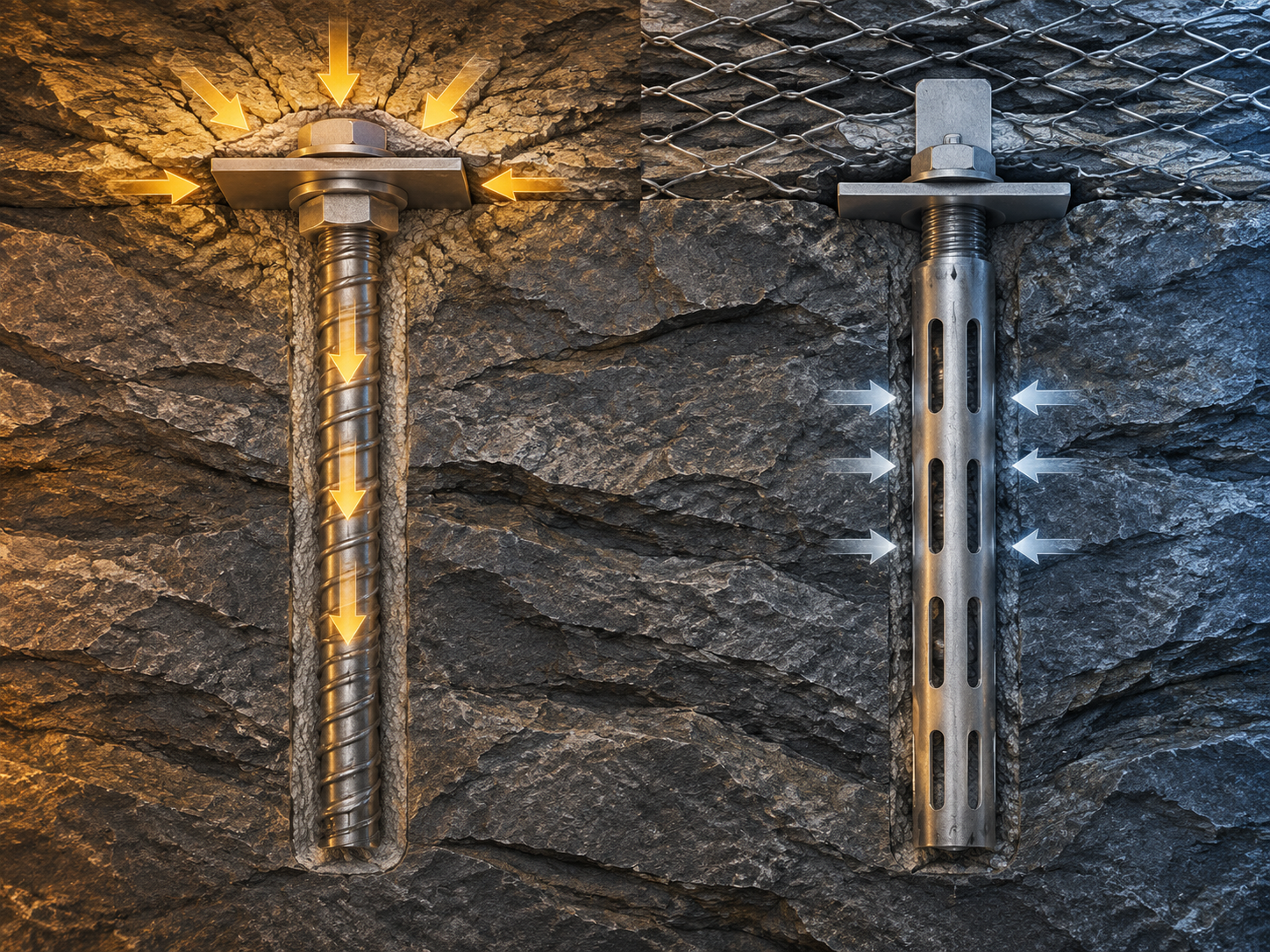
- An active anchor is tensioned or preloaded after installation and locked against a plate. It applies force to the rock before significant movement occurs.
- A passive anchor is not preloaded. It develops load as the rock mass deforms, dilates or shears.
- "Immediate load transfer" is not the same as "active." A Split Set or Swellex bolt can contact the hole and carry load quickly without being a prestressed tendon.
- "Grouted" is not the same as "passive." A resin bolt can be tensioned after the resin reaches sufficient strength.
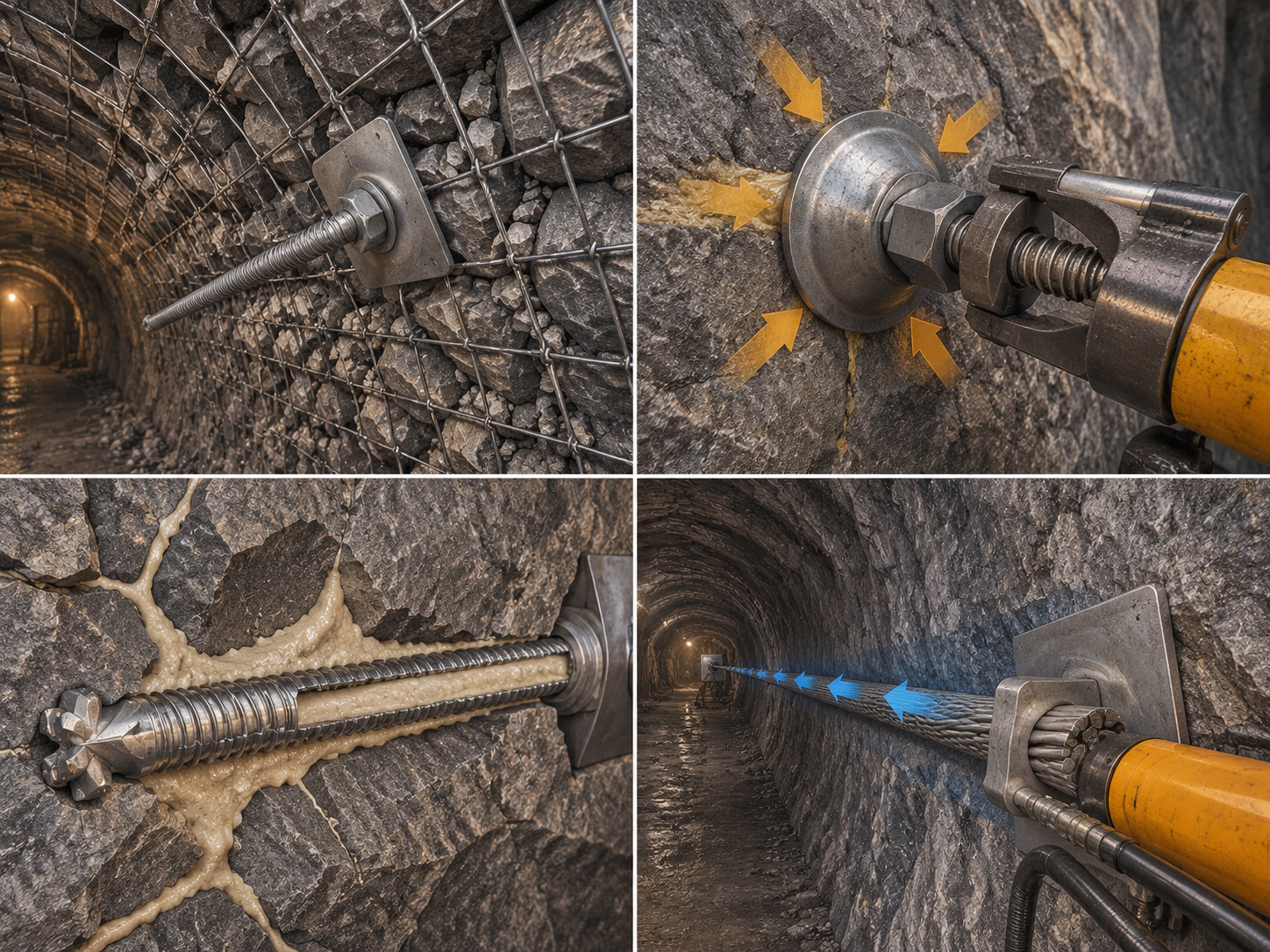
- Most real support systems are hybrid: active bolts preload the rock, passive mesh and straps retain loose blocks, and passive or active tendons reach deeper.
- Active is not automatically better. Passive is not automatically cheaper. The right choice depends on the failure mode, the allowed displacement, the anchorage medium, the surface support, the available equipment and the evidence the project requires.
The terminology problem: two different meanings of "active"
The words "active" and "passive" are used in two different ways in underground support. Mixing them leads to bad comparisons.
The first definition is about load timing. An active support element applies load to the rock mass before the rock moves. A passive element reacts to movement. This is the definition used in this article.
The second definition is about support element type. Some mining texts call rock bolts "active support" and call mesh, shotcrete, straps and arches "passive support." That usage is common, but it is not consistent. A fully grouted rebar bolt is a bolt, yet it behaves passively. A tensioned cable is also a bolt-type tendon, but it behaves actively. Mesh is passive, but it is not an anchor.
For procurement, the load-timing definition is more useful. It forces the team to ask:
- Is the anchor tensioned after installation?
- Is the tension measured and locked off?
- Does the rock mass need to move before the anchor develops its design load?
- Is the support system designed to control movement, tolerate movement, or both?
Those questions matter more than the product family name.
"Immediate" does not mean "active"
A Split Set friction bolt grips the hole wall along its slotted tube. It can carry load shortly after installation, without grout and without a long curing period. That is valuable in a development heading where the roof must be supported quickly. But the bolt is not tensioned against the rock in the same way as a prestressed bar. Its load develops through radial friction and rock movement. It is normally classified as passive.
Swellex works in a similar procurement conversation. The tube is inflated against the hole wall, creating immediate contact and friction. It is not a prestressed tendon. It is a passive system with fast installation and good contact in certain ground.
Immediate contact is an installation advantage. It is not the same as preload.
"Grouted" does not mean "passive"
A fully grouted rebar bolt is passive. The grout bonds the bar to the rock along its length, and the load develops as the rock deforms and shears the bond. There is no deliberate preload.
A resin bolt can be different. The resin anchors the bar, but after the resin reaches sufficient strength, the nut can be tensioned against a plate. If the project specifies and records that tension, the bolt is acting as an active anchor. If it is installed with a plate and nut but never tensioned, it is passive in behavior.
The same logic applies to mechanical expansion shell bolts. The shell provides a mechanical grip in the hole. The bolt becomes active only when the nut is tightened against the plate to develop a preload. Without that step, it is a passive mechanical anchor.
"Cable" does not mean "active"
A fully grouted cable bolt is passive. It bonds along its length and carries load as the rock mass moves. A prestressed cable bolt is active. It is anchored at the far end, tensioned at the collar, and locked against a bearing plate. The same product family can therefore sit on either side of the line, depending on the design and installation procedure.
| Product family | Common behavior | Why | What the buyer must confirm |
|---|---|---|---|
| Split Set friction bolt | Passive | Radial friction along the tube; load develops with rock movement | Hole diameter, tube fit, plate, installation method |
| Swellex expandable bolt | Passive | Inflation creates contact and friction; no deliberate preload | Pump, pressure, connection, hole condition |
| Fully grouted rebar bolt | Passive | Bond along the bar; load develops as rock deforms | Hole diameter, grout, bond length, cure |
| Resin bolt, not tensioned | Passive | Resin anchors the bar; no preload | Resin type, annulus, gel time, plate seating |
| Resin bolt, tensioned after cure | Active | Preload applied through nut and plate | Resin strength at tensioning, torque/tension, plate |
| Expansion shell bolt, not tensioned | Passive | Mechanical grip only | Shell size, hole diameter, seating |
| Expansion shell bolt, tensioned | Active | Preload applied through nut and plate | Shell grip, torque/tension, plate |
| Self-drilling hollow bar, not tensioned | Passive | Grout bond and bar; load develops with movement | Bit, grout, coupling, plate |
| Self-drilling hollow bar, tensioned | Active | Preload through plate and nut | Grout strength, tensioning, plate |
| Fully grouted cable | Passive | Bond along the strand | Grout, bond length, anchor detail |
| Prestressed cable | Active | Tensioned and locked against a plate | Anchor, wedge, plate, grout, tensioning |
| PT bar | Active by design | Threaded bar tensioned against a plate | Thread, coupler, anchor, tensioning |
| Mesh, strap, shotcrete, arch | Passive surface support | Reacts to rock movement; retains or confines | Overlap, fixing, thickness, compatibility |
The table is a starting point, not a specification. The installation procedure decides the actual behavior.
The load path: why the label is not the whole story
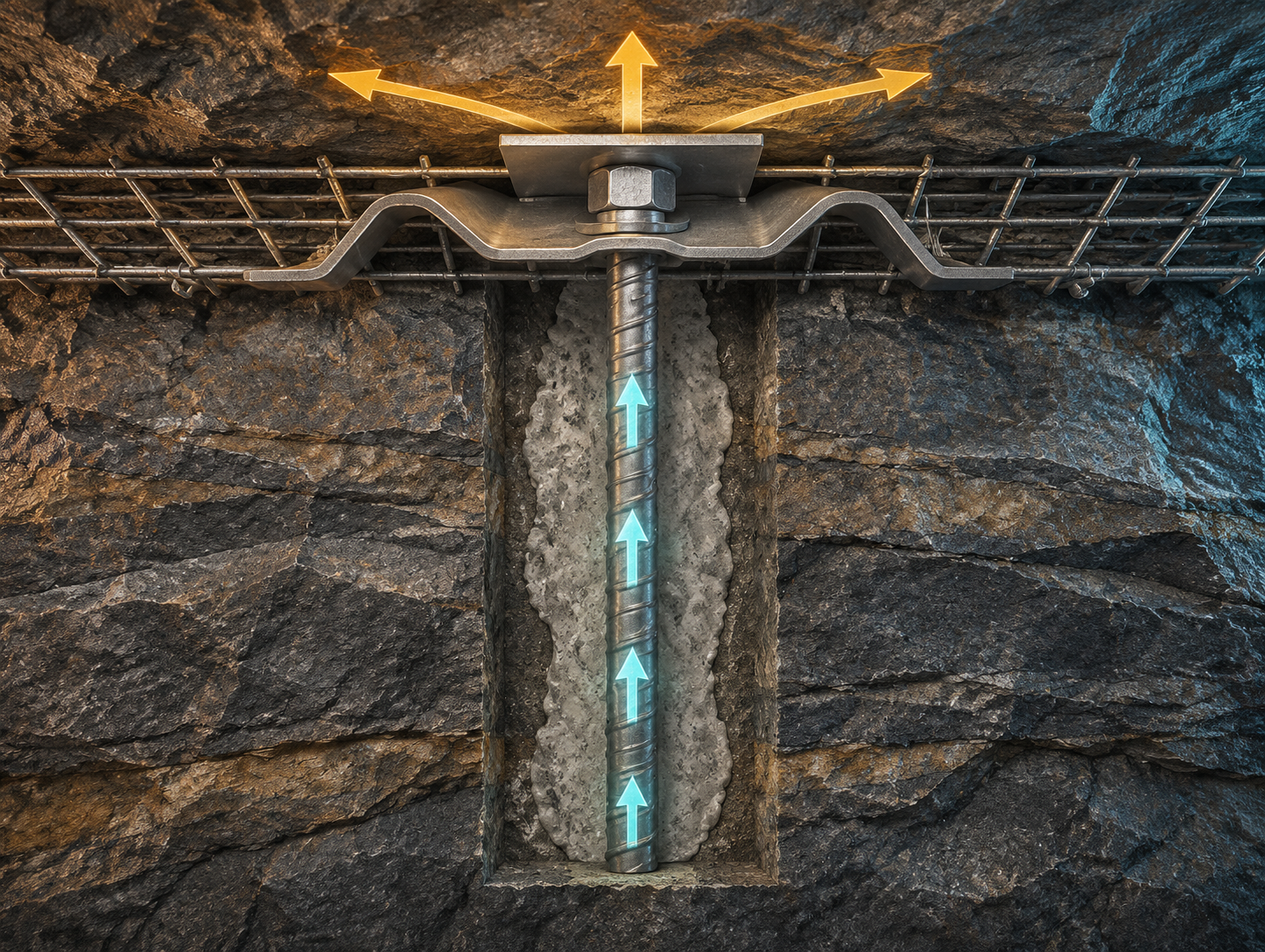
An anchor does not support the rock by itself. It completes a load path. For a typical bolted excavation, that path runs from the rock mass, through the anchorage, into the bar or strand, through the plate and nut or anchor head, and into the surface support.
Passive path: rock movement → plate and bar → anchorage → rock mass. The anchor becomes loaded because the rock tries to move.
Active path: tensioning force → plate → compression of the rock surface → anchorage → rock mass. The anchor loads the rock before significant movement.
Surface support path: loose block → mesh, strap, shotcrete or arch → adjacent rock and bolts. Surface support is mostly passive. It retains small blocks and spreads local load, but it does not prestress the deep rock mass.
The weakest link governs. A high-strength bar with a small plate can punch into the rock. A strong plate on a weak, broken surface can rotate and lose contact. A tensioned bolt with a poor anchorage can lose its preload. A passive bolt with a loose plate may not engage the surface at all. A mesh panel with inadequate overlap can unravel at the edge.
This is why active and passive cannot be compared on the anchor alone. The comparison must include the plate, nut, washer, anchor head, grout, surface support, installation procedure and corrosion protection.
What passive systems do well
Passive support is not a low-grade option. It is often the most practical choice for the first hours of an excavation, for ground that will move, and for surface retention.
Immediate restraint of loose rock
A passive friction bolt can be installed quickly and can grip the hole before grout cures. In a development heading, that speed matters. Mesh and straps can then retain small blocks between bolts. The system does not need to prestress the rock to be useful; it needs to connect the surface to the anchor and tolerate the movement that follows.
Displacement tolerance
Passive systems can be designed to yield. A friction bolt can slide, a yielding mesh can deform, and a steel arch can deflect. In squeezing ground or a rockburst-prone environment, that displacement capacity can be more important than static strength. A stiff active bolt that cannot tolerate movement may break before a more compliant passive system has used its capacity.
Simplicity and speed
Passive friction bolts and expandable bolts do not require grout mixing or curing. They can be installed with relatively simple equipment. In a narrow heading or a remote site, that simplicity can reduce downtime and improve cycle time.
Good fit for broken or variable ground
In highly fractured ground, a fully grouted passive bolt can transfer load along its length and help hold the rock mass together. A friction bolt can grip a rough hole. A mesh and strap system can retain small blocks that no single bolt can catch. The passive system is often the base layer on which active tendons are added.
Limits of passive support
Passive support needs movement to develop load. If the design requires the rock to be compressed before it can loosen, a purely passive system may allow too much initial deformation. Passive bolts are also sensitive to hole quality. A friction bolt that is too loose in the hole, or a grouted bolt with a poor annulus, may never develop its expected capacity. Mesh and straps do not replace deep anchorage.
What active systems do well
Active support changes the stress state of the rock mass. It does not make the rock stronger in the laboratory sense. It increases the normal stress across discontinuities, improves friction and shear resistance, and reduces the chance that bedding planes or joints open and dilate.
Preloading the rock before movement
A tensioned bolt or cable pulls the surface plate against the rock and transfers a compressive force into the rock mass. That preload can:
- increase friction along joints and bedding planes;
- reduce separation of layers;
- limit dilation and loosening;
- improve the "beam" or "arch" effect in layered or blocky ground;
- reduce roof sag and surface movement under service load.
The benefit depends on the anchorage. If the anchor cannot hold the tension, the preload is lost. If the plate seats on a loose surface, the preload is not transferred. If the rock creeps or relaxes, the load can drop over time.
Long tendons and high capacity
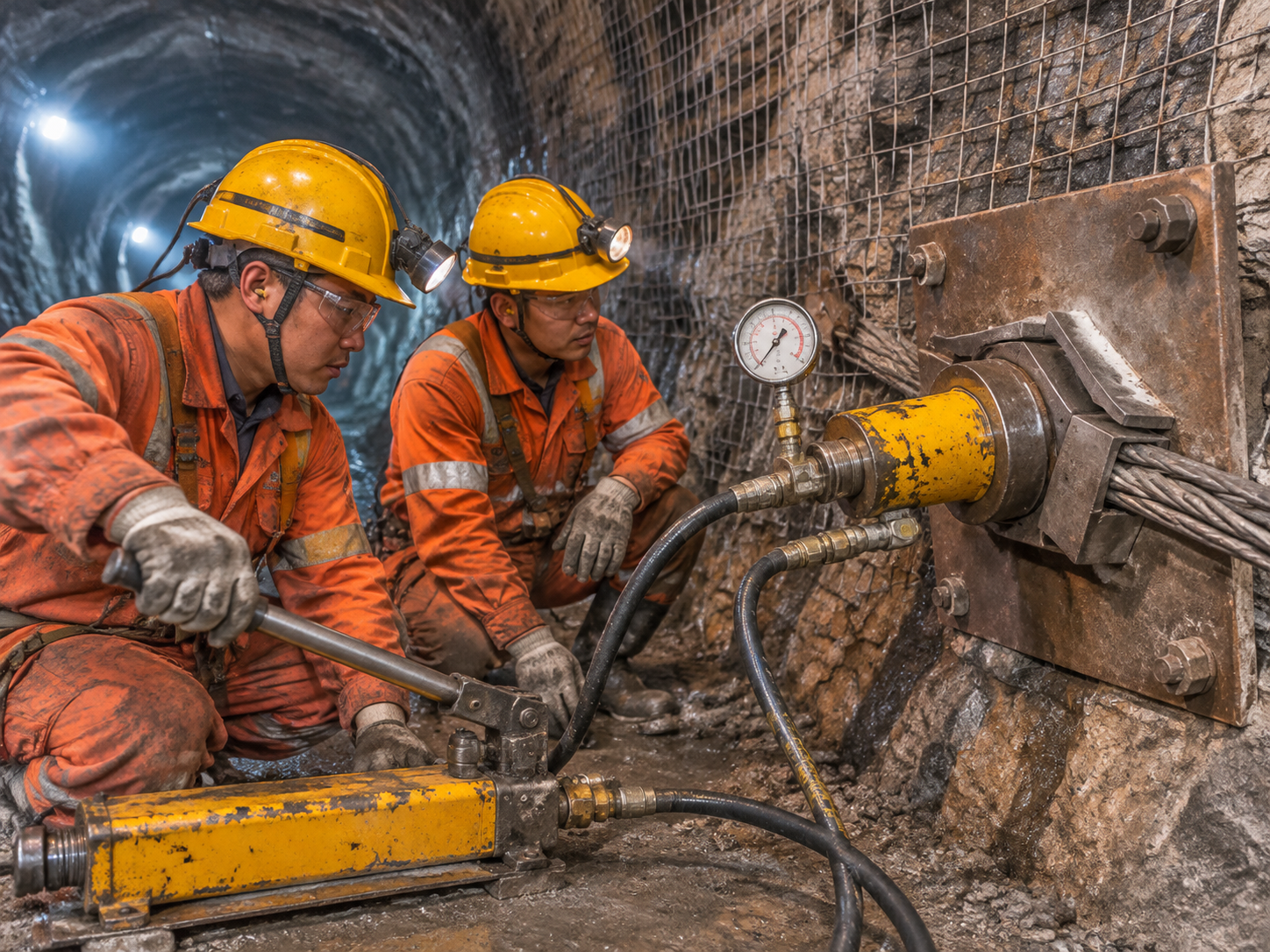
Prestressed cables and PT bars can reach beyond the immediate loosening zone. A cable is flexible and can be coiled for transport; a PT bar is rigid and threaded and can be coupled for long holes. Both can carry high loads and can be tensioned against a bearing plate. They are common where a shallow bolt cannot reach competent ground or where a large span needs a high-capacity tendon.
Controlled deformation in permanent works
In permanent tunnels, shafts, caverns and deep mining, active support can help control the initial deformation and reduce the risk of progressive loosening. It can also provide a known preload that can be checked and recorded. That record is useful for acceptance, for comparing suppliers and for investigating later movement.
Limits of active support
Active support is not a universal solution. It requires:
- a competent anchorage zone;
- a plate that can transfer the load without punching or bending;
- a tensioning method that is calibrated and understood;
- a locking detail that holds the load;
- corrosion protection for the exposed head and the anchorage;
- a rock mass that can accept the preload without excessive damage.
In very weak, broken or squeezing ground, a high preload may not be achievable, or it may be lost quickly. In rockburst-prone ground, a stiff active bolt may not have the displacement capacity the system needs. Active support must be matched to the ground, not simply specified because it sounds stronger.
Selection matrix by failure mode
The fastest way to choose is to start with the failure mode, not the product. The table below is a practical screening guide. It does not replace the project design.
| Failure mode or ground condition | Support objective | Typical first choice | Why | What to confirm |
|---|---|---|---|---|
| Loose surface blocks after development blast | Retain small blocks; support the face quickly | Passive friction bolt + mesh | Fast installation; immediate surface restraint; tolerates movement | Hole diameter, tube fit, plate, mesh overlap |
| Blocky, jointed rock | Clamp blocks; increase friction on joints | Active tensioned bolt (resin or mechanical) + mesh | Preload increases normal stress and friction | Anchorage capacity, tension/torque, plate seating |
| Layered roof or bedded strata | Prevent layer separation; build a beam | Active tensioned bolts + strap/mesh | Preload compresses layers and improves beam action | Bolt length/angle, tension, strap coverage |
| Weak, fractured or collapsing ground | Drill and support without losing the hole | Self-drilling hollow bar + grout, tension if required | Drilling and grouting in one pass; grout fills fractures | Bit, grout, coupling, plate, tensioning |
| Deep, high-stress or large-span opening | Reach beyond the loosening zone; carry high load | Prestressed cable or PT bar + surface support | Long tendon, high capacity, active preload | Anchor length, bond, anchor head, tensioning, corrosion |
| Squeezing or rockburst-prone ground | Tolerate displacement; absorb energy | Yielding passive system + energy-absorbing elements | Displacement capacity matters more than static strength alone | Dynamic/yield test evidence, system compatibility |
| Permanent support in corrosive water | Maintain load and section over design life | Grouted or prestressed tendon with corrosion protection | Long-term durability; protected anchorage and head | Coating, grout, drainage, design life, inspection |
| Surface between bolts | Retain small blocks; spread load | Mesh, strap, shotcrete or arch | Passive surface support connects blocks to the system | Wire diameter, opening, overlap, fixing, thickness |
The matrix has one clear message: most good systems combine active and passive elements. Active bolts preload the rock. Passive mesh and straps retain the surface. Passive or active tendons reach deeper. The combination is the system.
Seven questions that decide the system
What is the failure mode?
Is the problem a loose block, a bedding plane, a shear zone, a squeezing roadway, a rockburst, or a large-span opening? The failure mode determines whether the system needs preload, displacement capacity, surface retention, or deep anchorage. A bolt that is excellent for one mode may be poor for another.
When must the support act?
If the roof must be supported immediately after the blast, a passive friction bolt and mesh may be the right first pass. If the design requires the rock to be compressed before it loosens, an active bolt or cable may be needed. The sequence matters: install, tension, grout, mesh and shotcrete in the correct order.
How much displacement must the system tolerate?
A stiff active bolt in a squeezing roadway may reach its limit before the rock has finished moving. A yielding passive system may tolerate more displacement. The design must compare the support's load-displacement curve with the expected rock movement, not just the peak load.
What can the anchorage medium provide?
A tensioned bolt needs an anchorage that can hold the preload. In competent rock, a mechanical shell or resin anchor may work. In weak, broken ground, a grouted hollow bar or a long cable may be needed. If the anchorage is in the wrong zone, a longer bolt does not necessarily help.
What surface support is needed?
Anchors alone do not catch small blocks between them. Mesh, straps, shotcrete or arches are needed to retain the surface and spread load. The surface support must be compatible with the bolt spacing, plate size and expected movement.
What equipment and skills are available?
Active support requires tensioning equipment, calibration and records. Passive friction bolts require a drill that can produce the correct hole diameter and a suitable installation method. A system that cannot be installed consistently with the available equipment is not a good system, even if it performs well in a catalog.
What evidence does the project require?
Does the project require a pull test, a tensioning record, a material certificate, a corrosion test, a dynamic test, or a trial section? The evidence requirement should be defined before the supplier is selected. A product that cannot provide the required evidence is not qualified, regardless of its nominal capacity.
Common errors in active vs. passive selection
Treating active as automatically better. Active support is only as good as its anchorage, plate, tensioning and load retention. A tensioned bolt with a poor anchor can lose its preload and perform worse than a well-installed passive bolt.
Treating passive as automatically cheaper. Passive systems often need more surface support, more installation labor and more maintenance. The total cost includes mesh, straps, shotcrete, rework and rehabilitation, not just the bolt price.
Calling immediate load transfer "active." Split Set and Swellex can carry load quickly, but they are not prestressed tendons. The distinction matters when the design requires preload.
Calling a grouted bolt "passive" without checking the installation. A resin bolt can be tensioned after cure. A self-drilling bar can be tensioned against a plate. The installation procedure decides.
Comparing unit price only. A low-cost bolt that needs more accessories, more installation time or more surface support may be more expensive in place. Compare the installed system, not the piece price.
Ignoring preload loss. Preload can be lost through rock relaxation, creep, poor plate seating, corrosion, or movement. The design should state how the load is checked and what happens if it is low.
Using a stiff active bolt in yielding ground. If the rock needs to move, a stiff bolt may break or lose load. A yielding system may be more appropriate.
Using passive bolts without surface support. A passive bolt may hold a block, but it does not catch every small block between bolts. Mesh and straps are part of the system.
Testing the steel but not the system. A material certificate does not prove the anchor, plate, grout and installation work together. Ask for the test that matches the system.
Installation, testing and evidence
Active anchors
The critical installation steps are:
- confirm the anchor is in the specified anchorage zone;
- confirm the plate seats on a sound surface;
- tension in the specified stages;
- record the tension and, where required, the elongation;
- lock off the load;
- protect the exposed head and the anchorage against corrosion;
- re-check the load where the design requires it.
Torque is not the same as tension. A torque wrench measures the resistance of the thread, nut and plate, not the force in the bar. For critical anchors, the project should specify a tensioning method, a calibration procedure and an acceptance tolerance. A supplier's catalog torque value is not a substitute for the project's installation procedure.
Passive anchors
The critical installation steps are:
- drill the specified hole diameter and depth;
- clean the hole where the anchor type requires it;
- install the anchor to the specified depth;
- seat the plate against the rock surface;
- for grouted anchors, confirm the grout mix, volume and cure;
- for friction bolts, confirm the tube fits the hole and the plate is in contact;
- for mesh and straps, confirm overlap, fixing and tension.
A passive bolt can be installed with the correct steel and still fail to carry load if the hole is too large, the plate is loose, the grout is incomplete, or the anchor is not in the right zone.
Testing
A pull test is a sample check of the installed anchor. It does not prove that every anchor in the heading is correct, and it does not prove the long-term performance of the system. The test load, frequency and acceptance criteria must come from the project design.
ASTM D4435 provides a standard test method for rock bolt anchor pull tests. ASTM F432 covers roof and rock bolts and accessories, including bearing plates and washers. ISO 22477-6:2026 addresses testing of anchors and gives a framework for test types, equipment, procedures and records. These documents support the test; they do not set the acceptance value for a particular mine or tunnel.
For a useful test record, include:
- the project, heading and hole location;
- the anchor type, diameter, length and batch;
- the hole diameter and depth;
- the installation date and installer;
- the test equipment and calibration;
- the test load, displacement and failure mode;
- the acceptance criterion and result;
- any repair or replacement.
RFQ checklist
A comparable quotation starts with a clear support task. Send the following information to each supplier and ask for the exact product datasheet, not a generic catalog page.
| Item | What to state | Why it matters |
|---|---|---|
| Ground condition | Rock type, jointing, bedding, weakness zones, water, squeezing or rockburst history | Selects the failure mode and support concept |
| Failure mode | Loose block, layer separation, shear, squeezing, dynamic, surface retention | Defines whether preload, displacement or surface support is needed |
| Support objective | Temporary or permanent; control movement or tolerate movement | Sets the design philosophy |
| System type | Active, passive or hybrid; sequence of installation | Avoids comparing systems that work in different ways |
| Design load | Axial load, shear, preload, dynamic load, factor of safety | Defines the tendon and anchorage |
| Hole | Diameter, depth, angle, drilling method, deviation | Controls fit, annulus and anchorage |
| Anchorage | Anchor type, bond length, grout, resin, cure, test | Controls whether the load can be transferred |
| Surface support | Mesh, strap, shotcrete, arch, plate size, spacing | Completes the system |
| Corrosion | Environment, design life, coating, grout, drainage | Selects the protection system |
| Equipment | Drill rig, pump, tensioning jack, calibration | Confirms the system can be installed |
| Evidence | MTC, pull test, tension record, dynamic test, third-party inspection | Defines acceptance |
| Commercial | Quantity, packing, marking, delivery, destination | Makes the quotation comparable |
Ask the supplier to confirm:
- the exact product standard and grade;
- whether the anchor is designed to be tensioned or passive;
- the recommended hole diameter and depth;
- the anchorage length and grout/resin requirements;
- the plate, nut, washer, wedge or coupler;
- the tensioning method and load limit;
- the corrosion protection and expected service life;
- the test reports and traceability documents;
- the installation instructions and limitations.
How CQ Rockbolt products fit
CQ Rockbolt's public catalog includes passive, active and hybrid options. The values below are catalog data; the exact model datasheet, drawing and project specification govern.
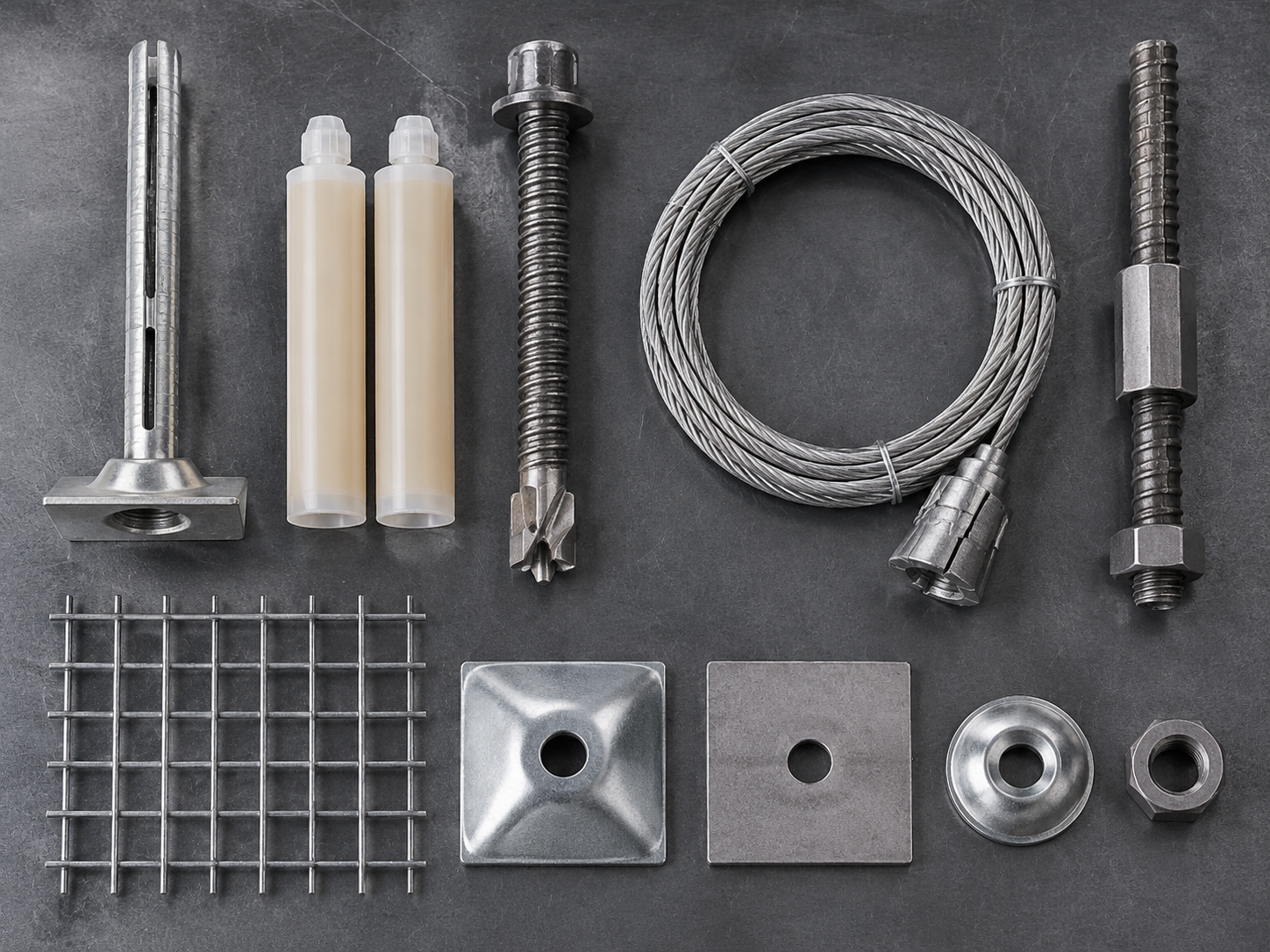
Split Set friction bolts. CQ's Split Set product page describes a passive friction bolt for mine roof and tunnel support, with immediate load-bearing capacity and no grout. The catalog lists 33 mm, 39 mm and 46 mm diameters and lengths from 0.9 m to 3.0 m. Confirm the hole diameter, tube fit, plate and installation method for the specific ground.
Resin capsules and threaded bars. CQ's resin capsule page lists a two-component resin system for bore diameters of 28–45 mm, with fast, medium and slow curing options. A resin bolt is passive if it is installed and left untensioned. It can act as an active anchor if the nut is tensioned after the resin reaches sufficient strength. Confirm the gel time, annulus, cure and tensioning procedure.
Expansion shell mechanical bolts. CQ's expansion shell page describes a mechanical anchor with a shell that grips the hole. The bolt is passive if it is only installed. It becomes active when the nut is tensioned against the plate. Confirm the shell size, hole diameter and plate seating.
Self-drilling hollow grouting bolts. CQ's self-drilling page describes a hollow threaded bar that combines drilling, grouting and anchoring. The catalog lists R25, R32, R38, R51 and T76 bars with matching drill bit diameters. The bar can be passive or active depending on the plate, nut and tensioning procedure. Confirm the bit, grout, coupling and corrosion protection.
Swellex expandable bolts. CQ's Swellex page describes water-inflated expandable bolts for fractured rock, with Mn12, Mn16 and Mn24 models. They are passive systems with immediate contact. Confirm the pump, pressure, connection and hole condition.
Steel strand anchor cables. CQ's cable page lists 1×7 strand in 15.2 mm, 17.8 mm and 21.6 mm diameters, a 1860 MPa grade and minimum breaking loads of 260 kN, 353 kN and 530 kN. A fully grouted cable is passive. A cable that is tensioned and locked against a plate is active. Confirm the anchor, wedge, plate, grout, free length and tensioning procedure.
PT bars. CQ's PT bar page lists 25 mm, 32 mm and 40 mm common sizes, a yield strength up to 830 MPa and a tensile range of 1860–2000 MPa, with ASTM A722 and GB/T 5224 references. PT bars are active by design. Confirm the thread, coupler, anchorage, plate and tensioning method.
Prestressing anchorage systems. CQ's prestressing anchorage page lists single-hole and multi-hole anchorages, wedge-type and threaded anchorages, and a working load up to 2,600 kN depending on configuration, with an anchorage efficiency of at least 95%. These are catalog values. Confirm the bar or strand match, the wedge and barrel, the plate and the system test.
Prestressing wedges. CQ's prestressing anchor wedge page lists wedge-type anchorage components for prestressing systems. A wedge is not a universal part. Confirm the strand diameter, taper, hardness, barrel and system compatibility.
Mining wire mesh. CQ's mining wire mesh page lists welded and woven mesh, wire diameters of 3–8 mm and mesh openings of 50×50 to 150×150 mm. Mesh is passive surface support. Confirm the wire, opening, panel size, overlap and fixing.
Plates, nuts and washers. CQ also lists dome plates and anchor plates, spherical washers, hex nuts, dome nuts and flanged nuts. The plate and nut are part of the load path. They must match the anchor diameter, thread, bearing area and design load.
To review a ground support system, send:
- the rock condition and expected failure mode;
- the support objective and required service life;
- the design load, preload and allowable displacement;
- the hole diameter, depth and drilling method;
- the anchorage type and bond length;
- the surface support and bolt spacing;
- the corrosion environment;
- the available equipment and tensioning method;
- the test and documentation requirements;
- the quantity, destination and delivery schedule.
Contact CQ Rockbolt with the project details. The team can then confirm the exact anchor, accessory and available evidence for the quotation.
Conclusion
Active and passive anchors are not two grades of the same product. They are two ways of transferring load. An active anchor preloads the rock before it moves. A passive anchor develops load as the rock moves. Surface support, mesh, straps, shotcrete and arches are generally passive, even when they are used with active bolts.
The right system depends on the failure mode, the timing of support, the allowable displacement, the anchorage medium, the surface support, the available equipment and the evidence the project requires. Active support is not automatically better. Passive support is not automatically cheaper. Most practical ground support systems combine both.
Related News
Other news you might be interested in

Self-Drilling Anchor Bolts for Water-Conveyance Tunnel Reinforcement
Self-drilling anchor bolts are useful for water-conveyance tunnel reinforcement when broken or water-bearing ground makes conventional drill-and-insert bolting difficult. By using a hollow threaded bar as both the drilling member and the permanent reinforcement, the system removes the separate bolt-insertion step and provides a channel for grouting through the same bar.For a water-conveyance tunnel, that installation advantage matters. Headrace, tailrace, diversion, irrigation and water-supply tunnels can pass through fault zones, weathered rock, weak interlayers and interconnected fractures. Groundwater may enter the excavation, boreholes may deteriorate after drilling, and support must be coordinated with drainage, waterproofing and the final lining.

What Is a Split Set Mining System and How Is It Different from Other Rock Bolts?
A split set is often described as a rock bolt, but in mining it is more useful to think of it as a support system. The steel tube is the most visible part. The way it performs also depends on the drilled hole, the bearing plate, the installation adapter, the drilling equipment, the surface support and the checks made underground. That distinction matters when a project compares rock bolts. Two quotations can list a similar diameter and length, yet propose different load-transfer mechanisms, different hole requirements and different installation procedures. A split set is not a resin bolt with the resin removed. It is not a mechanical expansion-shell bolt, a self-drilling hollow bar, a water-inflatable tube or a cable bolt. Each product family solves a different part of the ground-support problem.
Want to know more?
Get in touch with us for more information about our services and products.