

Common Types of Surrounding Rock Support in Tunnels

Dayang Yang
AuthorWith over 15 years of experience in the production and sales of ground anchoring and mining support products, we operate our own rock bolt and accessory manufacturing facility with stable large-scale production capacity. We are specialists in rock bolts, resin cartridges, anchor cables, bearing plates, and customized ground anchoring products for mining support and geotechnical anchoring solutions.
Tunnel support is often described as a list of products: rock bolts, wire mesh, shotcrete, steel arches. In practice, it is a system. The surrounding rock is not simply a dead load to be held up; it is the main load-bearing material. Support elements help the rock mass form a stable arch, retain loose blocks, control deformation and protect the opening until the final lining is complete.
The FHWA tunnel manual lists rock reinforcement, steel ribs, lagging, lattice girders, shotcrete, spiles or forepoling, concrete, steel mats, cables and precast concrete segments as possible initial support options. It notes that rock bolts or dowels combined with shotcrete are the most common system on US projects . ITA-AITES describes a similar conventional sequence: radial bolts, reinforced shotcrete and, where required, steel arches or lattice girders .
This article explains the common types, what each one does, where it is used and what to confirm before specifying or buying it. It is a general guide, not a support design. The approved geotechnical and structural design, the method statement and the project specification take precedence.
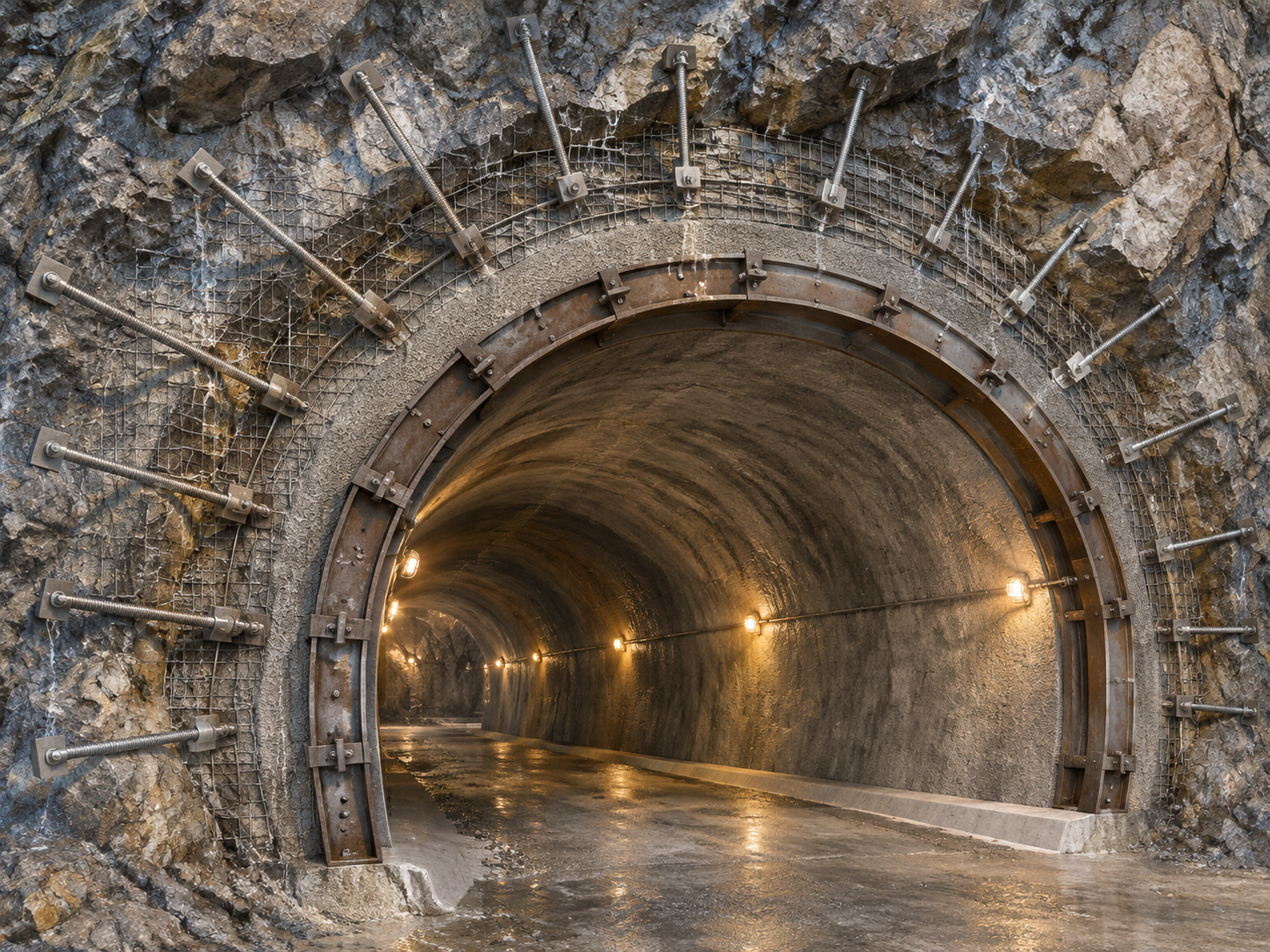
Quick comparison of common support types
| Support type | Main function | Typical use | Main limitation |
|---|---|---|---|
| Rock bolts and dowels | Reinforce the rock mass, tie blocks, create a bolted arch | Competent to fractured rock; pattern or spot support | Performance depends on anchorage, borehole and installation |
| Cable bolts and long anchors | Reinforce a deep zone beyond the immediate opening | Large spans, high stress, bedded or broken ground | Need long holes, anchorage and tensioning control |
| Wire mesh and straps | Retain small blocks and distribute load between bolts | Almost all bolted ground; surface containment | Not a standalone support in poor ground |
| Shotcrete | Seal the surface, limit unraveling, stiffen and protect | After bolts or with mesh and arches | Quality depends on mix, thickness, timing and curing |
| Steel arches and lattice girders | Carry ground loads and support the excavation profile | Weak, squeezing, shallow-cover or heavy-load sections | Heavy, slow to install; need blocking and invert closure |
| Forepoling and umbrella arch | Pre-support the ground ahead of the face | Portal, shallow cover, fault zones, running ground | Requires overlap, sequence and face support |
| Face and invert support | Control face extrusion and floor heave | Squeezing, weak or high-stress ground | Often overlooked in the support scheme |
| Final lining | Provide the permanent structure and watertightness | All tunnels, after primary support | Separate design from initial support |
What counts as surrounding rock support?
Support in a tunnel is usually divided into primary support and final lining. Primary support is installed during excavation. It may be temporary or permanent in intent, but its job is to stabilize the opening while the tunnel advances. Final lining is the long-term structure: cast-in-place concrete, precast segments or a designed shotcrete shell. The two are not interchangeable. A primary support system that looks complete at the face may not satisfy the final lining's structural, durability or watertightness requirements.
Support elements can also be described as active or passive. Pre-tensioned bolts, prestressed cables and expansion-shell bolts apply load to the rock soon after installation. Untensioned dowels, mesh, shotcrete and steel arches mainly respond as the rock moves. Most tunnel systems combine both: bolts reinforce the rock, mesh retains the surface, shotcrete stiffens and seals it, and an arch carries load where the rock cannot.
The important point is that the rock mass is part of the support system. A bolt does not "hold up the tunnel" by itself. It clamps a block, crosses a discontinuity or creates a reinforced zone that helps the surrounding rock carry its own load. That is why the same bolt type can perform well in one ground condition and poorly in another.
Rock bolts and anchors
Rock bolts are the most common reinforcement element in rock tunnels. They are used as spot bolts for individual blocks, as a systematic pattern over an excavation, and as part of a combined support system with mesh, shotcrete and arches. The terms "rock bolt" and "rock dowel" are often used loosely. In general, a dowel is untensioned and relies on displacement, while a bolt may be pre-tensioned. The distinction matters when specifying load transfer and installation.
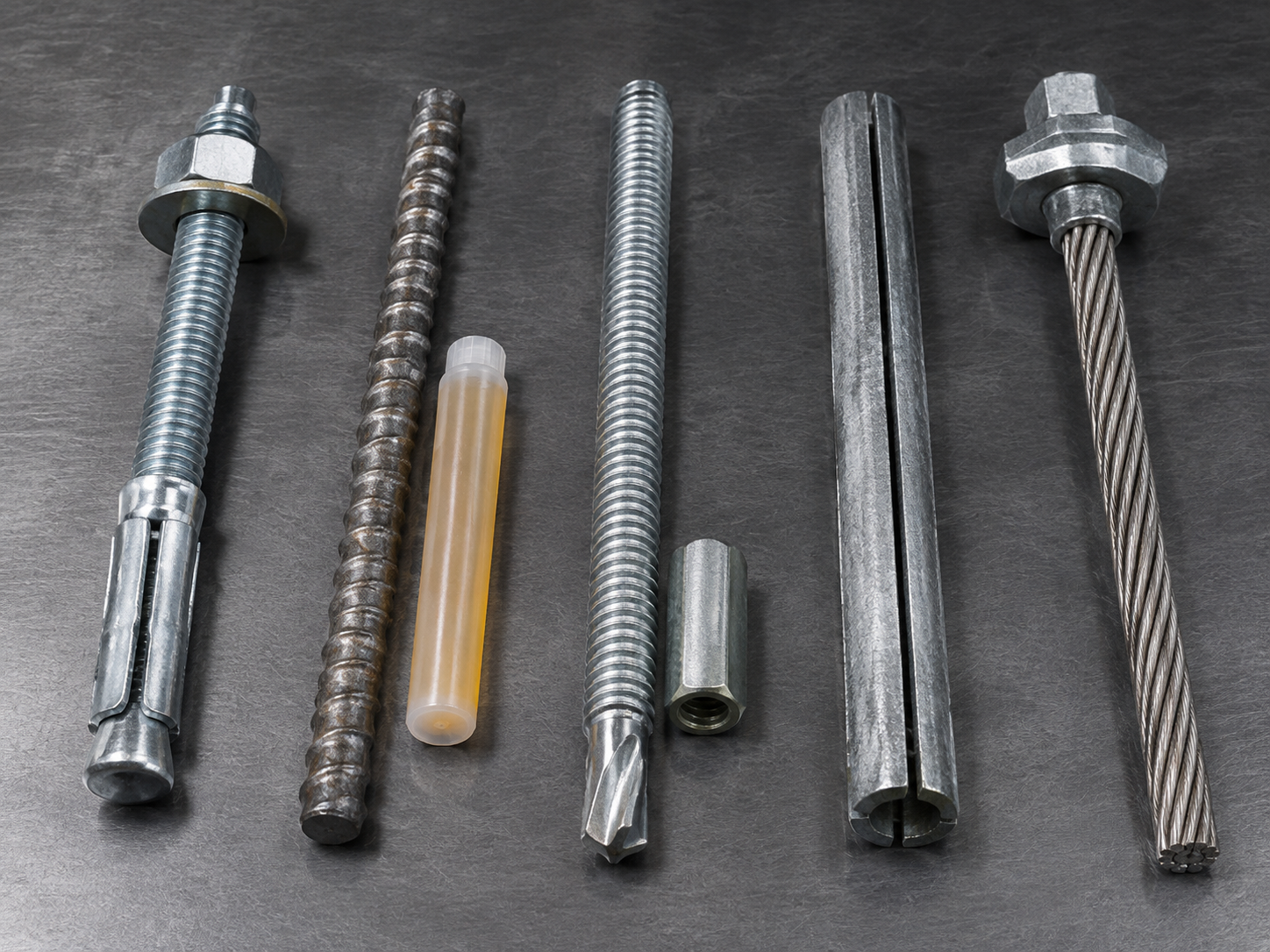
Mechanical rock bolts
A mechanical rock bolt uses an expansion shell, wedge or similar anchor at the far end of the bar. When the bolt is tensioned, the anchor expands against the borehole wall and develops immediate anchorage. This is useful in competent rock where the borehole stays open and a fast preload is needed.
Mechanical bolts can be used alone or combined with grout for long-term protection. The borehole diameter and shell type must match the bolt. A shell that is too small may not engage; one that is too large may not enter or may damage the hole. CQ's expansion shell mechanical rock bolt is described as providing immediate anchoring without waiting for grout curing, with a dual mechanical and grout-bonding mechanism.
Resin-anchored bolts
Resin-anchored bolts use a two-component resin cartridge. The bolt is rotated through the cartridge, mixing the resin and forming a bonded anchorage. Resin can develop high bond strength quickly, which is why it is common in mining and in tunnel sections where rapid support is needed.
Resin performance is sensitive to the borehole diameter, the cartridge size, the mixing action, the temperature and the time between mixing and loading. A cartridge selected for one hole size may not fit another. In a wet or oversized hole, the resin can be diluted, displaced or incompletely mixed. CQ's resin capsule cartridge page lists fast, medium and slow curing options, a working temperature range of -10°C to 40°C and a shelf life of 6–12 months under cool, dry storage . Those are published product data, not a site approval; the project still needs to confirm the exact cartridge, borehole and installation procedure.
Cement-grouted bolts
Cement-grouted bolts rely on a continuous grout column along the bar. They are often used for permanent support because the grout protects the bar and provides bond along the anchor length. The trade-off is time and quality control: the hole must be drilled, the bar inserted, the grout mixed and placed correctly, and the installation protected until the grout gains strength.
Grouted bolts are less sensitive than resin to short mixing windows, but they are more sensitive to hole cleaning, grout mix, water-cement ratio and injection procedure. In a tunnel, the grout record is part of the support record. Without it, the installed bolt cannot be compared with the design.
Self-drilling hollow grouting bolts
A self-drilling hollow grouting rock bolt uses the bar itself as the drill string. A sacrificial bit is fitted to the leading end; the hollow threaded bar carries flush during drilling and grout after drilling; couplers extend the bar; a plate and nut transfer load at the collar. The bar remains in the hole as the reinforcing element.
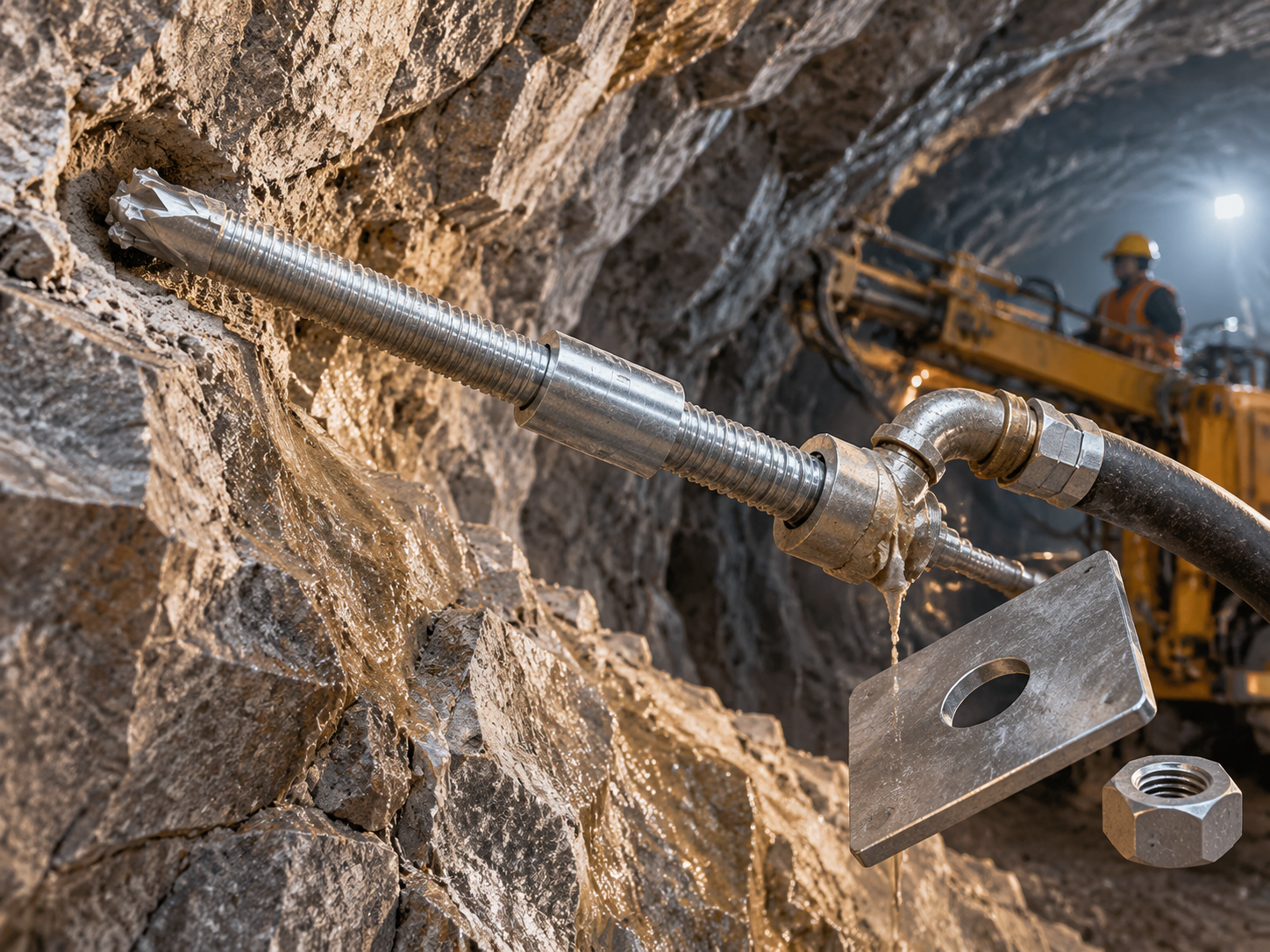
This system is used where a pre-drilled hole is difficult to maintain: weak or fractured rock, fault zones, running ground, portal sections and areas where the borehole collapses before a conventional bolt can be inserted. Hoek's description of very poor ground includes self-drilling rock bolts with a disposable bit grouted into place . That is the practical niche: the bolt is installed while the hole is being made, rather than after the hole has had time to close.
CQ's self-drilling hollow grouting rock bolt range includes R25, R32, R38, R51 and T76, with nominal diameters from 25 mm to 76 mm, matching drill bits and standard lengths from 2 m to 6 m depending on model. The published tensile strength is at least 550 MPa and the yield strength at least 350 MPa. CQ's general published grouting-pressure guidance is 0.5–2.0 MPa, subject to rock, grout and design.
Two details are easy to get wrong. First, the nominal bar diameter is not the hole diameter; the matching bit creates the annulus around the bar. Second, the bit, bar, coupler, plate and nut form a system. A visually similar bit or coupler from another thread system may not transmit drilling energy or carry load as intended.
Friction and expandable bolts
Friction bolts rely on radial contact between a steel tube and the borehole wall. A Split Set bolt is a slotted steel tube installed into a slightly smaller hole; the tube compresses and develops friction along its length. Installation is fast and does not require grout, which makes friction bolts common in mining and in temporary or rapid primary support.
The limitations are equally important. Friction bolts are not a full-length grouted anchor, and their long-term performance depends on corrosion protection and on the borehole staying in contact with the tube. In very poor ground, a borehole may not survive long enough to install the tube. CQ's friction split set range is described for primary and secondary support in mining and tunnel construction.
Expandable bolts, such as water-inflatable Swellex-type bolts, use a steel tube that is expanded against the borehole wall by water pressure. The expanded tube makes full-length contact with the rock and provides immediate anchorage. CQ lists Swellex-type bolts in several model sizes with optional zinc or epoxy coating . The method needs the specified water pressure, a compatible pump and a borehole within the product's tolerance. It is not a substitute for a grouted anchor where long-term bond or corrosion protection is the controlling requirement.
Cable bolts and long anchors
Cable bolts are long, flexible tension elements used to reinforce a zone beyond the immediate opening. They are common in large-span tunnels, high-stress ground, bedded or sheared rock, and locations where a conventional bolt is too short to reach a stable anchorage zone. Cable bolts can be grouted, prestressed or both.
Hoek's weak-rock guidance notes that rock bolts should extend about 1.5–2 m beyond the plastic zone to anchor in undamaged rock . That is a design principle, not a universal length. The required cable length, anchorage length, tensioning load and grout volume come from the ground model and the support design. CQ's steel strand anchor cable uses a 1×7 prestressed strand construction and is offered with matched anchors, bearing plates and grouting systems .
GFRP and corrosion-resistant bolts
Glass fiber reinforced polymer (GFRP) bolts are non-metallic. They are lightweight, corrosion-resistant and easy to cut, which makes them useful in tunnel faces, coal mine roadways and temporary support areas that will later be excavated or cut through. CQ's GFRP range includes solid bars, hollow grouting bars and fully threaded or ribbed forms .
GFRP is not simply a drop-in replacement for steel. Its stiffness, failure mode and connection details differ. It is a good fit where corrosion or later cutting is the main issue; it is not automatically the best choice for high-impact or high-deformation ground. The bolt, plate, nut and thread system must be designed together.
Surface support: mesh, straps and shotcrete
Rock bolts reinforce the mass, but they do not cover the surface between bolts. Surface support retains small blocks, prevents ravelling and transfers load from the rock surface to the bolts and arches.
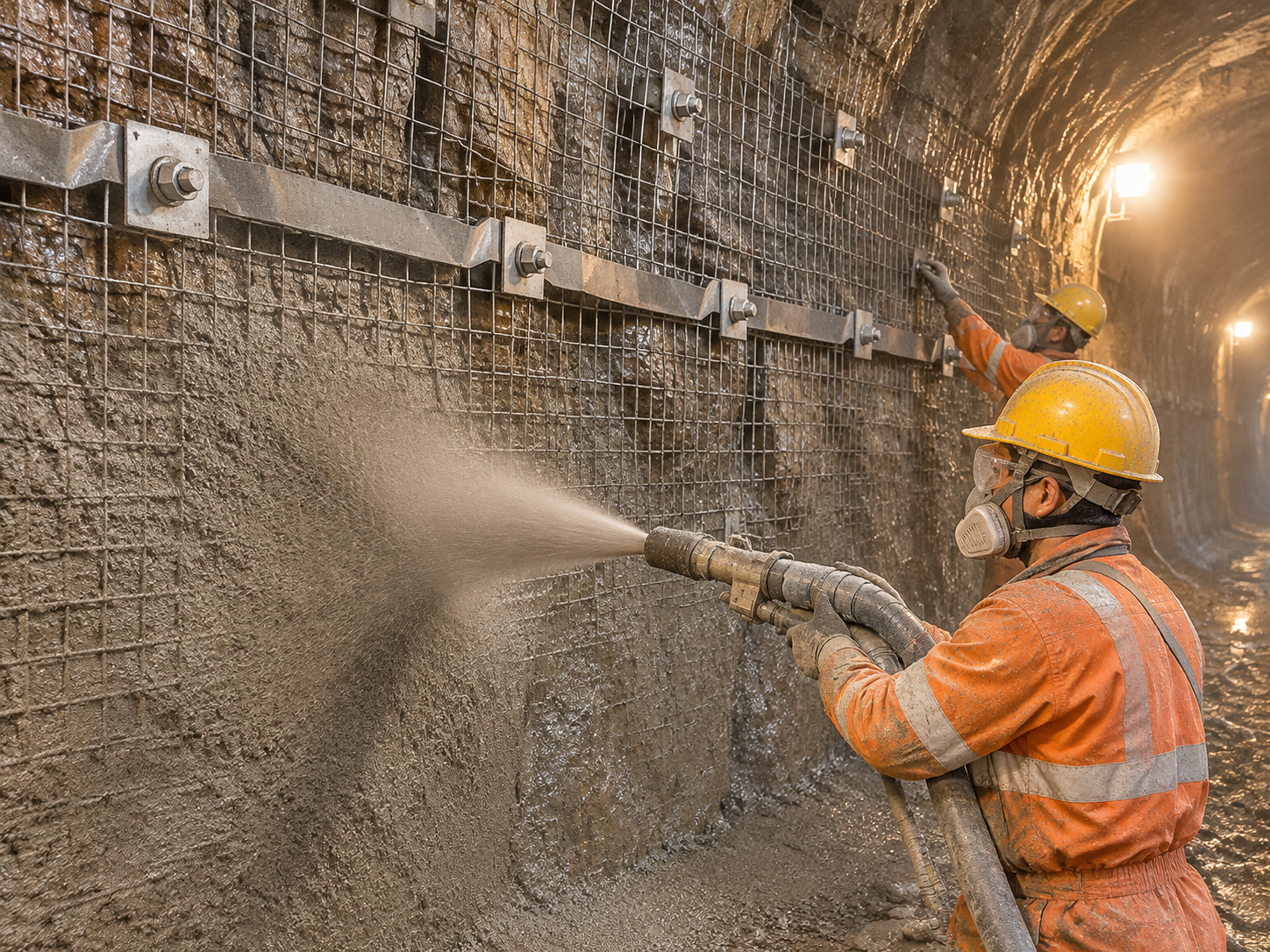
Wire mesh
Welded wire mesh is relatively rigid and is used where the surface needs firm containment. Woven mesh is more flexible and can conform to uneven rock. Reinforced mesh is used where higher strength or heavier loads are expected. CQ's mining wire mesh page describes welded, woven and reinforced options for underground tunnels, slopes and rock reinforcement.
Mesh is not a standalone support in poor ground. It needs adequate overlap, tensioning and fixed connection to the bolts or straps. The mesh aperture and wire diameter should match the expected block size and the bolt spacing. A mesh that is strong enough but poorly lapped can still unravel at the joints.
Steel straps
Steel straps distribute load between bolts and help support mesh. A W-shaped steel strap is cold-formed with a W cross-section and bolt holes at designed intervals; it connects individual point supports into a more continuous load-bearing line. CQ's W-shaped steel strap page describes it for tunnel reinforcement, weak surrounding rock and fault zones .
Straps are most useful where the rock surface is uneven or where a line of bolts needs to act together. They do not replace systematic bolting. The strap section, hole spacing and connection details must match the bolt pattern and the design load.
Shotcrete
Shotcrete is sprayed concrete. It seals the rock surface, limits unraveling, provides surface support and can be reinforced with steel or synthetic fibers. In conventional tunneling, it is often applied over bolts and mesh, and it may encase steel arches or lattice girders. ITA-AITES's shotcrete report describes steel-fibre reinforced shotcrete and bolts as a common primary rock support combination .
Shotcrete quality depends on the mix, the thickness, the timing, the surface preparation, the nozzle work and the curing. Shotcrete applied too late may not prevent a block from loosening; shotcrete applied too thin may not carry the expected load; shotcrete applied to a wet or dirty surface may not bond. In heavy support, shotcrete may be used to embed steel sets and provide a composite section, but the thickness and reinforcement must follow the design .
Shotcrete is not a substitute for bolts in blocky ground. It can hold small pieces together, but it cannot tie a large wedge back into the rock mass. That is why the common system is bolts plus mesh plus shotcrete, not shotcrete alone.
Plates, nuts and washers
The plate and nut are the load-transfer interface between the bolt and the surface. A plate that is too small may punch into the rock or deform; a nut that does not engage the full thread may strip; a rigid plate on an uneven surface may bear on a single point. Spherical washers and domed plates can compensate for small angle deviations and improve contact.
CQ's dome plate and anchor plate page describes spherical bearing plates that work with self-aligning washers to compensate for installation angle deviation, with a range of bearing capacities. The exact plate capacity, thread and coating must match the bolt system and the design.
Steel arches and lattice girders
Steel arches, also called steel ribs or steel sets, are structural supports installed at the tunnel profile. They carry ground loads, support the excavation before shotcrete gains strength and provide a fixed profile in weak or squeezing ground. Common forms include H-beam arches, U-steel arches and yielding arches with sliding joints.
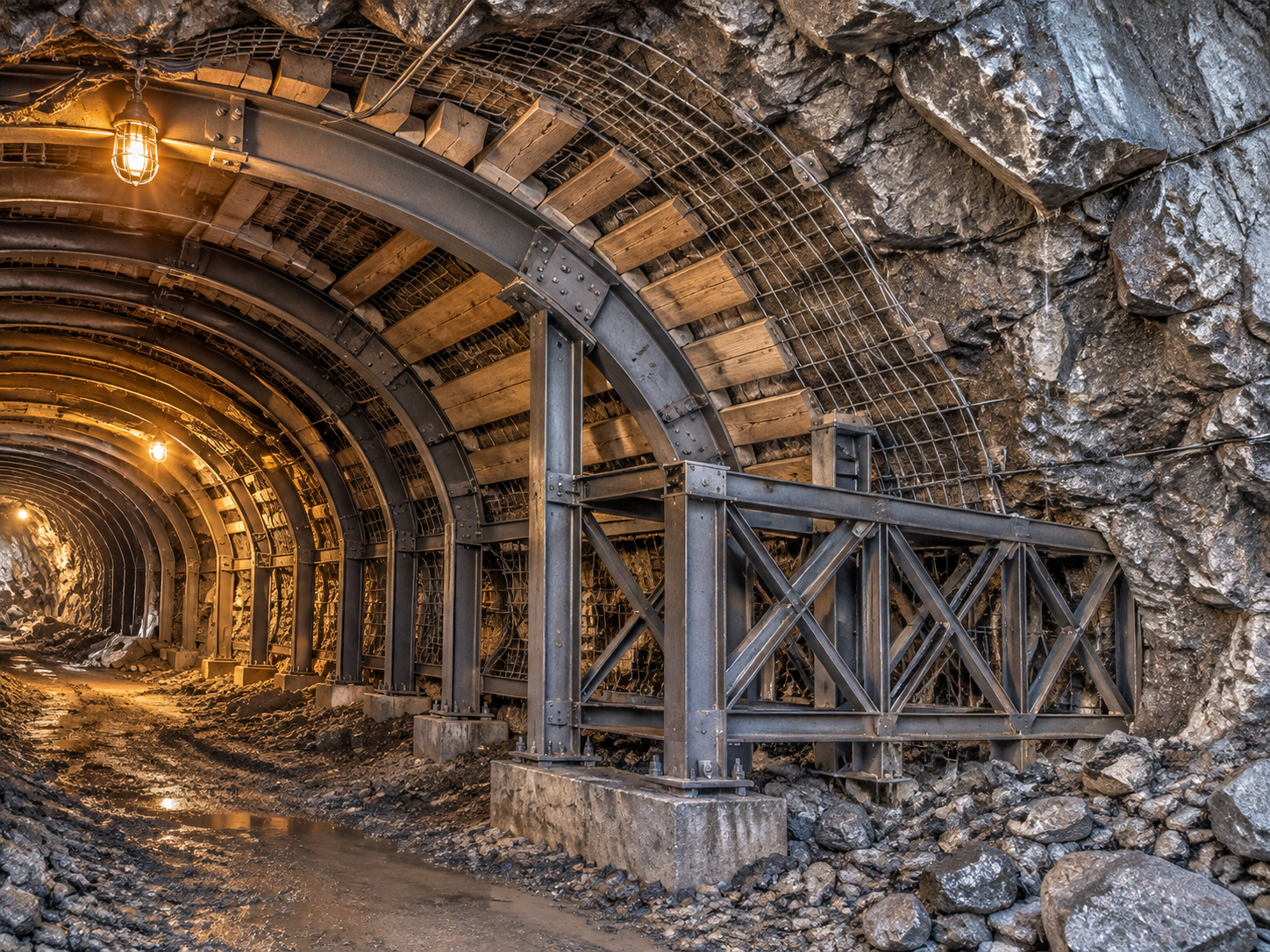
Steel arches need proper blocking against the rock, lagging to retain the ground between ribs, and a foundation that can carry the arch load. In squeezing ground, the arch may need a sliding connection or compressible element to yield without buckling. In many designs, the invert must be closed with an invert arch or strut; an open arch that stops at the springline may not control floor heave .
Lattice girders are lighter than heavy steel arches. They are made from welded reinforcement bars or lattice sections and are often used as part of a shotcrete support system. FHWA notes that lattice girders can provide a simple template for judging shotcrete thickness . They are not as stiff as a heavy H-beam arch, so the design intent matters: a lattice girder is not automatically interchangeable with a steel rib.
CQ's lattice steel beam is a perforated lattice section with custom length and section size, intended for mining and tunnel support, steel structure connection and equipment support . It is a structural component, not a complete support design. The section, hole pattern, connection and load path must be confirmed against the tunnel design.
Forepoling and umbrella arch pre-support
Forepoling is a pre-support method. Steel pipes, spiles or forepoles are installed ahead of the face, overlapping the next excavation round, to support the crown before the ground is exposed. When the forepoles are arranged as a crown umbrella, the system is often called an umbrella arch or pipe roof.
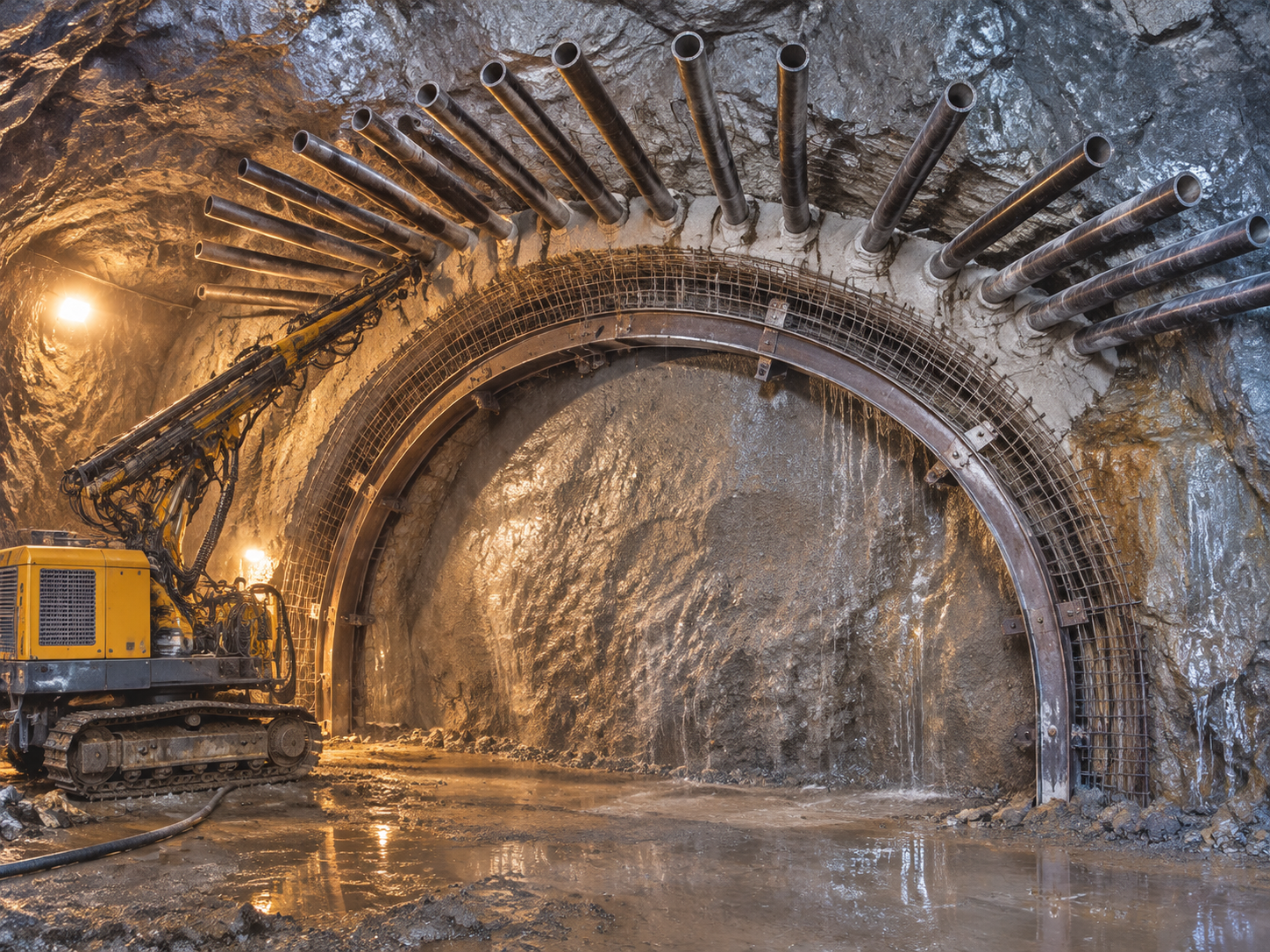
Forepoling is used at portals, in shallow cover, under roads or buildings, in fault zones and in running or cohesionless ground where the face cannot stand unsupported. The forepoles can be driven or drilled and may be grouted for stiffness and ground improvement. The overlap, angle, length and spacing are part of the design; a forepole that stops short of the next round does not provide continuous pre-support.
Hoek's description of a full-face tunnel in weak rock includes a forepole umbrella protecting the excavation, with steel sets, shotcrete and invert struts as part of the system . That is a useful reminder: forepoling is a pre-support, not a complete support system. It usually needs face support, surface support and a permanent lining behind it.
Face, invert and yielding support
Three parts of the system are often under-specified because they are not the most visible:
Face support. In weak or running ground, the face itself may be the critical surface. Face bolts, mesh, shotcrete, a controlled leave of core or a face seal can prevent the face from extruding or sloughing. The face support must be sequenced with excavation; it is not something to add after the face has already failed.
Invert support. Floor heave is common in squeezing ground. An invert arch, invert strut or curved invert closes the support ring and controls the floor. A support system that is strong at the crown but open at the invert can still suffer large floor movements.
Yielding support. In squeezing ground, a very stiff support may attract more load than it can carry. Yielding arches, compressible elements, sliding joints and yielding bolts allow controlled deformation while maintaining support. The design needs a defined yield allowance and monitoring to confirm that the movement stays within the allowed range.
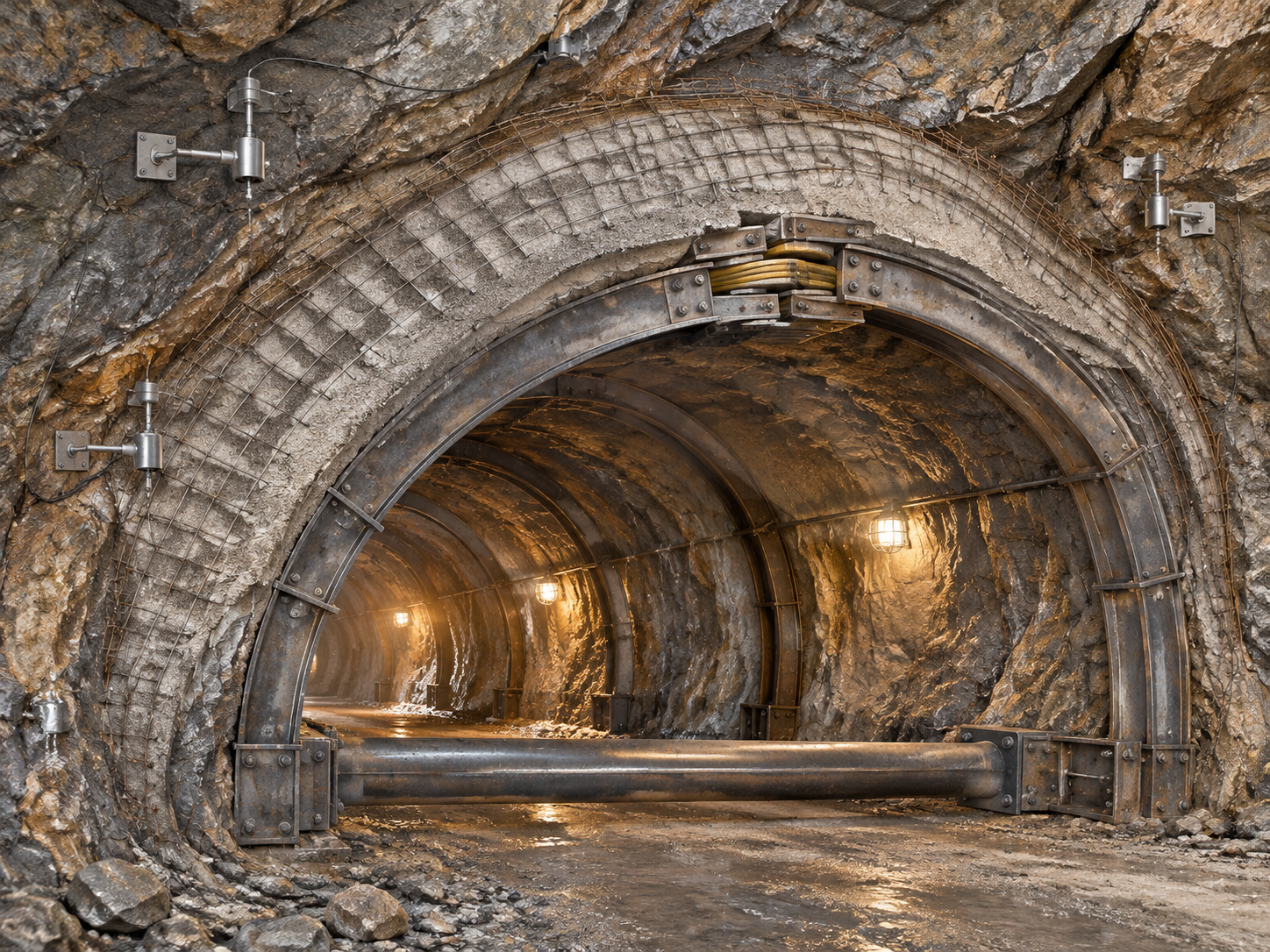
In rockburst-prone ground, the support also needs energy absorption and dynamic capacity. Mesh, fiber-reinforced shotcrete and yielding bolts are often used together; the exact system is a specialist design problem.
How the common types combine
The common support types are rarely used alone. A typical tunnel support system is a sequence:
- Excavate and scale the profile.
- Apply the initial surface protection where required.
- Install the primary bolts or cables.
- Add mesh, straps and plates.
- Apply shotcrete.
- Install steel arches or lattice girders where the ground requires them.
- Close the invert and install face support where needed.
- Monitor convergence and adjust.
- Install the final lining and waterproofing.
The exact order changes with the excavation method and ground condition. In a hard-rock tunnel, the cycle may be bolts, mesh and a thin shotcrete layer. In a weak-rock tunnel, it may be forepoling, a partial face excavation, a face seal, lattice girders, mesh, shotcrete and invert closure. The sequence is part of the design because each element supports the next stage of the excavation.
| Ground condition | Typical primary support | Main control point |
|---|---|---|
| Competent, blocky rock | Spot or pattern bolts, mesh, thin shotcrete | Wedge geometry and bolt anchorage |
| Moderately jointed rock | Systematic bolts, mesh, fiber-reinforced shotcrete | Joint orientation, block size, shotcrete bond |
| Weak or fractured rock | Self-drilling bolts, mesh, fiber-reinforced shotcrete, lattice beam or arch | Borehole stability, grout take, support sequence |
| Running or cohesionless ground | Forepoling or pipe roof, face support, shotcrete, arches | Pre-support overlap, face stability, settlement |
| Squeezing ground | Yielding support, over-excavation, heavy arch, invert strut | Convergence, yield allowance, invert closure |
| Rockburst-prone ground | Energy-absorbing bolts, mesh, fiber-reinforced shotcrete | Dynamic capacity, surface retention |
| Water-rich or corrosive ground | Corrosion-resistant bolts or cables, drainage, durable grout or resin | Water control, coating, long-term durability |
Selection by ground condition
Support selection starts with the ground, not the product catalogue. The design team needs the rock type, strength, weathering, discontinuity spacing and orientation, RQD, groundwater, in-situ stress, tunnel span and shape, depth of cover, excavation method, required service life and allowable deformation. The stand-up time of the ground is often the practical variable that decides whether a pre-drilled bolt, a self-drilling bolt, a friction bolt or forepoling is feasible.
Rock mass classification systems such as RMR and Q were developed to help estimate tunnel support, while GSI was developed to estimate rock mass strength. Hoek and Marinos note that RMR and Q were developed for tunnel reinforcement and support design, whereas GSI was developed solely for estimating rock mass properties; GSI is not a support design method on its own. That distinction matters. A classification rating is an input to design, not a prescription for a bolt pattern.
For ordinary tunnels, empirical methods can provide an initial support estimate. For large spans, weak rock, high stress, shallow cover, fault zones or squeezing ground, the design should be checked with numerical analysis, monitoring and the observational method. Convergence measurements, crown settlement, face extrusion and groundwater inflow should be compared with the design assumptions. If the ground behaves differently, the support should be adjusted.
There is no single "best" support type. A self-drilling bolt is not better than a resin bolt in competent rock; it is simply more suitable where the hole is unstable. A friction bolt is not better than a grouted bolt; it is faster but has different long-term behavior. A steel arch is not better than shotcrete; it carries load differently. The right choice is the one that matches the ground, the construction sequence and the required service life.
Specification and procurement checks
A support specification should define performance and interface requirements, not only product names. The following questions help prevent a quotation for different products being compared as if they were equivalent:
- What is the ground condition? Rock type, strength, fracture spacing, water inflow, stand-up time and expected deformation.
- What is the support design? Bolt type, diameter, length, pattern, angle, design load, mesh, shotcrete thickness and arch section.
- What is the borehole? Diameter, depth, drilling method and whether the hole stays open.
- What is the anchorage system? Mechanical shell, resin cartridge, cement grout or self-drilling hollow bar.
- What is the corrosion requirement? Temporary or permanent support, groundwater chemistry, coating or stainless/GFRP requirement.
- What accessories are included? Bit, coupler, plate, nut, washer, mesh, strap and connection details.
- What testing is required? Pull-out frequency, acceptance values, material certificates, coating thickness and batch traceability.
- What installation support is available? Method statement, training, equipment compatibility and site troubleshooting.
- What documentation is required? Mill certificates, test reports, installation records and as-built records.
- What are the commercial terms? Quantity, packaging, delivery point, lead time and warranty, all confirmed in writing.
Common specification mistakes include:
- Selecting a bolt by diameter alone, without matching the thread, bit, coupler, plate and nut.
- Using a resin cartridge in a wet or oversized hole without checking compatibility.
- Specifying mesh without overlap, tensioning or fixing details.
- Specifying shotcrete thickness without specifying timing, reinforcement or curing.
- Designing a steel arch without a foundation, blocking or invert closure.
- Using forepoling without a defined overlap and sequence.
- Ignoring corrosion protection for a permanent tunnel.
- Accepting a product certificate without an installation record or pull test.
For a project-specific review, send a single technical package: tunnel application and location, ground conditions, support drawing, borehole diameter, drilling method, grout or resin details, corrosion requirement, quantity, delivery point and required documentation. That gives the supplier and the design team the same basis for a technical comparison.
CQ product configurations and next step
CQ Rockbolt's published range covers the rock-reinforcement and surface-support side of a tunnel system. The table below is a starting point for a project discussion, not a substitute for the support design.
| Support function | CQ product | Typical role | Confirm before selection |
|---|---|---|---|
| Drill, grout and anchor in one pass | Self-drilling hollow grouting rock bolt | Weak, fractured or collapsing ground; fault zones; portal sections | Bar model, bit diameter, coupler, grout, length, plate and nut |
| Immediate friction support | Friction split set rock bolts | Rapid primary support in mining and tunnel development | Borehole diameter, length, coating and long-term requirement |
| Water-inflatable full-length anchorage | Swellex rock bolt | Fractured rock where immediate full-length contact is useful | Water pressure, borehole tolerance, coating and pump compatibility |
| Mechanical anchoring with immediate preload | Expansion shell mechanical rock bolt | Competent rock, roadway support, systematic bolting | Borehole diameter, shell type, plate, nut and grout option |
| Fast resin anchorage | Resin capsule cartridge | Stable borehole, rapid anchorage, mining and tunnel support | Borehole diameter, cartridge size, temperature, gel time and shelf life |
| Deep reinforcement | Steel strand anchor cable | Large spans, high stress, deep loosened zone | Anchorage length, tensioning, grouting and corrosion protection |
| Corrosion-resistant or cuttable support | GFRP bolt | Tunnel face, coal roadway, temporary support, corrosive ground | Load capacity, stiffness, thread system and plate compatibility |
| Surface retention | Mining wire mesh | Block retention between bolts; welded, woven or reinforced mesh | Wire diameter, aperture, overlap, coating and fixing |
| Load distribution between bolts | W-shaped steel strap | Weak rock, fault zones, mesh support | Section, hole spacing, strength and bolt compatibility |
| Structural support component | Lattice steel beam | Mining and tunnel support, shotcrete composite sections | Section, length, hole pattern, connection and design intent |
| Load transfer at the collar | Dome plate and anchor plate | Plate, nut and spherical washer assembly | Thread, plate capacity, angle compensation and coating |
The CQ published range shown here covers rock bolts, cables, mesh, straps, lattice beams and accessories. Shotcrete, heavy steel arches and final concrete lining should be treated as separate scope items; confirm the supply scope and interface with the project design team.
If you are comparing support types for a tunnel, start with the ground condition and the support drawing, not a single product price. Send the tunnel section, rock mass description, groundwater condition, support pattern, borehole diameter, quantities and delivery location to CQ for a product-specific review. The goal is a support system that fits the ground, the excavation sequence and the required service life, not a collection of unrelated products.
Related News
Other news you might be interested in

Self-Drilling Anchor Bolts for Water-Conveyance Tunnel Reinforcement
Self-drilling anchor bolts are useful for water-conveyance tunnel reinforcement when broken or water-bearing ground makes conventional drill-and-insert bolting difficult. By using a hollow threaded bar as both the drilling member and the permanent reinforcement, the system removes the separate bolt-insertion step and provides a channel for grouting through the same bar.For a water-conveyance tunnel, that installation advantage matters. Headrace, tailrace, diversion, irrigation and water-supply tunnels can pass through fault zones, weathered rock, weak interlayers and interconnected fractures. Groundwater may enter the excavation, boreholes may deteriorate after drilling, and support must be coordinated with drainage, waterproofing and the final lining.

What Is a Split Set Mining System and How Is It Different from Other Rock Bolts?
A split set is often described as a rock bolt, but in mining it is more useful to think of it as a support system. The steel tube is the most visible part. The way it performs also depends on the drilled hole, the bearing plate, the installation adapter, the drilling equipment, the surface support and the checks made underground. That distinction matters when a project compares rock bolts. Two quotations can list a similar diameter and length, yet propose different load-transfer mechanisms, different hole requirements and different installation procedures. A split set is not a resin bolt with the resin removed. It is not a mechanical expansion-shell bolt, a self-drilling hollow bar, a water-inflatable tube or a cable bolt. Each product family solves a different part of the ground-support problem.
Want to know more?
Get in touch with us for more information about our services and products.