

Underground Mine Support Systems: Types, How to Choose, and Monitoring

Dayang Yang
AuthorWith over 15 years of experience in the production and sales of ground anchoring and mining support products, we operate our own rock bolt and accessory manufacturing facility with stable large-scale production capacity. We are specialists in rock bolts, resin cartridges, anchor cables, bearing plates, and customized ground anchoring products for mining support and geotechnical anchoring solutions.
Choosing an underground mine support system is not simply a matter of selecting a stronger rock bolt or adding more support components. The system must match expected ground behavior, excavation geometry, stress conditions, groundwater, installation capability, and the required service life of the opening.
For teams sourcing or specifying mining ground support products, start by reviewing CQ Rockbolt's underground mining and tunneling support solutions. A practical decision path is to identify likely failure modes, define the required support functions, compare candidate components, verify installation quality, and monitor field performance.
What Is an Underground Mine Support System?
An underground mine support system is a coordinated combination of rock mass reinforcement, surface support, structural support, installation quality control, and field monitoring. It is not one rock bolt, one layer of wire mesh, or one steel set.
For example, rock bolts may reinforce potentially unstable ground; wire mesh and shotcrete may retain loose rock near the excavation surface; and steel arches or props may provide an additional structural load path in weak ground or large openings. These components must work together. Even a high-capacity bolt cannot deliver system performance if the plate, mesh connection, anchorage zone, or surrounding shotcrete fails first.
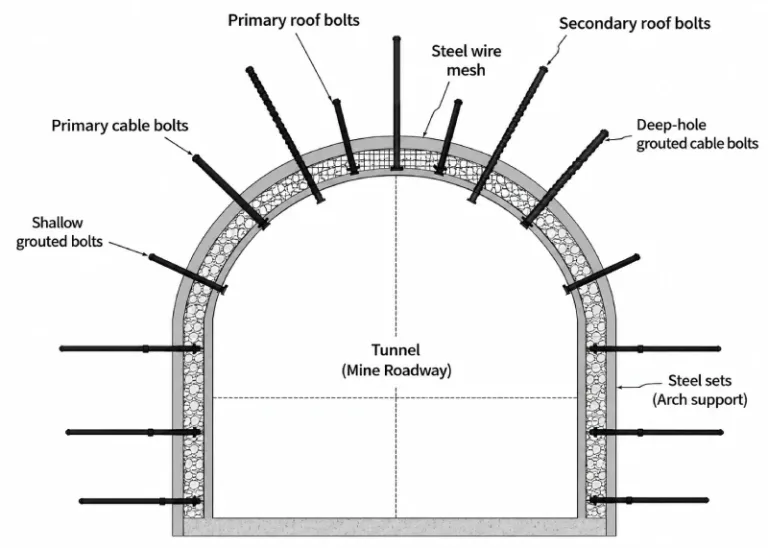
Diagram of an underground mine support system showing support arches, rock bolts, mesh, shotcrete, and tunnel structure
Support objectives also differ by project. A short-life development heading may need rapid local rock retention. A permanent access may require durable ground reinforcement and corrosion protection. A high-stress roadway may need a system that remains functional while the surrounding rock continues to deform.
What Are the Main Types of Underground Mine Support?
1. Reinforcement Within the Rock Mass
Rock bolts, friction bolts, mechanically anchored bolts, fully grouted bolts, self-drilling anchors, and cable bolts reinforce rock beyond the excavation boundary.
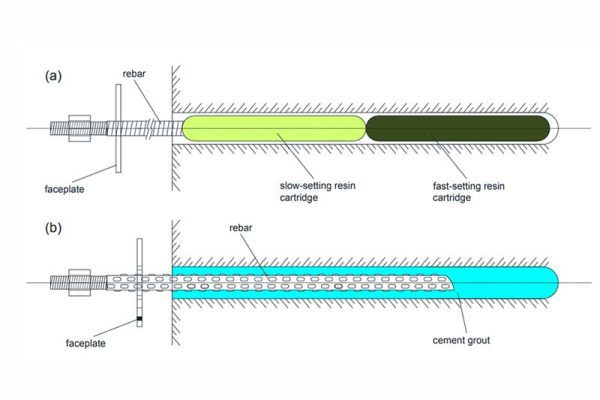
Each component transfers load differently. Mechanical bolts transfer load through an end anchor. Split Set friction bolts rely on contact with the borehole wall. Swellex expandable rock bolts expand against the borehole wall to create close contact. Fully grouted rock bolts transfer load through the bolt bar, grout, and surrounding rock.
Where instability extends deeper into the rock mass or requires longer anchorage, steel strand anchor cables may be considered. In fractured ground or conditions requiring drilling and grouting in one operation, evaluate a self-drilling anchor system.
When selecting rock reinforcement, assess borehole condition, hole diameter, anchor or bonded length, rock quality, installation method, corrosion exposure, plate contact, and acceptance-test requirements. A bolt's nominal load rating is only one part of the decision.
2. Surface Support and Rock Retention
Surface support controls loose material between reinforcement points and reduces rock-fall exposure at the excavation boundary. Common components include mining wire mesh, straps, bearing plates, shotcrete, and fibre-reinforced shotcrete.
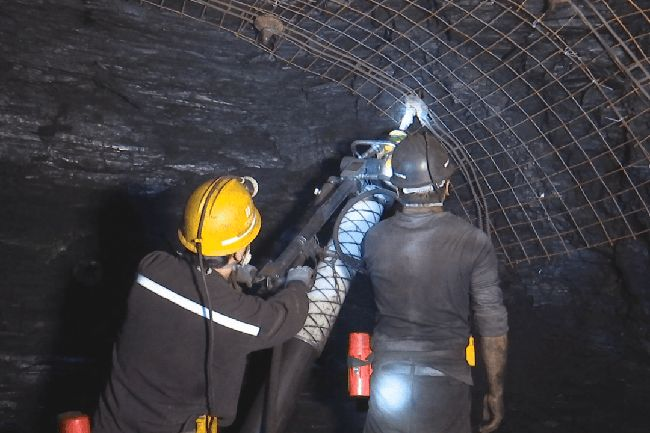
Wire mesh can retain smaller fragments, but its performance depends on overlap, fixing, edge restraint, and compatibility with bearing plates. Straps can distribute load across multiple bolts, but they may not provide continuous coverage. Shotcrete can form a continuous surface layer and reduce raveling, but its performance depends on substrate preparation, drainage, thickness, bond, toughness, early strength, and spraying quality.
Surface support does not replace internal reinforcement where instability extends deeper into the rock mass. It should be selected according to expected fragment size, ground condition, deformation demand, and worker exposure.
3. Structural and Standing Support
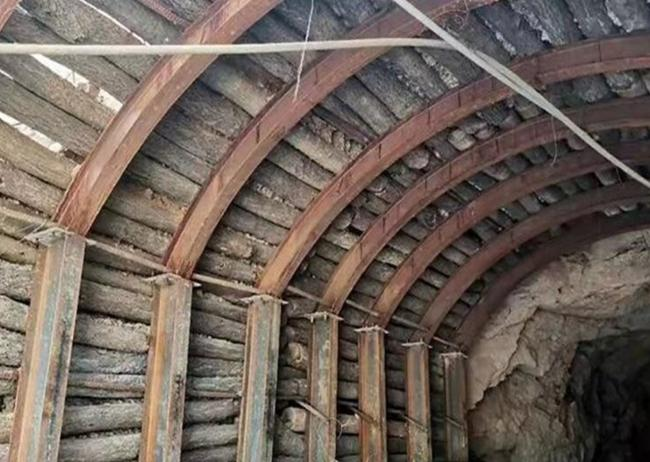
Steel sets, steel arches, timber sets, hydraulic props, and crib support provide direct structural restraint near the excavation boundary.
They may be appropriate in weak ground, large-span openings, intersections, rehabilitation areas, or locations with significant convergence. For example, a lattice steel beam can be used as an auxiliary structural component in mine roadway support and load-bearing applications.
The actual performance of structural support depends on practical details including rock contact, lagging, blocking, backfill, foundations, spacing, and connection quality. A steel set does not necessarily carry load uniformly simply because it has been installed. If rock contact is poor, load transfer may differ substantially from the design assumption.
4. Yielding and Energy-Absorbing Support Under Special Conditions
In squeezing ground, high-stress areas, or dynamic conditions, support may need controlled deformation or energy absorption while continuing to retain damaged rock.
A component that is too rigid may reach its limit before ground movement stops. However, a yielding bolt alone cannot guarantee full system performance if the plate, mesh, strap, or shotcrete cannot accommodate the same deformation. The complete ground support system should be assessed for load-displacement behavior, allowable movement, energy absorption, connection capacity, and surface-retention performance.
Why Are Combined Support Systems Common in Underground Mines?
Underground excavations often face multiple scales of instability at the same time. Internal reinforcement may control movement in the rock mass. Mesh and shotcrete may retain loose material at the surface. Structural support may provide additional restraint and help manage convergence.
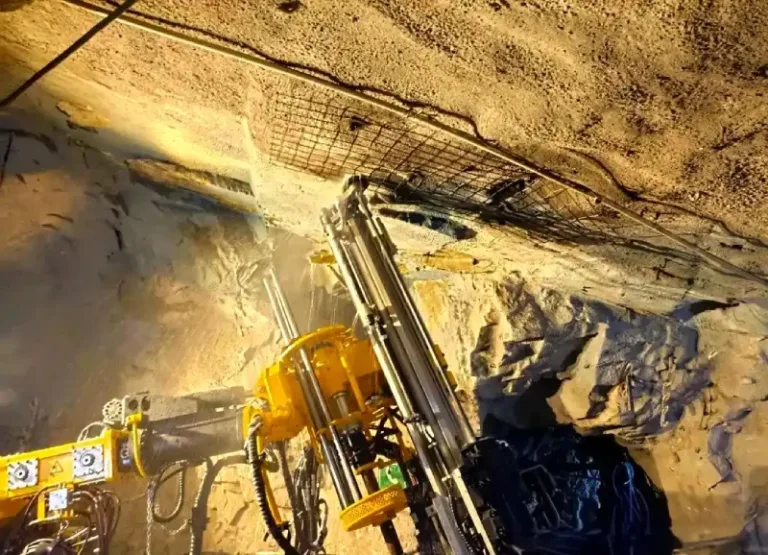
Combined systems are common because each component has a different role. The critical requirement is compatibility in spacing, stiffness, deformation capacity, installation sequence, and connection design.
What Support Functions Are Needed for Different Failure Modes?
Support selection should begin with a failure-mode hypothesis, not a product catalogue.
| Ground behavior | Main control objective | Support functions to assess |
|---|---|---|
| Loose blocks, slabbing, or small rock falls | Retain broken rock and reduce exposure | Surface support and local rock reinforcement |
| Wedges, slabs, or bed separation | Tie unstable rock to stable ground | Oriented rock bolts, straps, plates, and surface support |
| Squeezing ground or strong convergence | Keep the opening serviceable during movement | Internal reinforcement, surface support, structural restraint, and yielding capacity |
| Dynamic loading or rockburst risk | Absorb demand and retain damaged rock | Energy-absorbing bolts and robust surface retention |
| Groundwater-related softening or erosion | Maintain support performance as conditions change | Drainage, corrosion protection, and suitable reinforcement and facing |
This assessment should define what may move, how it may move, how quickly the condition may develop, and what needs to be protected. A wedge may require both internal anchorage and surface retention. A squeezing roadway may require all support layers to remain functional through a defined movement range.
How Do Candidate Support Components and Systems Compare?
| Component or system | Main role | Typical limitations | What to verify |
|---|---|---|---|
| Friction rock bolts | Rapid local reinforcement | Sensitive to borehole condition and diameter | Hole quality, anchorage performance, torque or load, plate seating |
| Fully grouted bolts | Load transfer along the bonded length | Sensitive to cleaning, mixing, curing, and grout continuity | Bar-hole match, bonded length, grout or resin process, testing |
| Steel strand anchor cables | Reinforcement of deeper unstable zones | Requires drilling accuracy, space, grouting, and equipment | Bonded length, free length, grout cover, corrosion protection |
| Mining wire mesh, straps, and plates | Surface retention and load distribution | Cannot control deep instability alone | Mesh overlap, fixing, plate contact, edge anchors |
| Shotcrete or fibre-reinforced shotcrete | Continuous surface layer | Depends on substrate, water, thickness, and application quality | Thickness, bond, early strength, toughness, drainage |
| Lattice steel beams and structural support | Structural restraint and convergence control | Requires reliable contact, foundations, connections, and maintenance | Spacing, blocking, lagging, footing, and connection condition |
| Yielding support | Controlled movement or energy management | Other accessories may fail before the yielding element | Load-displacement range and accessory compatibility |
Cost and installation speed are important, but they cannot be ranked universally. They depend on drill equipment, workforce capability, groundwater conditions, material supply, installation cycle, and inspection requirements.
How Should Project Conditions Guide Support Selection?
1. Excavation Use, Geometry, and Consequences of Failure
Define whether the opening is temporary development, production access, permanent infrastructure, an intersection, or an area with sustained personnel exposure. Span, height, profile, nearby excavations, and available working space all affect mine roadway support requirements.
The consequences of support failure should determine the level of conservatism, inspection frequency, and contingency planning.
2. Rock-Mass Conditions and Reliable Anchorage Zones
Assess lithology, joints, bedding, faults, weak seams, weathering, and the expected depth of broken ground. Anchoring elements should reach or work within a rock zone that can provide reliable resistance.
Where the anchorage zone is uncertain, more geological investigation, testing, or analysis may be needed before specifying bolt type and length.
3. Stress, Deformation, and Dynamic Demand
Mining depth, extraction sequence, stress redistribution, nearby openings, and seismic activity can significantly change the support problem.
Define expected displacement and displacement rate, not only the initial load. Where convergence or dynamic damage is credible, confirm that bolts, accessories, surface support, and structural elements can maintain their intended function within the required deformation range.
4. Groundwater, Drilling, Construction, and Durability Conditions
Groundwater can affect borehole stability, grout quality, shotcrete bond, corrosion, rock softening, and fines migration. The support system must also suit available drill rigs, installation equipment, mixing and pumping capacity, ventilation, access, and production-cycle requirements.
Where grouting or resin anchoring is used, assess the suitability of anchorage agents and resin grout materials, including the installation and curing requirements.
5. System Compatibility and Maintainability
Check the interfaces between bolt heads and plates, mesh and straps, shotcrete and the substrate, and steel sets and lagging. Drainage and corrosion protection also need to be considered.
For support systems involving prestressing or threaded-bar accessories, PT bars and prestressing anchorage systems can be evaluated as part of the complete support configuration.
How Can Installation Quality Be Verified?
Installation quality must be part of the underground mine support process, not merely a documentation task after construction.
1. Installation and Acceptance of Anchoring Elements
Verification may include:
- Borehole depth and diameter
- Borehole cleaning
- Rock bolt length and installed length
- Resin or grout mixing and curing process
- Bearing-plate seating and nut tightening
- Tensioning where required
- Pull testing or proof testing under the approved project procedure
The quality plan should define sampling frequency, rejection criteria, corrective actions, and responsibility for releasing the supported area.
2. Installation and Acceptance of Surface and Structural Support
For wire mesh and straps, inspect coverage, overlap, fixing, edge restraint, and damage. For shotcrete, verify substrate preparation, thickness, bond, early strength, drainage treatment, and testing requirements.
For steel sets and standing support, inspect spacing, rock contact, blocking, lagging, foundations, connections, and visible signs of uneven loading or deformation.
3. Record the As-Installed Condition
Record the installed support type, dimensions, spacing, test results, repairs, deviations, groundwater conditions, and relevant photographs or geotechnical observations.
These records create a baseline for later inspection and help distinguish new deterioration from an original installation condition.
How Can Monitoring Confirm Support Performance?
Ground support monitoring should be based on a defined failure hypothesis. It does not replace engineering judgement, but it can show whether ground and support behavior remain within the expected range.
Convergence stations can track closure between roof and floor or sidewalls. Multipoint extensometers can identify movement at different depths. Load cells can monitor selected bolts, cable bolts, or structural support. Routine inspections can identify cracking, spalling, mesh deformation, plate movement, shotcrete damage, broken elements, and groundwater changes.
A trigger-action-response plan should be defined before monitoring begins. Trigger values should account for instrument accuracy, normal variation, allowable deformation, support capacity, rate of change, worker exposure, and failure consequences.
Do not copy trigger values from another mine or from a general article. When observations exceed project-defined limits, responses may include additional inspections, access restrictions, supplementary support, changes to mining sequence, or a revised geotechnical assessment.
Frequently Asked Questions
Is a higher-strength rock bolt always the best upgrade?
No. A stronger bolt bar may not solve poor anchorage, insufficient bonded length, surface-support failure, poor installation quality, or deformation beyond the capacity of the complete system. Identify the failure mechanism first. See the underground mining roof bolt selection guide for a closer comparison of bolt types.
Can wire mesh or shotcrete replace rock mass reinforcement?
Wire mesh and shotcrete can retain loose material close to the excavation surface, but they generally do not replace the rock mass reinforcement required to control deeper instability.
When should an installed support design be reviewed?
A review is appropriate when displacement, support load, component damage, acceptance-test results, groundwater conditions, excavation geometry, blasting damage, mining sequence, or stress conditions move outside the original design assumptions or project trigger criteria.
Get an Underground Mine Support Solution
For projects requiring rock bolts, friction bolts, Swellex expandable bolts, self-drilling anchors, cable bolts, mining wire mesh, or a custom underground mine support system, visit the CQ Rockbolt product centre or contact CQ Rockbolt for technical support and a quotation.
Related News
Other news you might be interested in

Friction Rock Bolt Specifications: What Buyers Should Confirm Before Ordering
A friction rock bolt quotation is difficult to compare when it lists only a diameter, a length and a price. Buyers also need to know which product drawing applies, what is included, how the proposed bolt matches the drilling arrangement, and what the quoted performance figures actually describe.For mine engineers, technical buyers and ground-support distributors, the practical starting point is a clear specification package. This guide focuses on the slotted-tube friction bolt commonly described in product catalogues as a split set friction bolt. CQ Rockbolt lists this product family for underground mining and tunneling; the exact model and supply details should be confirmed against the current quotation.

Self-Drilling vs. Pre-Drilled Hollow-Core Rock Bolts: What Tunnel Contractors Should Confirm Before Ordering
Two quotations can describe threaded hollow rods, but still cover different installation tasks. One suggestion may be a self drilling system. Another possibility is to insert hollow bolts after drilling separate support holes.For tunnel contractors, this difference will affect the component list, equipment interfaces, and questions that need to be answered before purchase. The investigation of 'hollow anchor rods' alone leaves too much room for explanation.
Want to know more?
Get in touch with us for more information about our services and products.