

Grouted Bolts: Types, Applications, and Selection Basics

Dayang Yang
AuthorWith over 15 years of experience in the production and sales of ground anchoring and mining support products, we operate our own rock bolt and accessory manufacturing facility with stable large-scale production capacity. We are specialists in rock bolts, resin cartridges, anchor cables, bearing plates, and customized ground anchoring products for mining support and geotechnical anchoring solutions.
When engineers, contractors, or buyers compare ground support options, one common question is what makes a grouted bolt different from other rock bolts. The term sounds simple, but in practice it raises several practical concerns: how the bolt is bonded to the ground, what kind of grout is used, and in which conditions a grouted system makes more sense than other support methods. That is why understanding grouted bolts is not just about definition. It is also about installation logic, load transfer, and project fit.
What Is a Grouted Bolt and How Does It Work?
A grouted bolt is a rock reinforcement element installed in a drilled hole and bonded to the surrounding ground with grout, usually cementitious grout or resin. Instead of relying only on a mechanical anchoring point, it works by creating bond along part of the hole or along the full bolt length, depending on the system design.
Its support effect comes from load transfer between the bolt, the grout, and the surrounding rock or ground. When the ground deforms or tries to move, the bolt helps resist that movement, while the grout transfers stress into the surrounding material through bond and interface interaction. In simple terms, the grout is not just a filler. It is a key part of the anchoring mechanism.
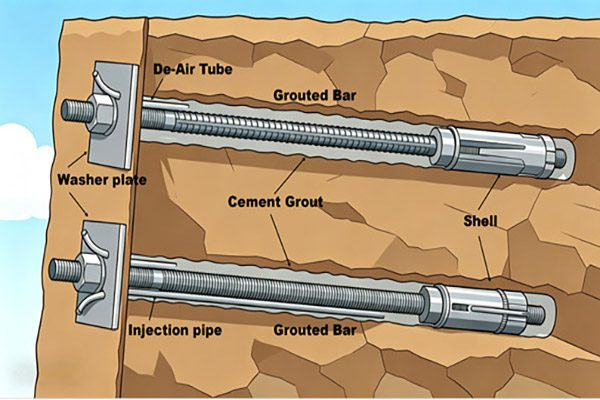
Technical cross-section of a grouted rock bolt system used in soil stabilization. Detailed labels highlight the mechanical operation of the anchor bar, expansion shell, and grout injection pipe.
Grouted bolts are widely used in tunneling, mining, slope stabilization, and other geotechnical works where ground reinforcement, load sharing, and longer-term support are important. Because they can be designed in different ways, the term “grouted bolt” covers more than one type of system, which is also why the classification can become confusing in real projects.
Common Grouted Bolt Types
Grouted bolts can be classified by bonding material, anchorage arrangement, or installation route. These dimensions answer different questions, and one installed system may belong to more than one category. The table below provides a framework for understanding the individual types that follow.
| Classification basis | Main categories | What it describes |
|---|---|---|
| Bonding material | Cement grout Resin | The material used to form the bond and the related placement, setting, and quality-control sequence. |
| Anchorage arrangement | Full-length bond Defined bond length with a free length Point or combination anchorage | Where the tendon is bonded and how the specified load is transferred into the surrounding ground. |
| Installation route | Conventional predrilled installation Self-drilling hollow-bar installation | How the hole is formed and how the reinforcing element and grout are installed. |
These categories overlap rather than compete. For example, a self-drilling hollow bar describes an installation route, while the same system may use cement grout and develop bond along its installed length. The classification should therefore be read as a set of design and construction characteristics, not as a list of mutually exclusive products.
1. Cement-Grouted Bolts
Cement-grouted bolts use cementitious grout to bond a steel bar or tendon to the borehole wall. They are widely used in underground and geotechnical reinforcement, but the material name alone does not establish service life, cost, or capacity. Performance depends on the specified grout mix, bond length, borehole condition, grout placement, curing, corrosion-protection details, and installation control.
2. Resin-Grouted Bolts
Resin-grouted bolts use resin cartridges or another specified resin system to form the bond. They are often considered when the construction sequence requires controlled and relatively rapid strength development, particularly in mining and fast-moving excavation work. Product set time, cartridge arrangement, mixing, hole dimensions, temperature, and installation procedure must all match the approved system. Resin should not be treated as universally faster or more suitable without those project-specific conditions.
3. Fully Grouted Bolts
Fully grouted bolts describe an anchorage arrangement rather than a separate material family. Grout or resin bonds the bar continuously along the intended embedded length, allowing load to transfer between the bar and surrounding ground through that bonded interface. The actual load distribution is not necessarily uniform; it depends on the stiffness and condition of the bar, grout, borehole, and ground.
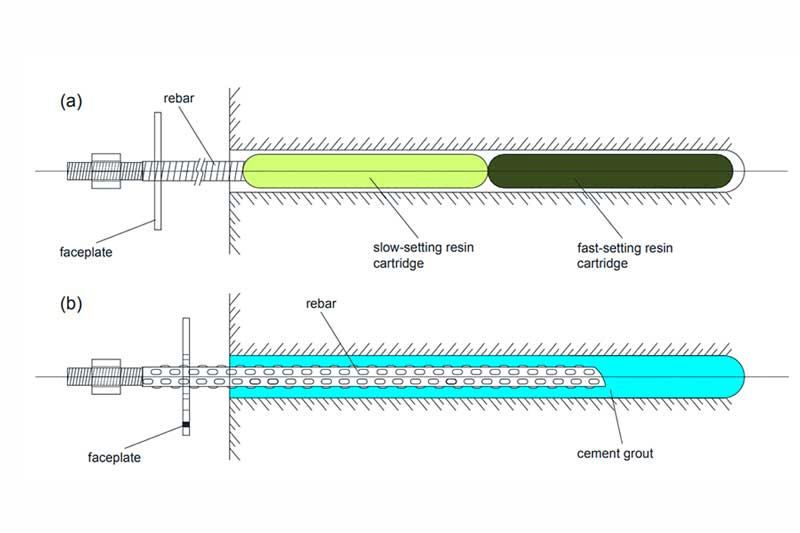
Fully grouted rock bolt arrangements: fully resin-grouted bolts (top) and fully cement-grouted bolts (bottom).
Full-length bonding is commonly used for passive reinforcement such as soil nails and untensioned rock dowels. However, full-length grout by itself does not prove that every system is passive. The design intent, installation sequence, head details, and any applied tension determine how the installed reinforcement works.
4. Defined Bond-Length and Free-Length Arrangements
Some tensioned anchor arrangements divide the tendon into a defined bond length and a free length. The bonded zone transfers the tendon force into the surrounding ground, while the free length allows the tendon to elongate during stressing without being bonded over that portion. After the specified bond has developed, the tendon can be tensioned and locked off according to the design and test procedure.
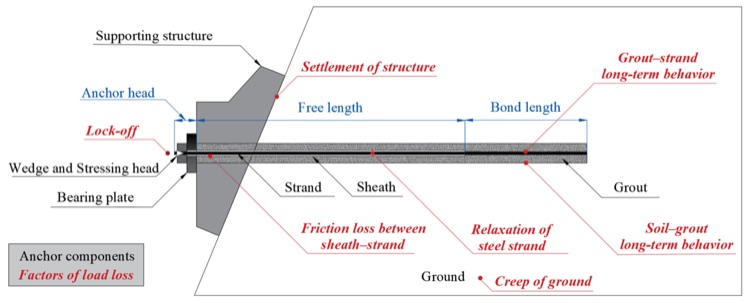
A prestressed ground anchor with a defined free length and bond length.
This arrangement is sometimes described loosely as “end grouted,” but that term can be misleading. The bond is not simply a small point at the hole tip, and the load should not be described as universally concentrated at the bottom. Its position and length are design variables.
5. Point and Combination Anchorage Systems
Point and combination anchorage are additional configurations used in some underground support systems. A specified system may combine a mechanical anchor with resin or grout so that the mechanical component provides initial anchorage or permits tensioning while the bonded material provides the required anchorage after it develops strength. This classification is especially common in mining roof support and should not be treated as a universal description of every civil ground anchor or soil nail.
Combination anchorage does not always mean a mechanical expansion anchor plus grout. Some specialized systems combine a localized resin anchorage zone with a separate cement-grouted body. The example below uses a resin body at the distal end and a cement-grouted body around a PVC-cased portion of the tendon. It illustrates one patented research configuration, not a standard detail for every combination-anchored bolt.
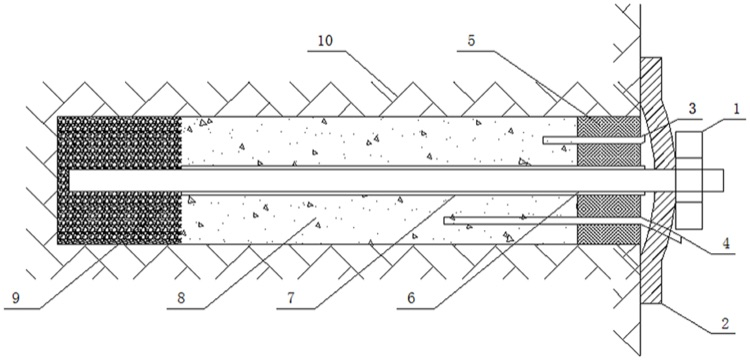
Example of a specialized resin-and-cement combination anchor: 1 nuts, 2 anchor tray, 3 exhaust pipe, 4 grouting pipe, 5 sealing plug, 6 anchor, 7 PVC casing, 8 grouting body, 9 resin body, and 10 surrounding rock.
MSHA’s mine-roof support guidance distinguishes fully grouted, tensioned rebar, point or combination-anchored, and mechanically anchored resin-assisted systems. This is useful for understanding mining configurations, although the approved project specification remains the controlling reference.
6. Self-Drilling Grouted Bolt Systems
Self-drilling grouted bolt systems, often based on hollow bars, describe an installation route. A sacrificial drill bit and hollow threaded bar advance together, and the bar remains as the reinforcing element. Grout is delivered through the hollow core during or after the specified drilling and flushing sequence to form the required bond.
This method is especially useful in weak, fractured, loose, or collapsing ground where a conventional open borehole may not remain stable long enough for normal bar installation. Combining drilling and grouting can reduce separate installation steps, but suitability still depends on ground conditions, drilling parameters, grout procedure, design role, and quality control. ApexRoc offers self-drilling anchor systems for projects where this installation route is specified.
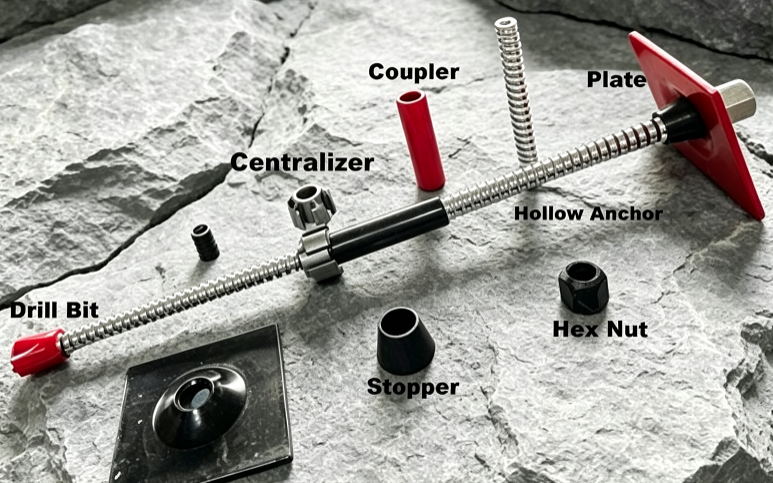
CQ ROCKBOLT’s high-efficiency self-drilling anchor systems are designed for seamless drilling and grouting in collapsing ground.
What to Consider Before Selecting Grouted Bolts
Selecting a grouted bolt requires more than choosing a bar and bonding material. The design must define the ground-support role, anchorage arrangement, installation route, required strength-development sequence, and service-life requirements. A system suited to passive reinforcement may not provide the free length and head details required for a tensioned anchor.
1. Ground Condition and System Role
Ground condition is the starting point. Rock strength, discontinuities, soil type, weathering, groundwater, and the stability of the surrounding ground affect borehole construction and bond performance. The design must also establish whether the element functions as a rock bolt, soil nail, rock dowel, or tensioned ground anchor. These systems may use related bars and grout, but their structural roles are not interchangeable.
2. Borehole Stability
Some ground conditions allow a clean drilled hole to remain open long enough for conventional bar installation and grouting. In loose, broken, or collapsing ground, the hole may close or deteriorate before the reinforcement can be installed properly. A self-drilling hollow-bar system may be considered where the approved construction method needs drilling and grouting to proceed as a more continuous operation.
3. Anchorage and Loading Requirement
The design should state whether continuous full-length bond, a defined bond length with a free length, or another approved anchorage arrangement is required. It should also identify whether the element is installed as passive reinforcement or must be stressed and locked off. These decisions affect the bar, head assembly, bond zone, installation sequence, testing, and acceptance criteria.
4. Required Strength-Development Sequence
Construction timing can influence material and system selection. Resin may be considered where the approved procedure requires controlled early anchorage, while cement grout follows its specified mixing, placement, and curing sequence. Neither material should be selected from a generic speed comparison alone; site temperature, groundwater, hole condition, product data, and the next construction stage must be considered.
5. Design Life, Corrosion Protection, and Durability
The required service life and exposure conditions determine the corrosion-protection strategy. Moisture, groundwater chemistry, grout coverage, cracks, and head exposure can all affect steel durability. Depending on the project, protection may include grout encapsulation, hot-dip galvanizing, duplex coatings, or another specified system. The final detail must match the design life and applicable project requirements.
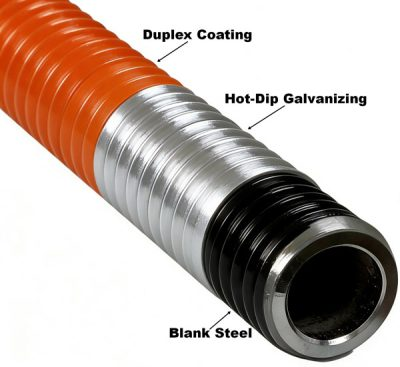
Corrosion protection design for CQ ROCKBOLT hollow bar systems
6. Grout Compatibility and Site Practice
The selected bolt system must be practical to install and inspect on site. Grout or resin type, mixing quality, pumping or cartridge procedure, borehole cleaning, crew experience, equipment, and installation records all affect the completed work. The product, anchorage configuration, construction method, and quality-control plan should therefore be checked as one system.
Conclusion
Grouted bolt types are easier to compare when bonding material, anchorage arrangement, and installation route are treated as separate but overlapping classifications. Selection should then follow the required ground-support role: passive or tensioned, fully bonded or built with a defined bond and free length, conventionally installed or self-drilling.
For projects involving unstable ground or difficult borehole conditions, an integrated self-drilling anchor system may provide a practical installation route when it is supported by the design and site procedure. CQ ROCKBOLT supplies hollow-bar systems and compatible components for these grouted reinforcement applications.
Related News
Other news you might be interested in

How to Choose a Reliable Self-Drilling Anchor System Manufacturer
In underground mining, tunneling, slope stabilization, deep excavation support, and foundation reinforcement projects, complex ground conditions often determine the difficulty of the support solution. In soft ground, fractured rock, weathered rock masses, or water-bearing formations, conventional pre-drilled holes can collapse, jam, or lose borehole stability. By combining drilling, anchoring, and grouting into one process, a self-drilling anchor system has become an important solution in geotechnical engineering.However, selecting the right self-drilling anchor is only the first step. A manufacturer's ability to consistently supply compatible hollow threaded bars, sacrificial drill bits, couplers, bearing plates, nuts, and grouting accessories, while understanding actual ground support requirements, directly affects installation efficiency, anchorage quality, and project safety.

How to Install Rock Bolts: A Complete Step-by-Step Guide
A reliable ground support system is not complete simply because the drill has reached the design depth. Borehole condition, compatibility between the bolt and accessories, correct grouting or anchoring procedures, and traceable installation records all affect the final support performance. For installation crews, a loss of control at any stage can disrupt later operations. For project managers and procurement teams, system compatibility and process records are equally important.
Want to know more?
Get in touch with us for more information about our services and products.