

Hollow Threaded Bars: How They Work in Self-Drilling Anchor Systems

Dayang Yang
AuthorWith over 15 years of experience in the production and sales of ground anchoring and mining support products, we operate our own rock bolt and accessory manufacturing facility with stable large-scale production capacity. We are specialists in rock bolts, resin cartridges, anchor cables, bearing plates, and customized ground anchoring products for mining support and geotechnical anchoring solutions.
Hollow threaded bars are the steel-bar component used in many self-drilling anchor systems. Their hollow core provides a route for drilling flush and grout, while the continuous external thread allows compatible couplers, nuts, and bearing plates to connect the system. In geotechnical engineering, the bar is not selected in isolation: ground conditions, drill bits, drill rigs, grouting procedures, design loads, corrosion exposure, and project specifications all matter.
This guide explains where hollow threaded bars fit, what the R and T thread families mean in practice, and how to start a size discussion without treating a catalog size as a design recommendation.
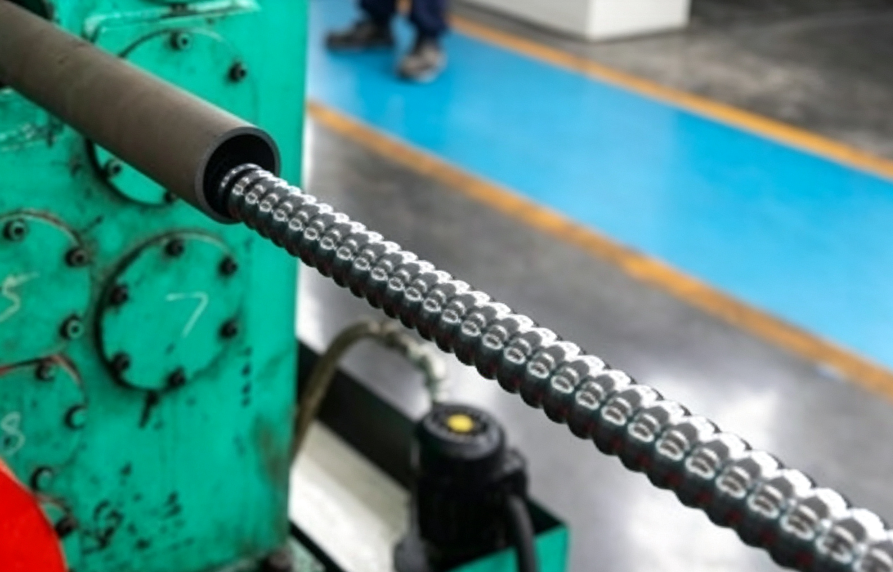
What Is a Hollow Threaded Bar?
A hollow threaded bar is a continuous-thread steel bar with a central bore. When assembled with a sacrificial drill bit, couplers, bearing plates, and nuts, it forms part of a self-drilling anchor system. The bar can act as the drill rod and grout conduit during installation, then remain as the steel reinforcing element in the completed system.
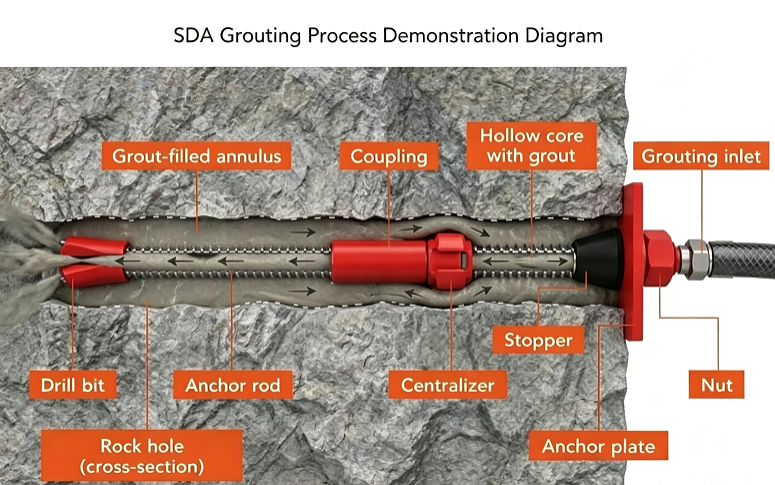
In a system illustration, the component labeled “Anchor Rod” is the hollow threaded bar. It carries grout through its central bore during installation and remains as the steel reinforcing element after installation.
For hollow-bar micropiles, the Federal Highway Administration describes Type E as drilling with grout injection through a continuous-thread hollow-core steel bar and sacrificial bit, so drilling and grouting are completed in one pass.
How a Hollow Threaded Bar Works in a Self-Drilling System
1. During Drilling and Grouting
The hollow threaded bar advances with a compatible drill bit. Its continuous external thread lets the bar function as a drill rod; on rope-thread bars, the self-cleaning profile can also help keep the thread clear during drilling. The sacrificial drill bit remains the component that cuts the ground. Grout or flushing medium can pass through the central bore as the system is drilled.
The final procedure, grout properties, grouting pressure, drilling method, and any casing requirements must follow the project design and installation plan. For an overview of active reinforcement using self-drilling anchor bolts, see CQ Rockbolt’s technical guide.
2. After Installation
The steel bar remains in the ground as part of the completed reinforcement system. Couplers extend the bar to the required installation length, while the bearing plate and nut transfer the specified load at the exposed head. The full system, rather than the bar alone, must be checked for material properties, connection compatibility, corrosion protection, and construction quality.
R Thread vs T Thread: What Do They Mean?
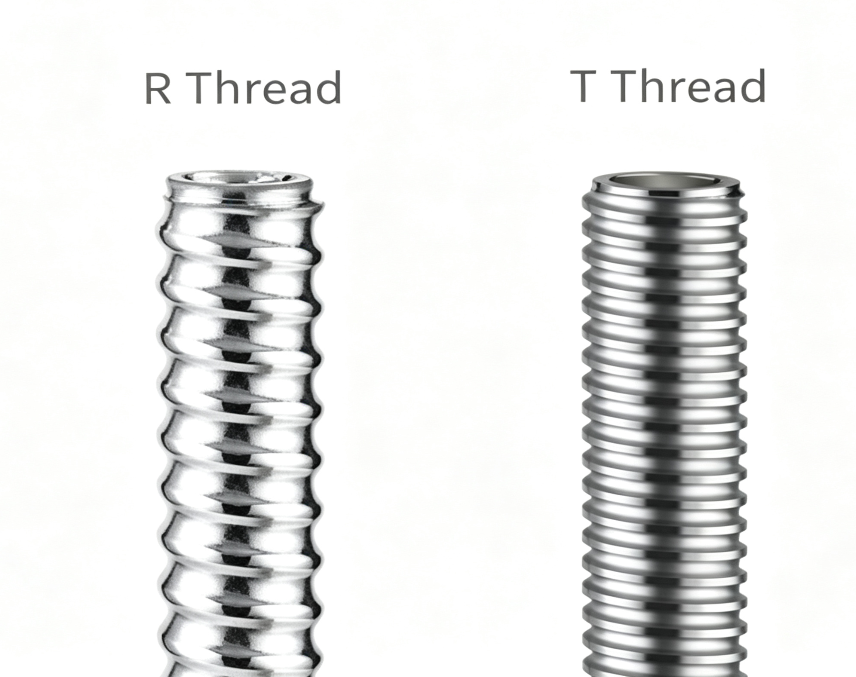
R and T identify the external thread geometry on a self-drilling hollow bar. An R thread is a rounded, wave-like rope profile. A T thread is a deeper trapezoidal profile with broader flanks. The difference matters principally at the steel-to-grout interface: the external profile creates the mechanical engagement between the bar and the hardened grout.
| Comparison Point | R Thread | T Thread |
|---|---|---|
| Thread geometry | Continuous rounded, wave-like rope profile with comparatively shallow flanks. | Deeper trapezoidal profile with broader flanks and a more pronounced mechanical key. |
| Bar-to-grout engagement | The rope profile provides a continuous external surface for load transfer into the grout body. | The deeper trapezoidal geometry can provide greater mechanical interlock at the bar-to-grout interface. |
| What it does not establish alone | Thread shape alone does not establish a fixed pull-out capacity, drilling-resistance value, or design load. Results also depend on bar size and steel section, grout, ground, drilling method, drill bit, and test arrangement. | Same. |
| Typical CQ Rockbolt series | R25, R32, R38, R51. | T30, T40, T52, T76, T103. The T range extends to larger nominal diameters, but R and T ranges overlap. |
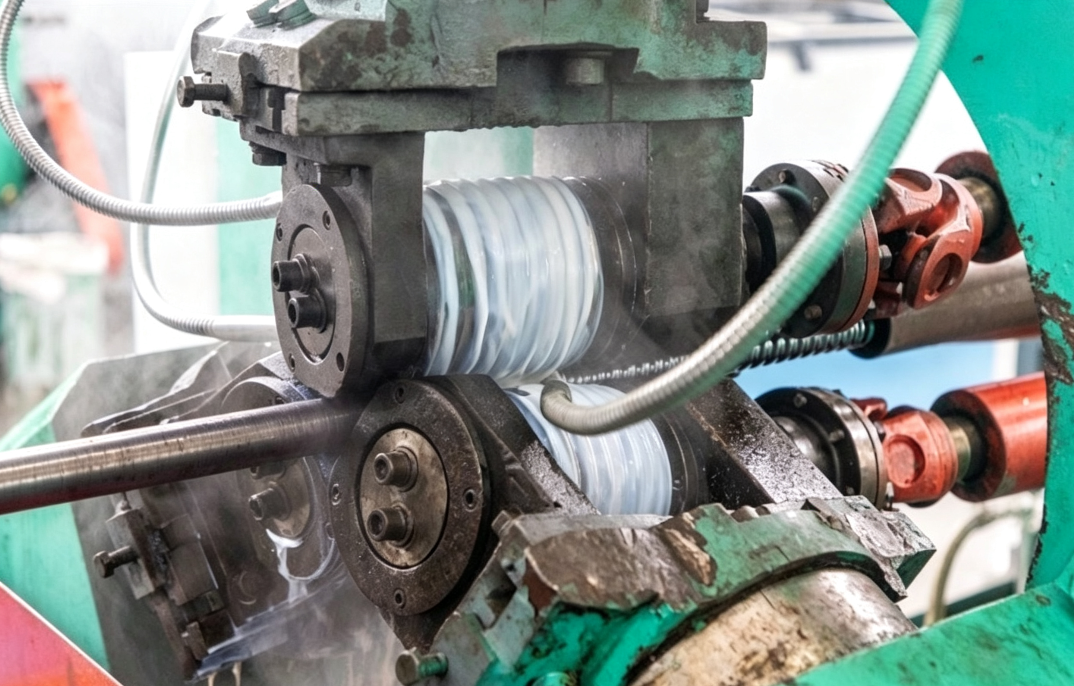
In practical selection, begin with the required load range and the candidate bar’s outer diameter, inner bore, steel section, and published model data. T-thread bars are often considered when a project moves into larger available bar sizes, but “T” is not a substitute for a model-specific capacity check. Likewise, an R-thread bar is not limited to one application merely because it has a rope profile.
Hollow Threaded Bar Sizes: How to Use Size Information Responsibly
CQ Rockbolt supplies a range of anchor and support products for mining support, tunnel support, and ground reinforcement. R25 to R51 R-thread bars and T30 to T103 T-thread bars identify system families and nominal outer diameters, but they do not prescribe one application per size. The same application can require different systems when the load path, ground, access, drill rig, drill bit, length, and durability requirements change.
| Published Size Family | What Changes | Application Discussion | What Must Still Be Confirmed |
|---|---|---|---|
| R25, R32, R38 | Bar section, internal bore, compatible couplers, drill bits, and handling requirements. | Initial discussions for soil nails, ground anchors, or other constrained-access ground-support work. | Required load, bond length, ground profile, drill tooling, and design specification. |
| R51, T30, T40, T52 | Connection family, steel section, available bit diameters, rig torque, and installation logistics. | Comparing self-drilling systems for ground support, retaining work, or micropile studies. | Whether the selected installation system and reinforcement meet project design and acceptance requirements. |
| T76, T103 | Larger steel sections and associated tooling, equipment, transport, and installation considerations. | Early discussions for higher-demand micropile, tunnel-support, or special foundation applications. | Design loads, connection checks, grout-to-ground bond, access, corrosion exposure, and testing requirements. |
Important: This table is a discussion guide, not a design rule. A smaller or larger nominal diameter is not automatically the correct choice for a particular application.
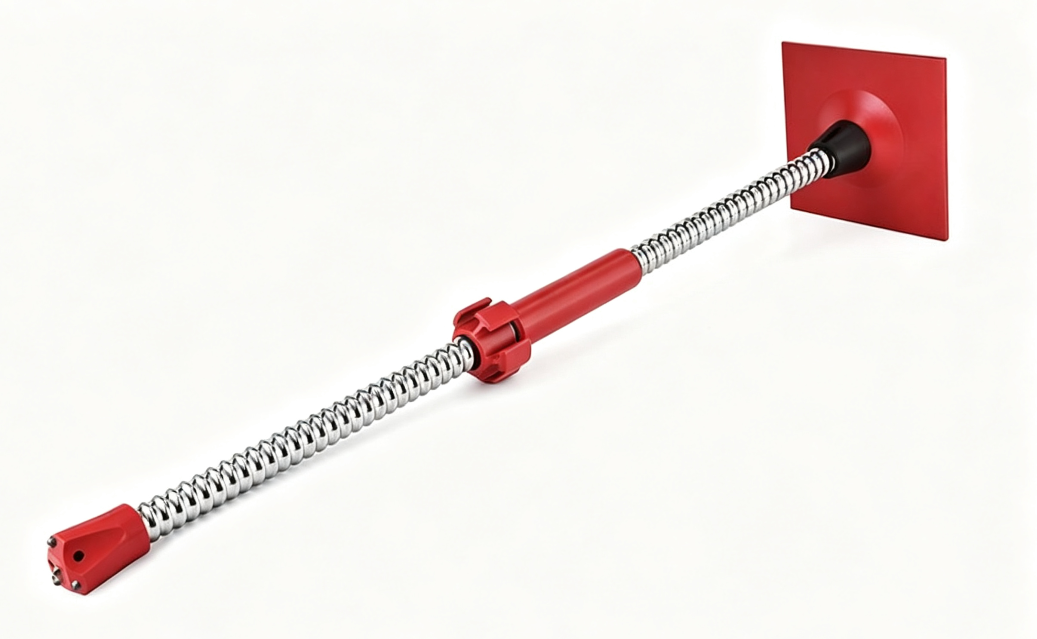
R‑Thread Self‑Drilling Hollow Bar System Components
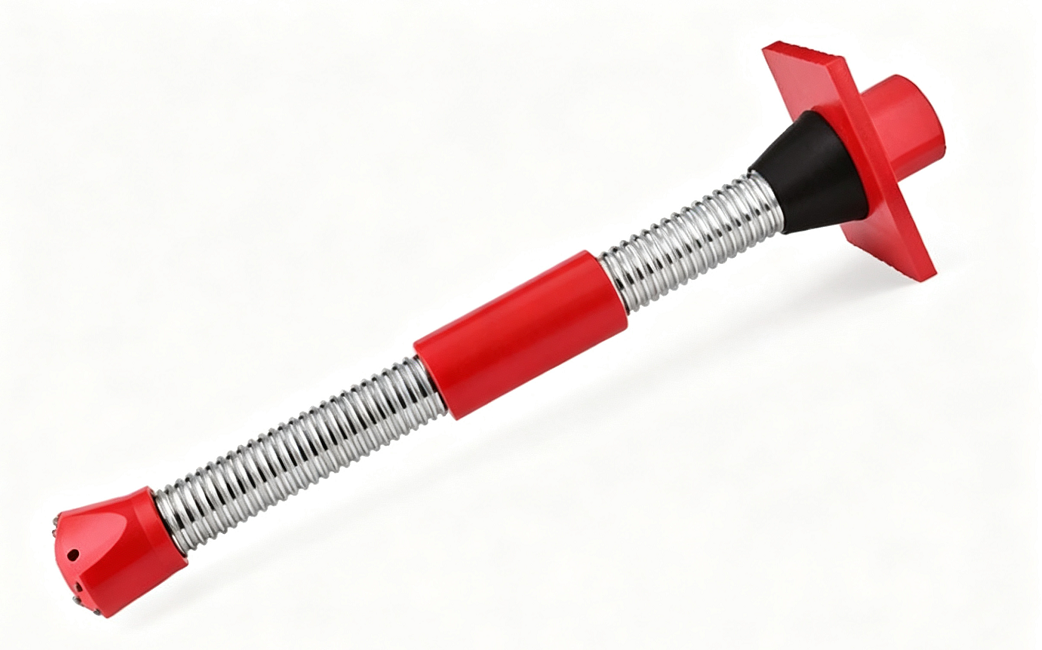
T‑Thread Self‑Drilling Hollow Bar System Components
Design Considerations: Load Transfer, Bond Length, and System Compatibility
A hollow threaded bar system should be evaluated as a complete load path, not simply by nominal bar diameter or published tensile value. Performance depends on how load transfers from the exposed head through the nut, bearing plate, couplers, steel bar, grout body, and surrounding ground. Design checks should consider the selected bar’s steel section, connection capacity, grout-to-ground bond, installation length, and governing project load combinations.
Bond length is determined by project-specific ground conditions, grout quality, drilling method, design load, and testing requirements. A longer bar does not automatically provide the required capacity if the effective bonded zone, grout placement, or ground response is not suitable. The project engineer should establish the design assumptions and confirm them through the applicable verification, proof, or performance testing program.
System compatibility also matters throughout installation. The bar, coupler, nut, bearing plate, drill bit, adapter, and drilling rig must belong to compatible system families and be used within their published limits. Substituting individual components without checking thread geometry, connection engagement, torque demand, or installation procedure can affect both constructability and completed-system performance.
Where Hollow Threaded Bars Fit Best
Hollow threaded bars can be evaluated when an integrated drilling-and-grouting system is practical, especially where an open borehole may be difficult to maintain or where access and sequencing matter. The final choice remains project-specific.
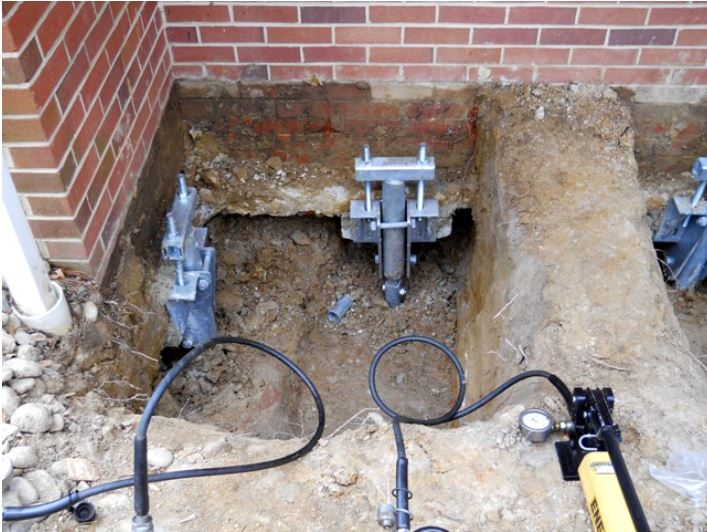
Installation Procedure and Quality Control for Self-Drilling Hollow Bar Systems
Installation begins with confirming the selected bar size, compatible drill bit, couplers, adapters, grout materials, and drilling equipment. The hollow bar advances with the sacrificial drill bit while grout or flushing medium passes through the central bore. Bar extensions are added with compatible couplers as drilling proceeds, and the drilling sequence should follow the approved project method statement.
Grout delivery and drilling records are important because the completed system depends on both the steel reinforcement and the surrounding grout body. The project procedure should define grout mix, pressure, flow, return criteria, drilling parameters, and any required regrouting or casing measures. Conditions such as loss of grout return, unstable ground, excessive deviation, or unexpected drilling resistance should be documented and addressed according to the project quality-control plan.
After reaching the specified depth, the exposed head is completed with the approved bearing plate and nut arrangement. Quality-control activities may include checking bar and component identification, installed length, grout records, coupler engagement, head details, corrosion-protection measures, and test results. Final acceptance should be based on the project specification, engineering design, and required inspection or testing procedures.
Durability and Corrosion Protection
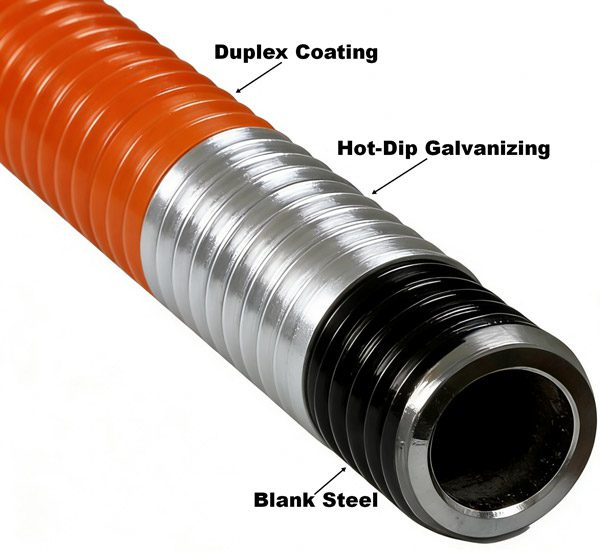
For permanent works, corrosion exposure and the required service life should be addressed during design. Coating or galvanizing options must be evaluated with the actual exposure condition, specified protection system, handling during installation, and project acceptance requirements. A coating option should not be presented as a universal durability solution.
For projects requiring customized bar lengths, thread specifications, surface treatments, or matching components, contact CQ Rockbolt for technical and quotation support.
Questions to Resolve Before Selecting a System
- What design loads, movement limits, and service-life requirements govern the work?
- Can the borehole remain stable through a conventional drill-and-grout sequence?
- Which bar, coupler, nut, drill bit, adapter, and rig are compatible as a system?
- What ground conditions, access limits, and drilling method are expected?
- What grouting procedures, quality-control records, testing, and corrosion protection are specified?
Conclusion
A hollow threaded bar is the core component of a self-drilling anchor system, but it is not a stand-alone specification. A sound selection starts with the required system function, then checks dimensions, compatible components, ground conditions, installation method, durability, and project acceptance criteria.
CQ Rockbolt supplies rock bolts, anchor components, and related products for mining support and tunnel engineering. Browse the product range or contact the technical team to discuss available system data for project requirements.
Frequently Asked Questions
Is a hollow threaded bar the same as a self-drilling anchor system?
No. The hollow threaded bar is the core steel component. A self-drilling anchor system includes the bar, compatible drill bit, couplers, nuts, bearing plates, adapters, and installation procedure.
Does a larger hollow bar always mean it is right for a micropile?
No. Nominal diameter is only one input. The selected system must be checked against design load, ground conditions, grout-to-ground bond, connection details, drilling equipment, corrosion exposure, and project specifications.
Do hollow threaded bars always eliminate casing?
No. An integrated hollow-bar system may be useful where open-hole stability is poor, but casing requirements depend on the ground, installation method, and project specification.
Can R-thread and T-thread systems be compared only by thread profile?
No. Although product specifications identify compatible system families, selection also requires published bar dimensions, bore size, steel section, drill-bit range, drilling equipment, ground conditions, required load, and project specifications.
Related News
Other news you might be interested in

Coal Mine Roadway Support Systems: How Rock Bolts, W-Straps, Mesh and Cable Bolts Work Together
Coal mine roadways are essential to safe, continuous underground operations. Their stability can be affected by changing geological conditions, mining-induced stress and excavation activity. As ground-control research increasingly focuses on the overall coordination and monitoring of support systems, rock bolts, W-straps, mesh and cable bolts should not be viewed as isolated components, but as elements that work together under site-specific mine conditions. This article explores their complementary roles in coal mine roadway support, while recognizing that support designs must be based on the conditions of each mine.

Five Major Advantages of Self-Drilling Anchors in Engineering Applications
In weak ground, fractured rock, loose soil, or rock masses with numerous joints, boreholes may narrow, shed material, or collapse. This can make it difficult to insert the anchor bar and may also affect subsequent grouting. Groundwater and changing strata add further uncertainty to construction.
Want to know more?
Get in touch with us for more information about our services and products.