

How to Prevent Tunnel Collapse in Soft and Wet Soil: A Technical Guide to Self-Drilling Anchor Systems

Dayang Yang
AuthorWith over 15 years of experience in the production and sales of ground anchoring and mining support products, we operate our own rock bolt and accessory manufacturing facility with stable large-scale production capacity. We are specialists in rock bolts, resin cartridges, anchor cables, bearing plates, and customized ground anchoring products for mining support and geotechnical anchoring solutions.
Underground excavation is inherently risky, but the danger multiplies when tunneling through soft, wet, or highly fractured soil. In regions with heavy rainfall and complex geology—such as Southeast Asia and coastal areas—traditional rock reinforcement methods often face a critical failure: the borehole collapses before the anchor can be inserted.
When facing loose clay, gravel, or water-saturated ground, relying on standard solid rock bolts is a recipe for project delays and safety hazards. For geotechnical engineers and mining operators dealing with these unstable conditions, the Self-Drilling Anchor (SDA) system is not just an alternative; it is the only reliable solution.
This technical guide breaks down why traditional methods fail in soft soil, how self-drilling anchors solve the problem, and how to source reliable SDA systems for your next underground project.
The Problem: Why Traditional Rock Bolts Fail in Wet Soil
In hard, stable rock, the installation process is straightforward: drill a hole, remove the drill rod, insert the rock bolt (like a split set or resin anchor), and secure it.
However, in soft or water-logged soil, this multi-step process breaks down completely due to borehole instability.
- As soon as the drill string is withdrawn, the wet soil immediately collapses into the newly drilled hole.
- Engineers are forced to use expensive and time-consuming casing systems to keep the hole open.
- Ground water pressure can wash away standard resin or cement grout before it sets.
This leads to massive losses in construction time, doubled labor costs, and unreliable anchor pull-out strength.
The Solution: How Self-Drilling Anchor (SDA) Systems Work
A Self-Drilling Anchor integrates three steps—drilling, anchoring, and grouting—into one single, seamless operation. It completely eliminates the need for pre-drilling and casing.
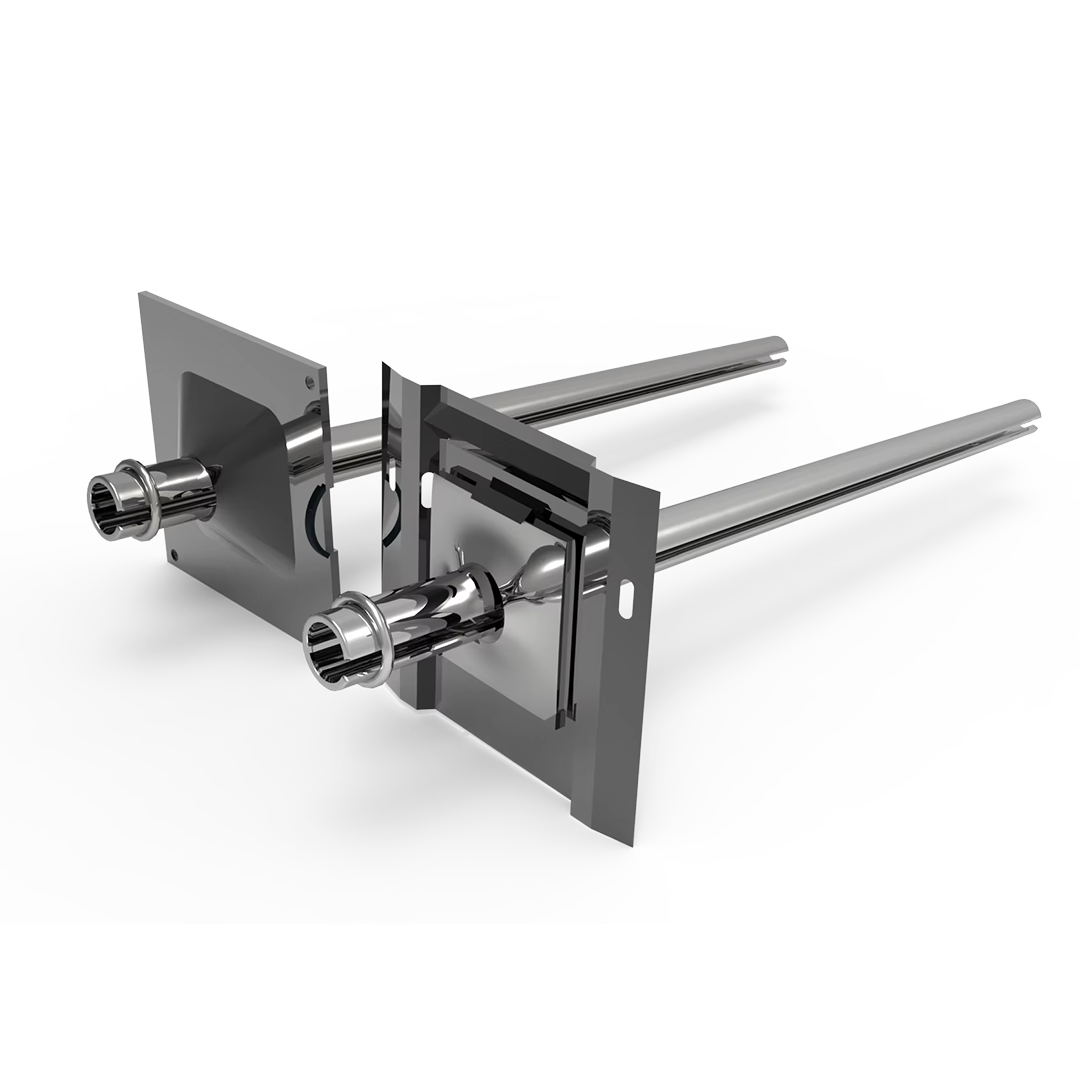
The system consists of a hollow, fully threaded steel bar, a sacrificial drill bit, a coupling (if extension is needed), a plate, and a nut.
Here is why it effectively prevents tunnel collapse:
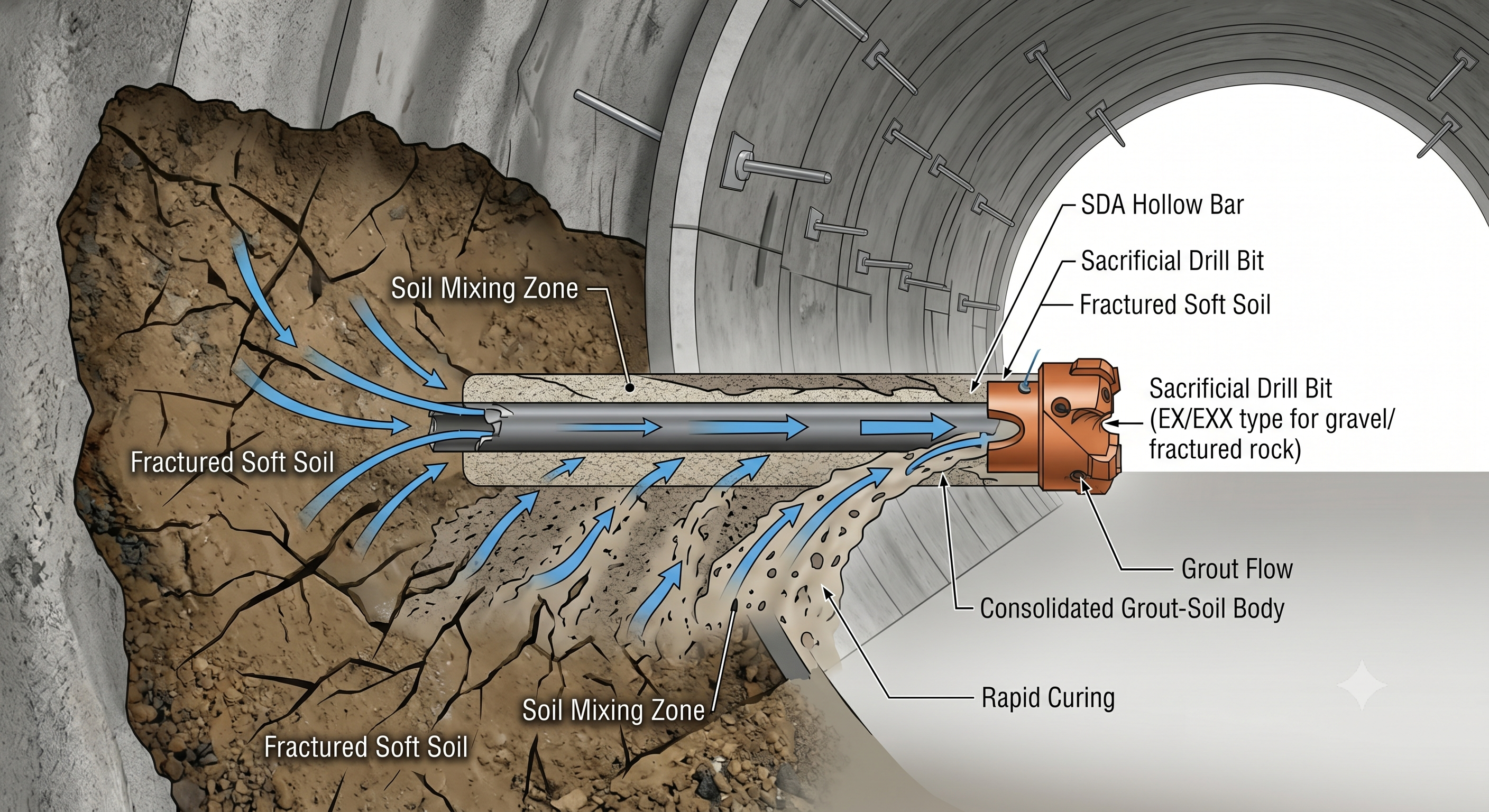
- The Bar is the Drill Rod: The hollow steel anchor acts as the drill rod itself. It is driven into the soft soil using a standard percussive rotary drill.
- Simultaneous Grouting: As the anchor is drilled into the wet soil, high-pressure cement grout is pumped directly through the hollow center of the bar.
- Flushing and Soil Mixing: The grout flows out through holes in the sacrificial drill bit. It flushes out debris and aggressively mixes with the surrounding soft soil.
- Immediate Consolidation: The cement-soil mixture fills all cracks and voids, curing rapidly to form a reinforced, high-strength cylinder around the steel bar. The anchor remains permanently in the ground.
Technical Selection: Choosing the Right SDA Components
Sourcing the right SDA system requires precise matching to your geotechnical conditions. Procurement managers and engineers should pay attention to the following specifications:
1. The Hollow Bar (Thread Standard)
SDA bars are categorized by their thread profiles, commonly R-thread (Rope thread) or T-thread (Trapezoidal thread).
- R-Thread (e.g., R32, R38): The industry standard for most tunneling and slope reinforcement. It allows for excellent grout flow.
- T-Thread (e.g., T40, T76): Provides a larger cross-sectional area and higher tensile strength, ideal for extreme high-stress marine engineering and deep tunnel portals.
2. The Sacrificial Drill Bit
The drill bit is left in the ground, so selecting the right type for the soil is critical for both efficiency and cost control.
- EX / EXX Bits (Hardened Cross Bits): Best for mixed ground containing gravel or fractured rock.
- Clay Bits / Tungsten Carbide Drop Center: Designed specifically for soft, sticky clay and wet soil, preventing the grout holes from clogging during drilling.
Sourcing SDAs: What to Look for in a Chinese Manufacturer
Self-drilling anchors operate under immense torque and pressure. A failure in the threading or a crack in the hollow bar during drilling can halt a project. When sourcing SDA systems directly from China, evaluate the manufacturer on these core disciplines:
- Thread Integrity: The threads must run the full length of the bar to allow the bar to be cut or coupled at any point. Poor machining leads to stripped threads during high-torque drilling.
- Wall Thickness Consistency: Because high-pressure grout flows through the center, any unevenness in the steel wall thickness can cause the bar to burst under pressure.
- Factory Direct Quality Control: Look for ISO 9001 certified manufacturers who conduct rigorous yield strength and tensile strength testing before export.
Conclusion
Tunneling through soft, wet soil does not have to result in collapsed boreholes and spiraling budgets. By upgrading from traditional rock bolts to Self-Drilling Anchor systems, engineering teams can achieve faster installation times, eliminate the need for casing, and guarantee structural stability even in the most challenging geotechnical environments.
FAQ: Self-Drilling Anchor Systems
Can Self-Drilling Anchors be used in hard rock?
While they are designed to solve soft soil and collapsing borehole issues, SDAs can be used in hard rock using specialized tungsten carbide button bits. However, for highly stable hard rock, traditional friction bolts (split sets) or resin anchors are usually more cost-effective.
Do I need a special drill rig to install SDA bolts?
No. SDAs can be installed using standard percussive rotary drilling equipment (jumbos or hand-held rock drills) fitted with the correct shank adaptor to allow for simultaneous grout flushing.
How do you connect multiple SDA bars for deep anchoring?
SDA bars are fully threaded and can be easily extended using high-strength coupling nuts. The couplings are designed to maintain the continuous flow of grout through the hollow center without leaking.
Facing challenging ground conditions on your next project?
As a source manufacturer of premium ground support equipment, CQ Rockbolt provides fully certified Self-Drilling Anchor systems tailored to your specific geological challenges.
Related News
Other news you might be interested in

Ground Support in Weak and Fractured Rock: How to Select Rock Bolt Systems for Mining and Tunneling
In underground mining, tunneling, slope excavation, and foundation pit construction, ground stability does not depend only on the strength of an individual rock bolt. Where the ground contains developed joints and fractures, loose rock, unstable boreholes, significant groundwater, or strong excavation disturbance, a single rock bolt support measure may not provide every required support function. A reliable ground support system must consider ground conditions, support objectives, equipment capacity, borehole stability, grouting procedures, system accessories, and long-term durability. Project teams can review the available systems in the CQ Rockbolt product center before selecting a solution that matches the actual site conditions, rather than choosing only by product name or rated capacity.

Why Does the Mining Industry Use Self-Drilling Anchors?
As underground mining moves into deeper and more complex areas, ground stability has become a critical factor affecting both safe production and development efficiency. Fractured rock, fault zones, high in-situ stress, groundwater, and ongoing mining-induced disturbance can all cause deformation or loosening at roadway roofs, sidewalls, and intersections. The objective of modern mining ground support is not simply to address local instability, but to create a stable working environment for mining, haulage, and ventilation through reliable rock reinforcement solutions.
Want to know more?
Get in touch with us for more information about our services and products.