
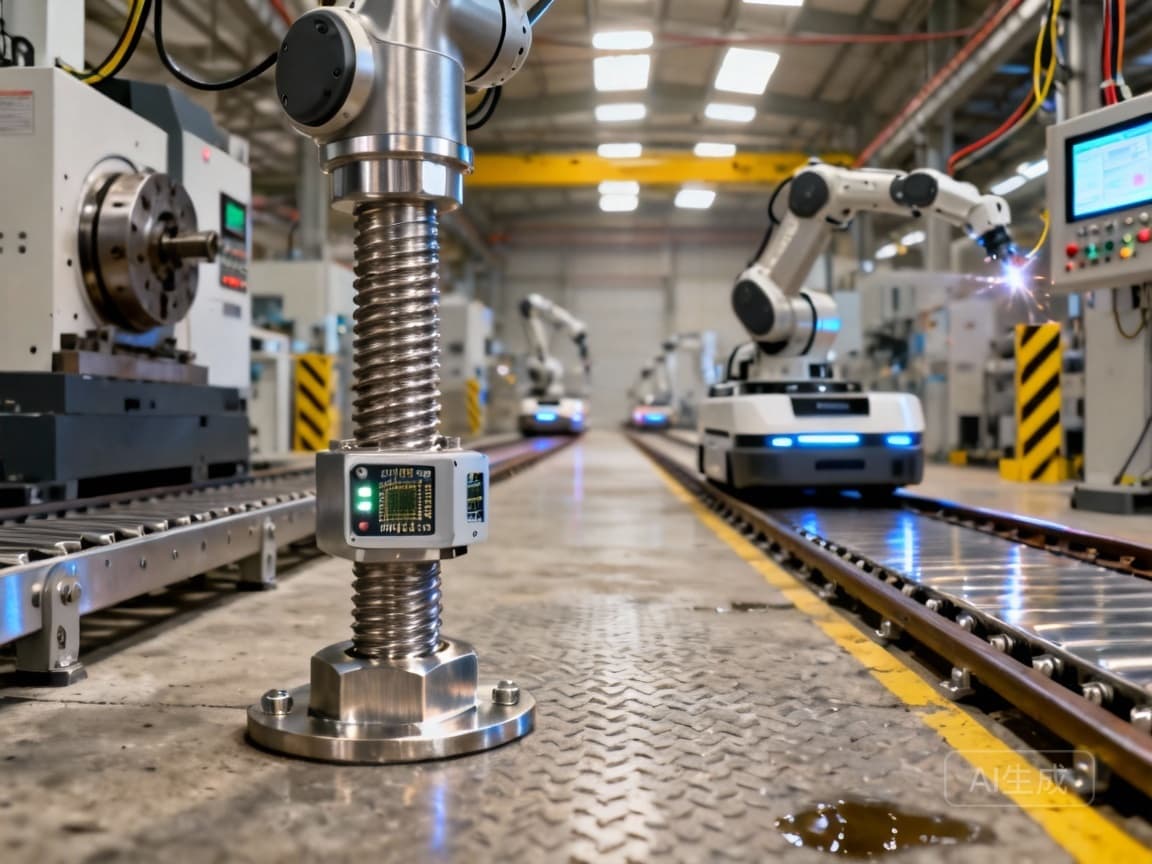
Smart Anchoring Systems: Enable 3.3% Trade Growth & Automated Factories

Dayang Yang
AuthorWith over 15 years of experience in the production and sales of ground anchoring and mining support products, we operate our own rock bolt and accessory manufacturing facility with stable large-scale production capacity. We are specialists in rock bolts, resin cartridges, anchor cables, bearing plates, and customized ground anchoring products for mining support and geotechnical anchoring solutions.
The Silent Guardians of Automation: Why Smart Anchoring Systems Are Manufacturing's Critical Infrastructure
As manufacturing accelerates toward fully automated "dark factories" and global merchandise trade is projected to grow by 3.3% in 2025, a critical question emerges: when factories operate without human supervision, which component failure could cause the most catastrophic losses? The answer lies not in flashy robotics or AI systems, but in the fundamental infrastructure that holds everything together—advanced anchoring systems that have evolved from simple mechanical fasteners to intelligent safety components.
The Automation Imperative: Zero-Margin for Error
The rise of completely automated manufacturing facilities represents one of the most significant industrial shifts of our decade. According to Advanced Tech's manufacturing trends analysis, these "dark factories" operate with minimal human intervention, relying on IIoT security frameworks with zero-trust architecture and AI threat detection. In this environment, a single anchor failure can trigger cascading system failures that cost millions in downtime and equipment damage.
Consider the mathematics of automation downtime: a major automotive manufacturer calculated that every minute of production stoppage costs approximately $22,000 in lost revenue and recovery expenses. When a robotic assembly line shifts due to inadequate anchoring, the resulting misalignment can halt entire production cells. Smart anchoring systems with embedded sensors can detect micro-movements and stress changes before they become critical failures, providing the reliability backbone that automated factories demand.
Fully automated 'dark factories' represent the pinnacle of manufacturing efficiency, but they demand infrastructure components with near-perfect reliability ratings—especially for foundational elements like anchoring systems that support entire production ecosystems.
Trade Growth Driving Infrastructure Expansion
The WTO projects global merchandise trade growth of 2.6% in 2024 accelerating to 3.3% in 2025, with Africa leading export growth at 5.3%. This expansion directly translates to increased manufacturing capacity requirements and infrastructure development. New production facilities, warehouse expansions, and logistics centers all require advanced anchoring solutions that can support heavier loads, dynamic stresses, and longer service life.
This growth creates a hidden demand surge for high-performance anchoring systems. Every new manufacturing facility requires thousands of anchor points for machinery, robotics, and structural components. The transition toward reshoring—driven by skilled workforce availability and policy changes—further accelerates this demand as companies rebuild domestic manufacturing capabilities with modern automation standards.
IIoT Integration: From Mechanical Fasteners to Smart Components
The convergence of manufacturing automation trends and IIoT security requirements creates unprecedented opportunities for anchoring system innovation. Modern smart anchoring systems incorporate:
- Embedded strain gauges that monitor load distribution in real-time
- Micro-movement sensors that detect shifts as small as 0.1 millimeters
- Wireless connectivity integrating with plant-wide IIoT networks
- Predictive analytics algorithms that forecast maintenance needs based on stress patterns
These capabilities transform traditional anchoring from passive components to active safety systems that contribute to overall facility intelligence. They align perfectly with zero-trust security architectures by providing verifiable integrity data for critical infrastructure components.
Implementation Framework: Upgrading to Smart Anchoring Systems
For manufacturing operations planning automation upgrades or new facility construction, implementing smart anchoring systems requires a structured approach:
Phase 1: Infrastructure Assessment
- Conduct laser alignment scans of existing machinery and structural supports
- Map anchor points against equipment criticality ratings
- Identify high-risk areas where failures would cause cascading shutdowns
Phase 2: Technology Integration Planning
- Select anchoring systems with appropriate sensor capabilities for each application
- Plan IIoT network integration points for data collection
- Establish baseline measurements for ongoing performance monitoring
Phase 3: Continuous Monitoring Implementation
- Install cloud-connected monitoring platforms for real-time anchor integrity data
- Set alert thresholds based on equipment tolerances and safety factors
- Integrate with existing maintenance management systems for automated work orders
Cost-Benefit Analysis: The ROI of Smart Anchoring
While smart anchoring systems represent a 15-25% premium over conventional alternatives, the financial justification becomes clear when examining automation downtime costs. A mid-sized automotive parts manufacturer documented these results after implementation:
- 74% reduction in unplanned downtime related to equipment shifting
- $2.3 million annual savings in avoided production interruptions
- 18-month ROI on the smart anchoring investment
- 27% improvement in preventive maintenance scheduling accuracy
These figures demonstrate that in highly automated environments, the reliability premium of advanced anchoring systems delivers substantial financial returns while providing the infrastructure confidence required for unattended operation.
Future-Proofing Manufacturing Infrastructure
As spatial computing approaches $200 billion by 2025 and AI-driven optimization becomes standard in manufacturing, the physical infrastructure supporting these technologies must evolve accordingly. Smart anchoring systems represent the foundation upon which automated manufacturing builds its reliability—transforming from simple mechanical components to critical intelligence infrastructure that supports the next generation of industrial productivity.
The manufacturing facilities that will lead in 2025 and beyond aren't just automating their processes; they're building intelligent infrastructure ecosystems where every component, down to the anchors securing equipment to the floor, contributes to overall system intelligence, reliability, and performance. In the era of dark factories and global trade expansion, smart anchoring systems have become silent guardians of manufacturing continuity—proving that sometimes, the most critical technologies are those you never see until they prevent a catastrophe.
Related News
Other news you might be interested in

Resin Cartridges for Rock Bolts: Gel Time, Temperature and Storage Checks Before Ordering
A quotation for resin cartridges may list a diameter, length and setting-speed code. For a mining or tunneling buyer, those details leave several questions unanswered: Does the timing apply at the temperature underground? Does it fit the specified bolt and installation method? How much usable shelf life will remain when the shipment reaches the mine?When comparing resin cartridges for rock bolts, ask suppliers to identify the exact product, explain its timing conditions and document its storage requirements. This guide sets out the information to collect before ordering so that technical and commercial offers can be compared on the same basis.

Friction Rock Bolt Specifications: What Buyers Should Confirm Before Ordering
A friction rock bolt quotation is difficult to compare when it lists only a diameter, a length and a price. Buyers also need to know which product drawing applies, what is included, how the proposed bolt matches the drilling arrangement, and what the quoted performance figures actually describe.For mine engineers, technical buyers and ground-support distributors, the practical starting point is a clear specification package. This guide focuses on the slotted-tube friction bolt commonly described in product catalogues as a split set friction bolt. CQ Rockbolt lists this product family for underground mining and tunneling; the exact model and supply details should be confirmed against the current quotation.
Want to know more?
Get in touch with us for more information about our services and products.