

Enhancing Underground Safety and Efficiency: The Next Generation of Rock Bolting Solutions

Dayang Yang
AuthorWith over 15 years of experience in the production and sales of ground anchoring and mining support products, we operate our own rock bolt and accessory manufacturing facility with stable large-scale production capacity. We are specialists in rock bolts, resin cartridges, anchor cables, bearing plates, and customized ground anchoring products for mining support and geotechnical anchoring solutions.
The Hidden Costs of Inadequate Ground Support
When a rock bolt fails underground, the consequences ripple far beyond a single anchor point. Yet many operations continue to accept subpar performance as normal—treating ground support as a commodity rather than a strategic investment. Bolt quality and installation precision directly determine whether your crew goes home safely and your production targets stay on track.
Dust contamination in glue-in bolts remains one of the most overlooked failure modes we encounter. A resin capsule or resin cartridge installed in a dusty borehole never achieves its design bond strength—and that compromised anchor becomes a liability the moment strata loads shift. Similarly, improper torque application on threaded steel rebar bolts creates a false sense of security; the bolt may feel tight at installation but lacks the tensile strength reserve needed when ground pressure intensifies.
Industry research from 2024 confirmed what experienced ground control engineers already knew: two of the most significant operational challenges were anticipating failure points before they manifest and maintaining consistent quality across every bolt in every heading. One improperly set expansion shell or an under-torqued hex nut can cascade into a ground fall that halts production for days. Without rigorous quality assurance and components built to precise specifications, even the most carefully engineered support designs fail—turning predictable maintenance into emergency rehabilitation with costs that erase narrow operating margins.
Critical Factors for Reliable Rock Bolting Systems
Selecting rock bolts isn't about picking the strongest product on the shelf. It's about matching mechanical properties to the ground you're actually dealing with. Three properties demand your attention: yield strength determines when permanent deformation begins, tensile strength sets the ultimate breaking point, and load bearing capacity defines what the system handles before the rock mass itself yields. Get any of these wrong, and you're engineering a failure into your support plan.
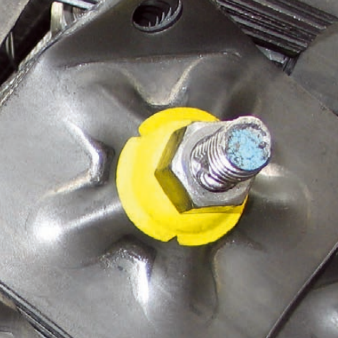
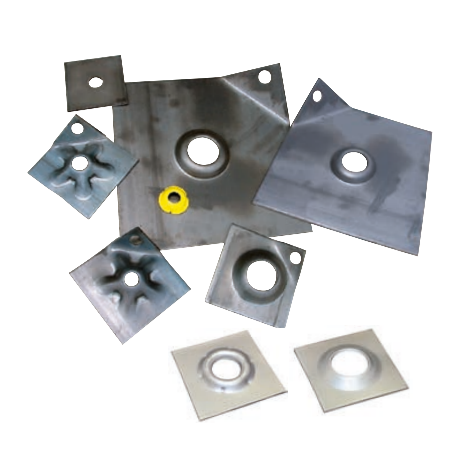
But the bolt is only half the equation. Surface hardware—often treated as an afterthought—makes or breaks system performance. Irregular rock faces create angular misalignment between the bolt and the anchor plate, concentrating stress at a single point. That's where dome plates, spherical washers, and dome nuts become non-negotiable. These components accommodate angular surfaces up to 18°, distributing load evenly rather than shearing the bolt at the collar. Our Rocbolt accessories for rock and roof bolts—including domed, ribbed, and flat washer configurations alongside W-straps, couplers, and high-strength mining nuts—are engineered to maintain tension integrity even as ground conditions evolve throughout the mining cycle.
Surface control completes the system. Steel wire mesh, welded wire mesh, and chain link mesh each serve distinct roles in strata control and shotcrete reinforcement. The wrong mesh specification—or mesh that's improperly lapped and anchored—creates weak zones where small rockfalls can propagate into larger failures. Our mining wire mesh for underground slope support is manufactured to exacting specifications, ensuring consistent weld strength and dimensional accuracy that simplifies installation while maximizing areal coverage. When combined with butterfly plates that bridge mesh intersections, the entire surface support system works as a unified membrane rather than isolated components.
Innovations in Rock Bolting: From Swellex to Prestressing Anchorage
Water-inflatable Swellex rock bolts represent a generational advance in anchoring technology for underground mining and tunneling. Unlike mechanical point-anchored systems, Swellex bolts exert uniform radial pressure along the entire borehole length—effectively reinforcing the full rock mass annulus. Available in custom lengths and diameters with integrated sleeve configurations for specific ground conditions, these anchors eliminate the curing time and quality variables inherent in chemical or cementitious grouting. For operations where cycle time directly impacts profitability, that elimination of waiting translates to immediate productivity gains.
For decades, pipe seam anchors—known commonly as friction bolts—have provided straightforward, reliable ground support in metal mining. Their simplicity belies their effectiveness: insertion into an undersized borehole generates immediate frictional resistance along the entire bolt length, making them particularly valuable in squeezing ground where rigid bolts might fail. As a hollow grouting bolt variant, these anchors can also serve a dual purpose, enabling post-installation injection grout to create a permanently bonded reinforcement column.
Where active loading is required, our prestressing anchorage systems for PT bars and steel strands deliver reliable load transfer across applications spanning bridges, geotechnical anchoring, and structural reinforcement. A strand cable bolt with properly designed anchorage components applies controlled force to the rock mass, pre-compressing potentially unstable blocks before excavation-induced stress can trigger movement. Rocbolt tensioning equipment—including hydraulic jacks and strand tensioners rated from 100 to 250 kN—enables precise pre-loading with gauged systems that eliminate guesswork from the critical tensioning phase.
Proven Results: ROI and Safety Improvements
The global rock bolts market—projected to reach $1.38 billion by 2033—reflects a fundamental shift in how operators value ground support. This isn't growth driven by commodity price cycles alone; it reflects recognition that advanced bolting systems directly impact operational economics. When a single ground fall can cost hundreds of thousands in lost production, rehabilitation, and regulatory scrutiny, the investment case for premium components becomes self-evident.
Case studies presented at industry conferences consistently demonstrate a clear pattern: operations that move beyond guesswork and optimize mine support design with full-scale shear test data achieve measurable reductions in both incident frequency and unplanned downtime. Proper bolt selection informed by empirical data—not rule-of-thumb approximations—produces ground support that performs predictably under dynamic loading conditions, including seismic resistance scenarios where bolt ductility and energy absorption become life-safety factors.
Our clients report substantial improvements in rock mass stability when transitioning to integrated support systems. The combination is what matters: a properly selected bolt, correctly torqued with the right dome nut or hex nut, paired with mesh that's anchored by anchor plates designed for the specific surface geometry. Reduced rehabilitation requirements translate directly to lower maintenance costs and extended heading availability—metrics that mining engineers and financial controllers both appreciate.
Choosing the Right Ground Support System for Your Operation
No single bolt type or support configuration suits every geological environment. The decision framework must account for seismic resistance requirements in seismically active districts, strata control needs in heavily fractured or foliated rock masses, and corrosion considerations—whether galvanized steel or glass fiber reinforced polymer (GFRP) bolts—in acidic groundwater conditions or long-life infrastructure applications. Each variable narrows the field of appropriate solutions, and optimizing for one parameter at the expense of others creates vulnerabilities that reveal themselves under stress.
The complete system perspective spans far beyond the bolt itself. Chemical anchor bolts using polyester or epoxy resin cartridges offer rapid strength development in competent rock. Cementitious or quick-setting mortar grouts provide economical encapsulation where curing time is available. Post-tensioned strand cable bolts with cement grout encapsulation combine active reinforcement with full-column bonding. And for specialized applications—self-drilling anchors in collapsing ground, T-section steel sets in heavy squeezing conditions, or lattice girders for underground roadway reinforcement—selecting the right primary support element determines whether secondary support becomes necessary at all.
Ground support optimization requires more than a product catalog. It demands technical partnership with specialists who understand the interaction between expansion shell anchorage, sleeve friction, injection grout rheology, and the butterfly plate bearing response on irregular surfaces. Partner with our engineering team for a custom evaluation of your ground conditions. Request your assessment now.
Related News
Other news you might be interested in

Resin Cartridges for Rock Bolts: Gel Time, Temperature and Storage Checks Before Ordering
A quotation for resin cartridges may list a diameter, length and setting-speed code. For a mining or tunneling buyer, those details leave several questions unanswered: Does the timing apply at the temperature underground? Does it fit the specified bolt and installation method? How much usable shelf life will remain when the shipment reaches the mine?When comparing resin cartridges for rock bolts, ask suppliers to identify the exact product, explain its timing conditions and document its storage requirements. This guide sets out the information to collect before ordering so that technical and commercial offers can be compared on the same basis.

Friction Rock Bolt Specifications: What Buyers Should Confirm Before Ordering
A friction rock bolt quotation is difficult to compare when it lists only a diameter, a length and a price. Buyers also need to know which product drawing applies, what is included, how the proposed bolt matches the drilling arrangement, and what the quoted performance figures actually describe.For mine engineers, technical buyers and ground-support distributors, the practical starting point is a clear specification package. This guide focuses on the slotted-tube friction bolt commonly described in product catalogues as a split set friction bolt. CQ Rockbolt lists this product family for underground mining and tunneling; the exact model and supply details should be confirmed against the current quotation.
Want to know more?
Get in touch with us for more information about our services and products.