

Elevate Rock Mass Stability: Advanced Ground Support Solutions to Solve Mining & Tunneling Challenges and Drive 2026 ROI

Dayang Yang
AuthorWith over 15 years of experience in the production and sales of ground anchoring and mining support products, we operate our own rock bolt and accessory manufacturing facility with stable large-scale production capacity. We are specialists in rock bolts, resin cartridges, anchor cables, bearing plates, and customized ground anchoring products for mining support and geotechnical anchoring solutions.
Introduction: Addressing the Urgency of Unresolved Ground Support Challenges
According to Equipment Today February 2025 (ForConstructionPros.com), industry expert Tanel identified unplanned pain points from inadequate component selection and torque inaccuracies as 2024’s top ground support challenges—risks that persist for mining and tunneling operations heading into 2026. Low-quality bolts and improper torque application (a critical warning for rock reinforcement professionals) lead to compromised load bearing capacity, safety incidents, and costly project delays. With the global rock bolts market projected to reach $1.38 billion by 2033 (Rock Bolts Market Research Report 2033), organizations are increasingly prioritizing high-performance ground support systems to mitigate risks and unlock long-term ROI.
The Hidden Costs of Cutting Corners on Ground Support Components
Inaccurate torque (often from skipping manufacturer specs) reduces tensile strength and yield strength of bolts, leading to premature failure in underground roadway reinforcement projects. Low-quality accessories (e.g., washers, nuts) fail to accommodate angular surfaces, compromising tension stability and requiring costly rework in strata control applications. Corrosion-prone components increase maintenance costs over time, especially in humid or chemical-exposed mining environments—underscoring the need for galvanized or corrosion-resistant solutions like Glass Fiber Reinforced Polymer (GFRP) Bolts or chemical anchor bolts with resin cartridges. For optimal design, leverage insights from Beyond Guesswork: Optimize Mine Support Design with Full-Scale Shear Test Data to avoid these pitfalls.
Key 2026 Trends Shaping Ground Support System Investments

Equipment Today February 2025 highlights growing demand for immediate ground support solutions (e.g., friction anchors, water-inflatable bolts) to accelerate tunneling and mining timelines. SME_MXC24_Annual_Conf_Onsite_Program_F2_low.pdf emphasizes seismic resistance and corrosion resistance as non-negotiable features for 2026 geotechnical and mining projects. The $1.38 billion 2033 market projection (Rock Bolts Market Research Report) reflects industry shift toward premium, system-integrated ground support solutions over standalone components, driven by innovations like Smart Anchoring Systems Enable 33% Trade Growth via Automated Factories that enhance efficiency.
Proven Ground Support Products to Mitigate Risks and Boost Stability in 2026
- Swellex Rock Bolt: High-performance water-inflatable anchors for mining and tunneling—custom lengths/diameters deliver immediate rock mass stability in fractured or weak rock formations, often paired with shotcrete reinforcement for enhanced support.
- Friction Anchor Bolt (Split Set Bolt): High-tensile C-shaped steel tubes (33–47 mm, 0.6–3 m) with black/HDG finish, bearing rings, and plates—driven into undersized holes for full-length radial friction and immediate ground support, ideal for soft strata control.
- Rocbolt Tensioning Equipment for CableLok Anchors: Robust hydraulic kit (stressing jack, interchangeable jaws, shear rings, air/hand pump, 290 kN cable cropper) delivers accurate pre-loading (100–250 kN) for CableLok anchors, ensuring reliable load bearing capacity with safety slings for easy handling, crucial for strand cable bolt installations.
- Prestressing Anchorage System: High-performance systems for PT bars and steel strands—designed for post-tensioned concrete, bridges, and geotechnical anchoring with reliable load transfer and durability. Explore our Prestressing Anchorage System for applications requiring T-section steel or hollow grouting bolts.
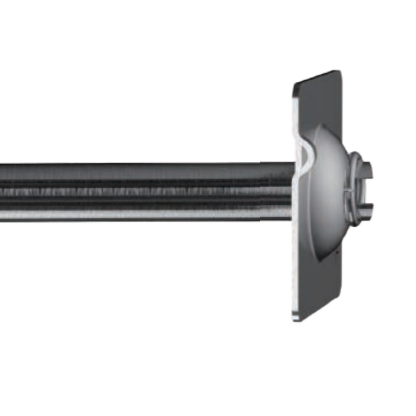
- Rocbolt Accessories for Rock and Roof Bolts: Comprehensive lineup including dome plates, spherical washers, couplers, butterfly plates, and torque indicators tested for high yield strength, accommodating angular surfaces up to 18° for stable underground mining support. Enhance your system with Rocbolt Accessories like W-straps and anchor plates for secure bolted connections.
- Mining Nut | High-Strength Nuts: Custom sizes, threads, and coatings (e.g., hex nuts, dome nuts) for bolted connections in mining, tunneling, and heavy infrastructure—ensuring durable, high-tension stability in heavy-duty applications. Discover reliable options in our Mining Nut solutions for threaded steel rebar bolts or expansion shell assemblies.
For surface reinforcement, integrate mining wire mesh for underground slope support such as chain link mesh or welded wire mesh to complement bolt systems and improve shotcrete reinforcement.
Real-World ROI: How Leading Operations Transformed Ground Support
SME_MXC24_Annual_Conf_Onsite_Program_F2_low.pdf features a mining operation that adopted Swellex Rock Bolts and Rocbolt Accessories, reducing roof support-related downtime by 30% and cutting rework costs by 25% in 2024. Rock Bolts Market Research Report 2033 data shows organizations investing in integrated ground support systems (e.g., Split Set bolts + Rocbolt Tensioning Equipment) see 15–20% higher long-term ROI due to reduced maintenance and improved safety. A 2024 tunneling project used the Prestressing Anchorage System and Split Set bolts with quick-setting mortar to meet seismic resistance requirements, achieving 20% faster construction timelines while reducing post-project stability checks by 40%.
Your 2026 Ground Support Checklist: Choosing the Right Solutions
- Assess rock mass characteristics: Opt for Swellex Rock Bolts for fractured rock or Split Set Bolts for soft ground to ensure immediate stability, and consider steel wire mesh for additional surface control.
- Prioritize torque accuracy: Pair mining nuts with Rocbolt Accessories’ torque indicators to meet manufacturer specs and maintain tensile strength, using sleeves and couplers for seamless connections.
- Evaluate load bearing needs: Deploy Rocbolt Tensioning Equipment for precise pre-loading of CableLok anchors in high-stress underground roadway reinforcement, ensuring optimal strata control.
- Factor in environmental conditions: Select galvanized components, GFRP Bolts, or chemical anchor bolts with resin capsules for corrosion resistance in humid or chemical-exposed sites, and use injection grout for durable anchoring.
- Consult experts: Partner with DSI for model-specific configurations (e.g., combo bolts, custom Swellex lengths) tailored to 2026 project requirements, including seismic resistance and load bearing capacity.
Next Steps to Secure Your 2026 Projects with Reliable Ground Support
Download the Rocbolt Accessories datasheet to review yield strength and angular surface compatibility specs for your mining or tunneling project. Request a demo of the Rocbolt Tensioning Equipment for CableLok Anchors to see accurate pre-loading and safety features in action. Consult our engineers to customize a ground support system (Swellex, Split Set, Prestressing Anchorage) aligned with your 2026 seismic resistance, corrosion resistance, and load bearing needs. Get a free quote for high-strength mining nuts or custom Swellex Rock Bolt configurations to lock in 2026 project timelines and budgets. For details on data handling, review our privacy and terms.
Ready to elevate your rock mass stability and secure 2026 project success? Contact our ground support experts today to discuss tailored solutions for your mining or tunneling operations.
Related News
Other news you might be interested in

Active vs. Passive Anchors: How to Choose the Right Ground Support System
A ground support system can fail for a simple reason: the team selected a product by name before deciding how the load should develop. Two anchors may look similar in a catalog, use the same diameter, and carry the same nominal steel grade, yet behave very differently underground. One is tensioned against the rock immediately after installation. The other begins to carry load only when the rock mass starts to move.That difference is what "active" and "passive" should describe. It is not a quality ranking. It is not a choice between modern and old-fashioned support. It is a choice about timing, displacement and load path.

How do concrete anchor bolts improve foundation stability?
A concrete anchor bolt is a small part of a foundation, but it decides whether the foundation and the structure above it behave as one system. The bolt does not make the concrete stronger or the soil stiffer. It provides a controlled load path between the steel structure, the base plate, the concrete, and—when the anchor is designed to reach it—the deeper ground.In this article, the term covers cast-in anchor rods, post-installed mechanical or adhesive anchors, and post-tensioned bars or strand anchors used to tie a structure or foundation element into concrete.That distinction is the key to answering the question. Anchor bolts improve foundation stability by resisting uplift, shear and overturning, maintaining clamping force, helping to distribute concentrated loads, and tying the foundation to a competent bearing stratum. They cannot compensate for an undersized footing, a poor subgrade, or a missing reinforcement detail.
Want to know more?
Get in touch with us for more information about our services and products.