Preventing Anchorage Slip: Sourcing Prestressing Wedges & Couplers

Preventing Anchorage Slip: Sourcing Prestressing Wedges & Couplers

2026-06-24
5 views
0 likes

In civil engineering, tunneling, and deep mining, prestressed rock bolts and PT (Prestressing Thread) bars carry massive dynamic and static loads. Procurement teams often spend significant time analyzing the yield strength and steel grade of the PT bar itself, only to treat the anchorage accessories—the wedges, plates, and couplers—as afterthoughts.

This is a dangerous oversight. The highest-grade PT bar in the world is useless if the anchoring mechanism fails. When an anchorage system is loaded with dozens of tons of force, a dimensional mismatch of even a millimeter between the wedge and the anchor plate can cause anchorage slip—a sudden release of tension that can lead to catastrophic structural failure and extreme safety hazards for personnel.

For procurement managers and engineers, sourcing a prestressing anchorage system requires strict attention to tolerances, material grades, and system compatibility. Here is a practical guide to avoiding the hidden risks in ground support accessories.

The Danger of "Mix-and-Match" Sourcing

A common procurement mistake is buying PT bars from one factory and sourcing wedges and plates from a cheaper, secondary hardware supplier.

Prestressing anchorage is a system, not a collection of independent parts. The friction grip relies on exact mathematical relationships between the angle of the wedge, the cone angle of the anchor plate (or block), and the thread profile of the bar.

When parts are mixed from different manufacturers with varying machining tolerances, the wedge may not seat perfectly. This leads to uneven stress distribution, point-loading, and eventual slip or wedge fracture under peak loads.

1. Prestressing Wedges: The Core of the Grip

The wedge (夹片) is the most critical component in preventing slip. It must bite into the steel bar without shearing its own teeth or snapping under pressure.

When auditing a supplier's wedges, look for two crucial manufacturing controls:

  • Precise Taper Angles: The outer taper of the wedge must perfectly match the inner cone of the anchor plate. If the angle is slightly off, the wedge will only make contact at the top or bottom edge, severely reducing the grip area.
  • Heat Treatment & Tooth Hardness: The internal teeth of the wedge must be significantly harder than the PT bar to penetrate the steel, while the body of the wedge must retain enough toughness to avoid shattering. If the supplier skips proper carburizing or heat treatment processes, the teeth will flatten under tension, causing immediate slip.

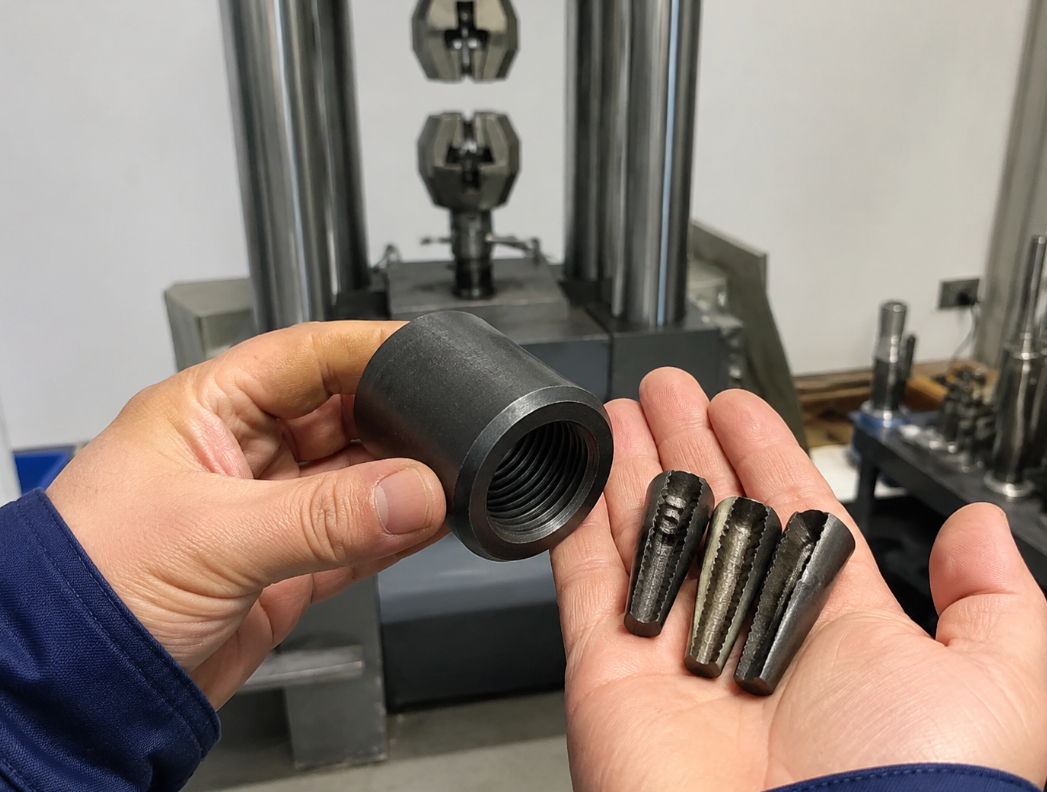
[Insert Image Here: A realistic photo inside the CQ Rockbolt QA lab. A Chinese quality control engineer is holding a 32mm PT bar coupler and a set of prestressing wedges in their hands—clearly showing the accurately small scale of the accessories relative to a human hand. The background shows an industrial tensile testing machine, avoiding any exaggerated or "AI-generated" glossy look.]

2. Couplers: Maintaining Continuous Load Transfer

Couplers (连接套筒) are used to extend PT bars in deep boreholes. A failure here means the entire length of the bar beyond the coupler is lost.

  • Thread Engagement: The internal threads of the coupler must be machined to match the specific pitch and depth of the PT bar. Loose threads cause load stripping, where the threads shear off under tension.
  • Material Strength: The coupler must be manufactured from a steel grade that guarantees a breaking load greater than the PT bar itself. The rule of thumb in geotechnical engineering is that if the system is pushed to ultimate failure, the bar should break before the coupler yields.

3. Anchor Plates: Resisting Deformation

The anchor plate transfers the massive point load of the stressed bar over a wider area of the rock face or concrete structure.

Many buyers unknowingly purchase undersized or overly thin plates to save on steel weight. Under high prestress, a thin plate will undergo "punch-through" failure—the wedge block is literally pulled through the center hole, or the plate bends into a bowl shape, causing the wedges to misalign and release their grip.

Sourcing ChecklistCritical Verification Point
WedgesVerify specific heat treatment (surface hardness vs. core toughness).
CouplersEnsure tensile strength rating exceeds the PT bar rating.
PlatesConfirm thickness aligns with maximum expected tonnage.
SystemRequest system-level pull-test reports, not just raw material certificates.

The Solution: System-Level Assembly and Testing

To eliminate the risk of anchorage slip, serious industrial buyers shift from "component sourcing" to "system sourcing."

When evaluating a manufacturer, do not just ask for the Mill Test Certificate (MTC) of the steel. Ask for the System Assembly Pull Test. A reliable manufacturer will assemble the PT bar, the wedges, the anchor block, and the plate, and pull them on a hydraulic test bench to simulate real-world conditions.

At CQ Rockbolt, we treat prestressing ground support as an integrated system. Our wedges, couplers, and anchor plates are machined in-house to exact tolerances designed specifically for our high-strength PT bars. Before any batch is exported, we conduct rigorous system-level testing to ensure that the wedge bite is secure, the coupler holds firm, and the complete assembly delivers the exact tension your engineering design demands.

FAQ: Prestressing Anchorage Systems

Why does anchorage slip occur in ground support? Slip usually occurs due to dimensional mismatches between the wedge and the anchor plate, improper heat treatment of the wedge teeth, or debris inside the cone preventing the wedge from seating correctly during tensioning.

Can I use standard nuts instead of a wedge system for PT bars? While some PT bars use high-strength hex or dome nuts for passive support, active prestressing systems requiring high-tonnage tensioning rely on wedge systems to lock in the load efficiently without thread binding.

How do I verify the quality of a PT bar coupler? A quality coupler should be accompanied by tensile test data proving that it can withstand a load greater than the ultimate tensile strength of the connected bars, ensuring the joint is never the weakest link.


Want to know more?

Get in touch with us for more information about our services and products.