

Prévenir le glissement d'ancrage: Sourcing des coins et des coupleurs de prétension

Dayang Yang
AuteurAvec plus de 15 ans d'expérience dans la production et la vente de produits d'ancrage géotechnique et de soutènement minier, nous exploitons notre propre usine de fabrication de boulons d'ancrage et d'accessoires avec une capacité de production à grande échelle stable. Nous sommes spécialistes des boulons d'ancrage, cartouches de résine, câbles d'ancrage, plaques d'appui et produits d'ancrage géotechnique sur mesure pour le soutènement minier et les solutions d'ancrage géotechnique.
En génie civil, dans le creusement de tunnels et l'exploitation minière en profondeur, les boulons de roche précontraints et les barres PT (barres de précontrainte) supportent des charges dynamiques et statiques massives. Les équipes d'approvisionnement passent souvent beaucoup de temps à analyser la limite d'élasticité et la nuance d'acier de la barre PT elle-même, pour ne traiter les accessoires d'ancrage – les coins, les plaques et les coupleurs – qu'après coup.
C'est un oubli dangereux. La barre PT de la plus haute qualité au monde est inutile si le mécanisme d'ancrage fait défaut. Lorsqu'un système d'ancrage est chargé avec des dizaines de tonnes de force, un désalignement dimensionnel, même d'un millimètre, entre le coin et la plaque d'ancrage peut provoquer un glissement d'ancrage – une libération soudaine de la tension qui peut entraîner une défaillance structurelle catastrophique et des risques de sécurité extrêmes pour le personnel.
Pour les responsables d'approvisionnement et les ingénieurs, se procurer un système d'ancrage de précontrainte nécessite une attention stricte aux tolérances, aux nuances de matériaux et à la compatibilité du système. Voici un guide pratique pour éviter les risques cachés liés aux accessoires de soutènement du terrain.
Le danger de l'approvisionnement "panaché"
Une erreur d'approvisionnement courante consiste à acheter des barres PT dans une usine et à se procurer les coins et les plaques auprès d'un fournisseur de quincaillerie secondaire moins cher.
L'ancrage de précontrainte est un système, pas une collection de pièces indépendantes. La prise par friction repose sur des relations mathématiques exactes entre l'angle du coin, l'angle du cône de la plaque d'ancrage (ou du bloc) et le profil du filetage de la barre.
Lorsque des pièces de différents fabricants avec des tolérances d'usinage variables sont mélangées, le coin peut ne pas s'asseoir parfaitement. Cela conduit à une répartition inégale des contraintes, à une charge ponctuelle et, finalement, à un glissement ou à une fracture du coin sous les charges de pointe.
1. Coins de précontrainte : Le cœur de la prise
Le coin est le composant le plus critique pour empêcher le glissement. Il doit mordre dans la barre d'acier sans cisailler ses propres dents ni se rompre sous la pression.
Lors de l'audit des coins d'un fournisseur, recherchez deux contrôles de fabrication cruciaux :
Angles de conicité précis : La conicité extérieure du coin doit correspondre parfaitement au cône intérieur de la plaque d'ancrage. Si l'angle est légèrement décalé, le coin n'entrera en contact que par le bord supérieur ou inférieur, réduisant considérablement la surface de prise.
Traitement thermique et dureté des dents : Les dents intérieures du coin doivent être nettement plus dures que la barre PT pour pénétrer l'acier, tandis que le corps du coin doit conserver une ténacité suffisante pour éviter l'éclatement. Si le fournisseur néglige les processus appropriés de cémentation ou de traitement thermique, les dents s'aplatiront sous la tension, provoquant un glissement immédiat.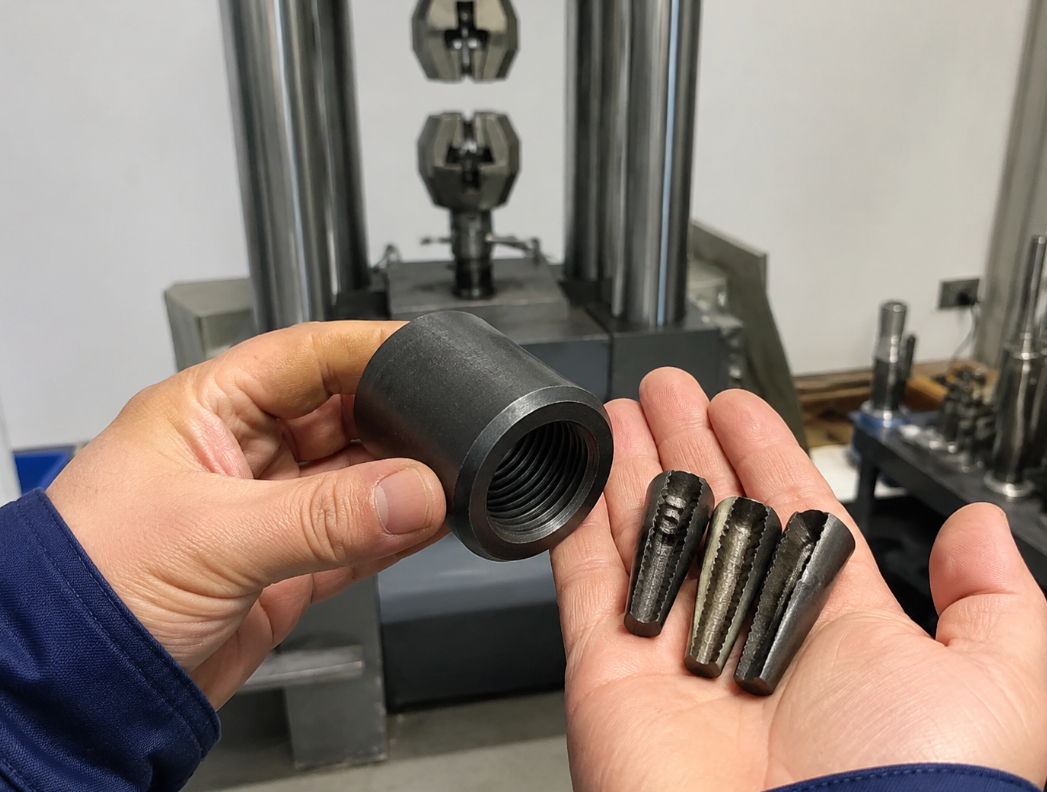
2. Coupleurs : Maintenir un transfert de charge continu
Les coupleurs sont utilisés pour prolonger les barres PT dans les trous de forage profonds. Une défaillance ici signifie que toute la longueur de la barre au-delà du coupleur est perdue.
Engagement du filetage : Les filetages internes du coupleur doivent être usinés pour correspondre au pas et à la profondeur spécifiques de la barre PT. Des filetages lâches provoquent un décapage de la charge, où les filets cisaillent sous la tension.
Résistance du matériau : Le coupleur doit être fabriqué à partir d'une nuance d'acier garantissant une charge de rupture supérieure à celle de la barre PT elle-même. La règle empirique en géotechnique est que si le système est poussé jusqu'à la rupture ultime, la barre doit casser avant que le coupleur ne cède.
3. Plaques d'ancrage : Résister à la déformation
La plaque d'ancrage transfère la charge ponctuelle massive de la barre mise en tension sur une zone plus large de la paroi rocheuse ou de la structure en béton.
De nombreux acheteurs achètent sans le savoir des plaques sous-dimensionnées ou trop fines pour économiser du poids d'acier. Sous une précontrainte élevée, une plaque mince subira une défaillance par "poinçonnage" – le bloc de coin est littéralement tiré à travers le trou central, ou la plaque se plie en forme de bol, provoquant le désalignement des coins et la libération de leur prise.
Liste de contrôle pour l'approvisionnement
| Composant | Point de vérification critique |
|---|---|
| Coins | Vérifier le traitement thermique spécifique (dureté de surface vs. ténacité du noyau). |
| Coupleurs | S'assurer que la résistance à la traction nominale dépasse celle de la barre PT. |
| Plaques | Confirmer que l'épaisseur correspond au tonnage maximal attendu. |
| Système | Demander des rapports d'essai de traction au niveau du système, pas seulement des certificats de matière première. |
La solution : Assemblage et test au niveau du système
Pour éliminer le risque de glissement d'ancrage, les acheteurs industriels sérieux passent de "l'approvisionnement en composants" à "l'approvisionnement en système".
Lors de l'évaluation d'un fabricant, ne vous contentez pas de demander le certificat d'essai en usine (MTC) de l'acier. Demandez l'essai de traction de l'assemblage du système. Un fabricant fiable assemblera la barre PT, les coins, le bloc d'ancrage et la plaque, et les tirera sur un banc d'essai hydraulique pour simuler les conditions réelles.
Chez CQ Rockbolt, nous traitons le soutènement du terrain par précontrainte comme un système intégré. Nos coins, coupleurs et plaques d'ancrage sont usinés en interne selon des tolérances exactes conçues spécifiquement pour nos barres PT à haute résistance. Avant l'exportation de tout lot, nous effectuons des tests rigoureux au niveau du système pour garantir que la morsure du coin est sécurisée, que le coupleur tient fermement et que l'assemblage complet délivre la tension exacte requise par votre conception technique.
FAQ
Pourquoi le glissement d'ancrage se produit-il dans le soutènement du terrain ?
Le glissement se produit généralement en raison de désalignements dimensionnels entre le coin et la plaque d'ancrage, d'un traitement thermique inadéquat des dents du coin, ou de débris à l'intérieur du cône empêchant le coin de se positionner correctement lors de la mise en tension.
Puis-je utiliser des écrous standard au lieu d'un système de coins pour les barres PT ?
Bien que certaines barres PT utilisent des écrous hexagonaux ou en dôme à haute résistance pour un soutien passif, les systèmes de précontrainte active nécessitant une mise en tension à fort tonnage s'appuient sur des systèmes de coins pour verrouiller la charge efficacement sans grippage du filetage.
Comment vérifier la qualité d'un coupleur de barre PT ?
Un coupleur de qualité doit être accompagné de données d'essai de traction prouvant qu'il peut résister à une charge supérieure à la résistance ultime à la traction des barres connectées, garantissant que le joint n'est jamais le maillon le plus faible.
---
Si vous avez besoin de systèmes de coins, coupleurs et plaques d'ancrage assortis compatibles avec vos spécifications de barres PT, ou si vous avez besoin de rapports d'essai de traction complets du système pour la soumission d'appels d'offres, contactez notre équipe d'ingénierie dès aujourd'hui.
Nous fournissons des tailles personnalisées, une documentation d'inspection complète et un support d'exportation en gros pour les projets de précontrainte dans les tunnels, les mines et les ponts dans le monde entier.
Related News
Other news you might be interested in

Comment choisir un fabricant fiable de systèmes d'ancrage autoforeurs
Dans les projets de mines souterraines, de tunnels, de stabilisation de pentes, de soutènement d'excavations profondes et de renforcement de fondations, les conditions de terrain complexes déterminent souvent la difficulté de la solution de soutènement. Dans les sols meubles, les roches fracturées, les massifs rocheux altérés ou les formations aquifères, les trous pré-forés conventionnels peuvent s'effondrer, se bloquer ou perdre leur stabilité. En combinant le forage, l'ancrage et l'injection en un seul processus, un système d'ancrage autoforeur est devenu une solution importante en géotechnique. Cependant, choisir le bon ancrage autoforeur n'est que la première étape. La capacité d'un fabricant à fournir de manière constante des barres filetées creuses compatibles, des trépans sacrificiels, des coupleurs, des plaques d'appui, des écrous et des accessoires d'injection, tout en comprenant les exigences réelles de soutènement du sol, affecte directement l'efficacité de l'installation, la qualité de l'ancrage et la sécurité du projet.

Guide complet pour l'installation des boulons d'ancrage : étape par étape
Un système de soutènement fiable n'est pas complet simplement parce que le forage a atteint la profondeur prévue. L'état du trou de forage, la compatibilité entre le boulon et les accessoires, les procédures correctes d'injection ou d'ancrage, ainsi que les enregistrements d'installation traçables, influencent tous les performances finales de soutènement. Pour les équipes d'installation, une perte de contrôle à n'importe quelle étape peut perturber les opérations ultérieures. Pour les chefs de projet et les équipes d'approvisionnement, la compatibilité du système et les enregistrements de processus sont tout aussi importants.
Want to know more?
Get in touch with us for more information about our services and products.